
Loading, please wait...

LOT 0698
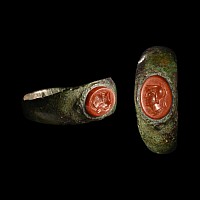
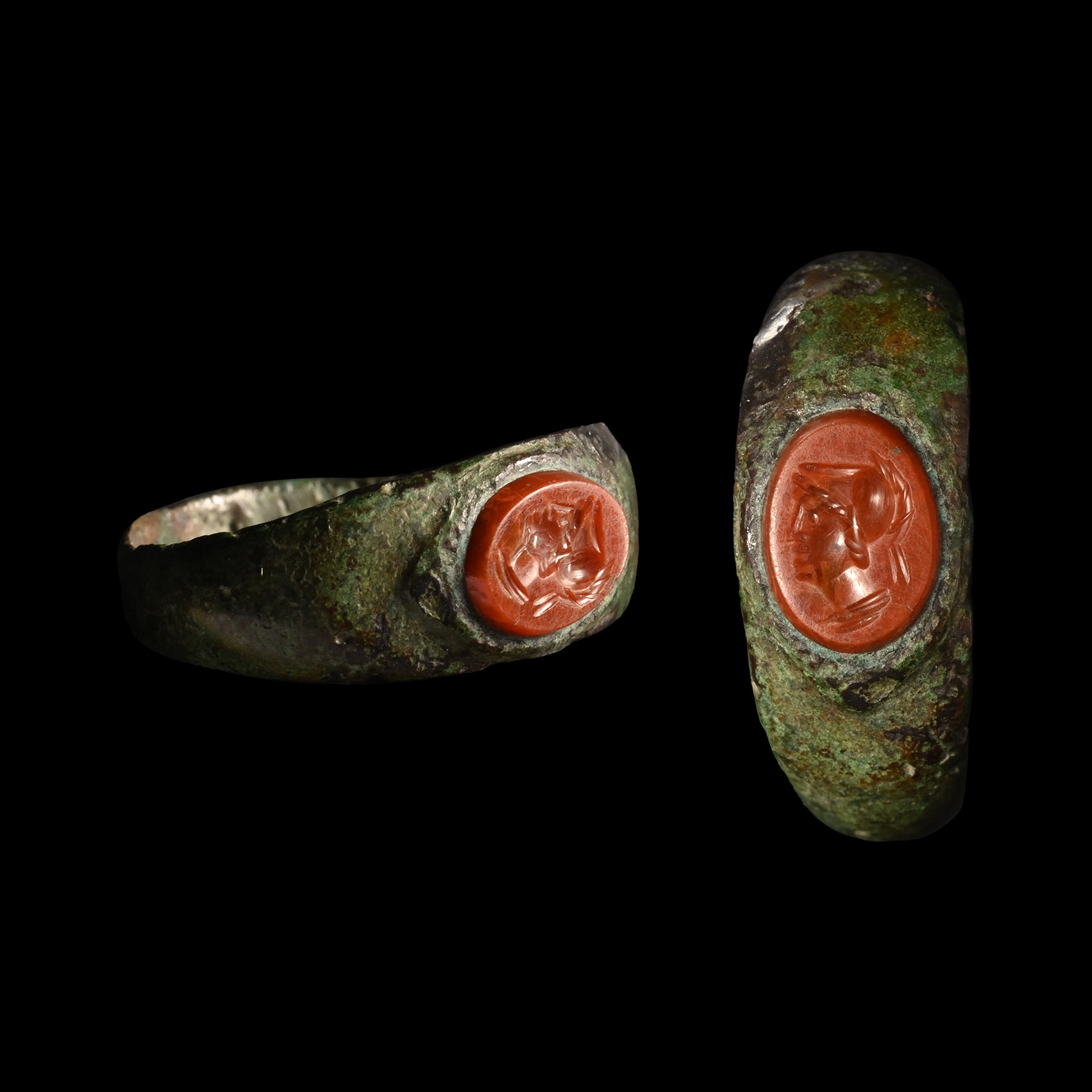
Roman Bronze Ring with Minerva Gemstone
1ST-2ND CENTURY A.D.
3.4 in, (3.39 grams, 21.07 mm overall, 17.61 mm internal diameter (approximate size British L 1/2, USA 6, Europe 11.87, Japan 11)).
With inset jasper gemstone, intaglio profile bust of Minerva (Greek Athena) wearing a crested helmet.
ProvenanceEx German art market, 2000s.
Acquired from an EU collector living in London.
From the collection of Surrey, UK, gentleman.
Cf. Ruseva-Slokoska, L. Roman Jewellery, Sofia, 1991, item 233, for type.
CONDITIONTimeLine Auctions follows a vetting process to ensure the authenticity and legality of all items, reinforcing our commitment to integrity and responsible trading. Each antiquity, antique, and coin lot undergoes thorough examination by a vetting committee of at least ten external specialists, professional trade association members, scientists, and archaeologists: Our Vetting Process
AUCTIONS:
TimeLine is a leading auction house specialising in antiquities, ancient art, collectables, natural history, coins, medals, and books. Our auctions offer museums, collectors, historians, and enthusiasts the opportunity to acquire unique and historically significant pieces.
-
.jpg)
Large Roman Tinned Bronze Patera
1st century A.D.Estimate: £800 - 1,000 (‡+bp*)
Opening Bid: £444
With a deep bowl and flat-section handle with integral loop; shallow concentric grooves around the exterior of the neck, rolled rim, concentric rings to the underside; finished on a lathe; cracked and split. 903 grams, 33 cm wide
Acquired in Europe before 1993. Private collection, Europe. This lot has been checked against the Interpol Database of stolen works of art and is accompanied by search certificate number no.11788-206494.
In contrast to their elaborate counterparts, paterae such as this were likely carried as part of the standard kit of Roman soldiers, used as a general cooking and eating utensil. The regular heap up (sarcina) of the legionaries is well represented on the reliefs of Trajan's column. It was composed of a T stake (furca), to which a linen bag (sacculus) was hung, as well as the leather haversack for 15-20 days supplies (trinum nundinum) and personal effects, a pot (ollula), a cup (patera), and a basket for work on the fields. -
.jpg)
Roman Marble Head of a Young Man
2nd-3rd century A.D.Estimate: £3,500 - 4,500 (‡+bp*)
Opening Bid: £1,250
Worked in high-relief with hairstyle typical of the transitional period from the Consulate to the Empire; oval face with a prominent forehead, oval eyelids and clearly defined lines around the eyes; hair arranged in vertical lines combed back from the forehead; pronounced lips, typical rendering of the wide auricles; the lower part of the tunic visible with a well defined round edge around the neck; mounted on a custom-made display stand. 5.94 kg total, 22.5 cm high including stand
Acquired from Gallery Gryphos, Munich, 1992. European private collection. Accompanied by an academic report by Dr Raffaele D’Amato. This lot has been checked against the Interpol Database of stolen works of art and is accompanied by search certificate number no.11996-211878.
The head was probably pertinent to a series of funerary family portraits. It has realistic modelling of male features, which speaks of a portrait in reduced dimensions or a reference to a well-known person in the environment where it was exhibited. The portrait is worked only on the front, leaving the back, as well as the lower part of the sculpture, roughly treated. -
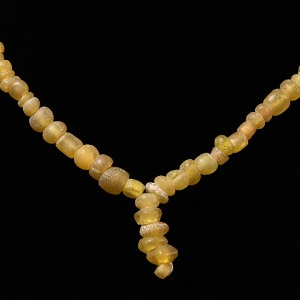
Roman Amber Glass Bead Necklace String
1st-4th century A.D. and laterSold for (Inc. bp): £39
Restrung designer necklace of graduated irregular oblate and other beads. 31.4 grams, 37.5 cm
Acquired 1980-2015. Ex Abelita family collection.
