Loading, please wait...
Details
LOT 0682
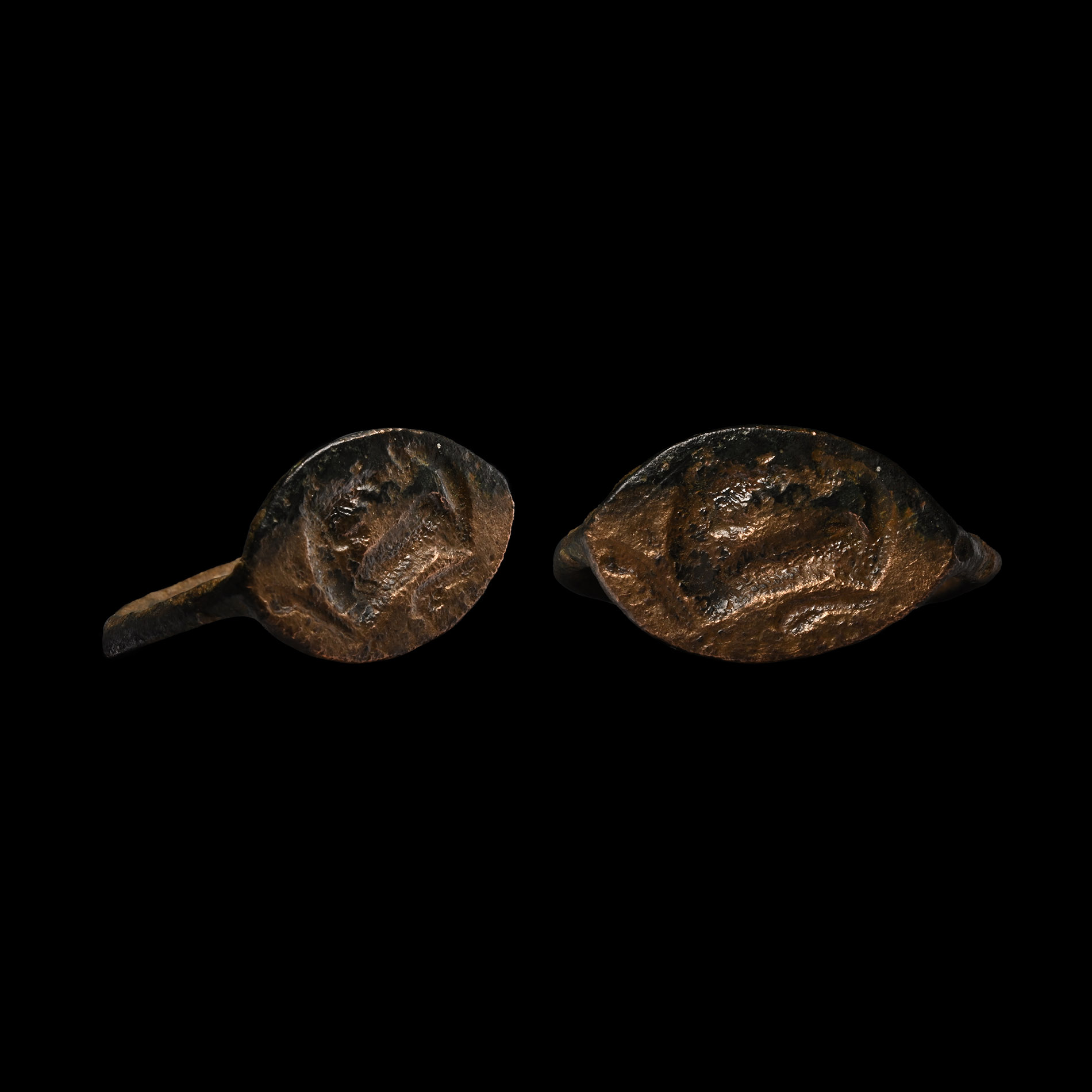
Roman Bronze Ring with Lion
1ST CENTURY B.C.-1ST CENTURY A.D.
1 in. (3.23 grams, 23.62 mm overall, 19.50 mm internal diameter (approximate size British R, USA 8 1/2, Europe 18 3/4, Japan 18)).
With ellipsoid bezel, low-relief figure of a regardant lion with tail raised and foreleg extended. [No Reserve]
Provenance
UK private collection before 2000.
Acquired on the UK art market.
Property of a London gentleman.
VETTING:
TimeLine Auctions follows a rigorous vetting process to ensure the authenticity and legality of all items, reinforcing our commitment to integrity and responsible trading. Each antiquity, antique, and coin lot undergoes thorough examination by a vetting committee of at least ten external specialists, professional trade association members, scientists, and archaeologists: Our Vetting Process
AUCTIONS:
TimeLine is a leading auction house specialising in antiquities, ancient art, collectables, natural history, coins, medals, and books. Our auctions offer museums, collectors, historians, and enthusiasts the opportunity to acquire unique and historically significant pieces.
RELATED LOTS
-
Roman Historic Cut & Polished Porphyry Slice Group
1st-5th century A.D. and laterSold for (Inc. bp): £234
Comprising three lacquered porphyry slices of rectangular shape, cut on both faces and polished on one face; probably from recycled material mined in ancient Roman times between the 1st and 5th century A.D.; intended for use as inlay panels. 82.8 grams total, 7.2-10.1 cm
From Egypt. Ex Mineral Imports, London, UK. Gregory, Bottley & Lloyd (Gregory's).
Mons Porphyrites (today Jabal Abu Dukhkhan) is the mountainous site of a group of ancient quarries in the Red Sea Hills of the inhospitable eastern desert in Egypt, a five day trip from the Nile during Roman times. They were discovered by Caius Cominus Leugas in 18 A.D., and during the Roman Empire the mines officially belonged to the emperor and were the only known source of the Imperial Porphyry, Mons Porphyrites. This dark purple stone was associated with royalty and used for prestigious sculpture and architecture. The location of the mines was lost some time in the 5th century, and rediscovered in the early 19th century. Excavations in the area have revealed the well-preserved quarries and the dwelling places of the quarry men, and also thousands of ostraca have been discovered containing messages that provide details of how the quarrying took place, and of how the highly skilled quarrymen ordered their food. -
Large Late Roman Sigma-Shaped Marble Offering Table Top
Eastern Mediterranean, 4th-6th century A.D.Sold for (Inc. bp): £3,900
Semi-circular with raised and slightly everted edge, the top with a recessed area with a funnel-shaped outlet; for votive offerings within a church; restored. 84.5 kg including backplate, 91 cm wide
In general good condition, re-assembled.
Acquired in the late 1960s or early 1970s. Ex David Read collection. Accompanied by an academic report by Dr Raffaele D’Amato. This lot has been checked against the Interpol Database of stolen works of art and is accompanied by search certificate number no.12080-214035.
Marble tables such as the present example are called in archaeological terms sigma tables, in consideration of their resemblance to the Greek letter sigma. Sigma-shaped tables appeared in the banquet halls at the end of the 4th century and within Christian buildings from the following century. Most of the undecorated slabs were used as liturgical table tops for feasts to honour the deceased. This commemorative practice was known throughout the late Roman world in west and east, where it continued in the daily life of the citizens of the Eastern Roman Empire. In ecclesiastical settings, circular and sigma-shaped tables were used to collect offerings or for celebrating the agape, more generally as secondary furniture, while the rectangular form was preferred for use as an altar. -
Roman Bronze Ring with Hand
2nd-3rd century A.D.Sold for (Inc. bp): £65
Wide hoop expanding to an oval-shaped intaglio with open hand. 3.18 grams, 20.88 mm overall, 17.14 mm internal diameter (approximate size British N, USA 6 1/2, Europe 13.72, Japan 13)
Private collection formed since the 1940s. UK art market. Property of an Essex, UK, gentleman.