Loading, please wait...

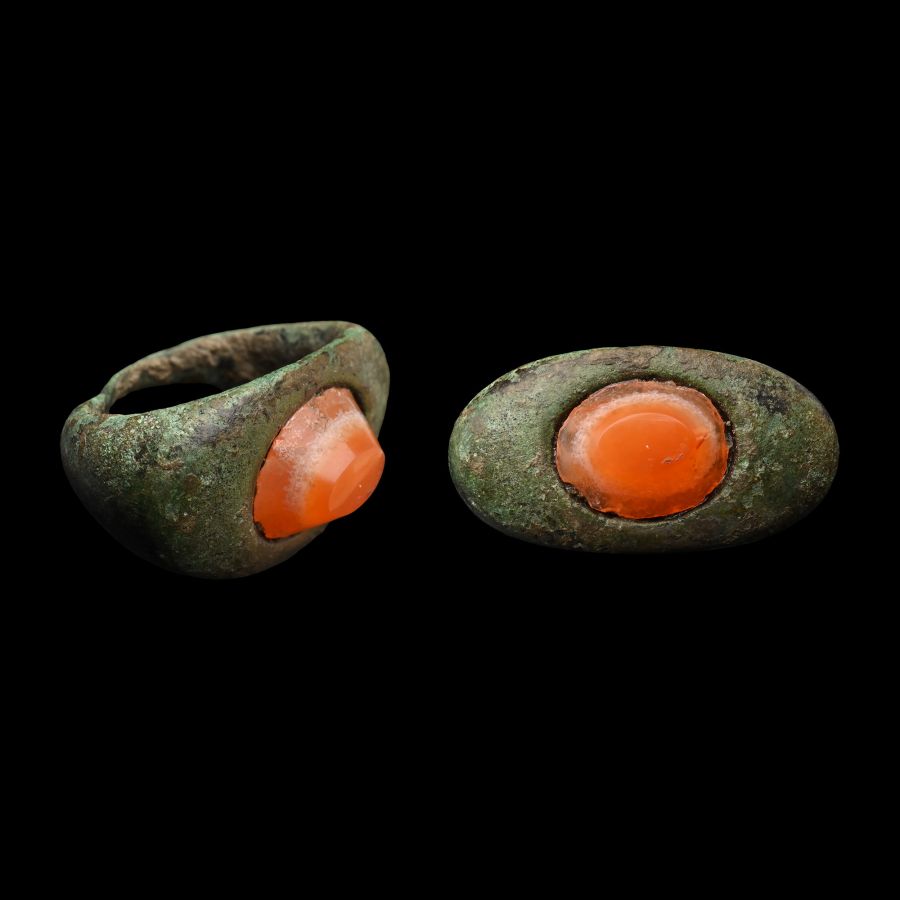
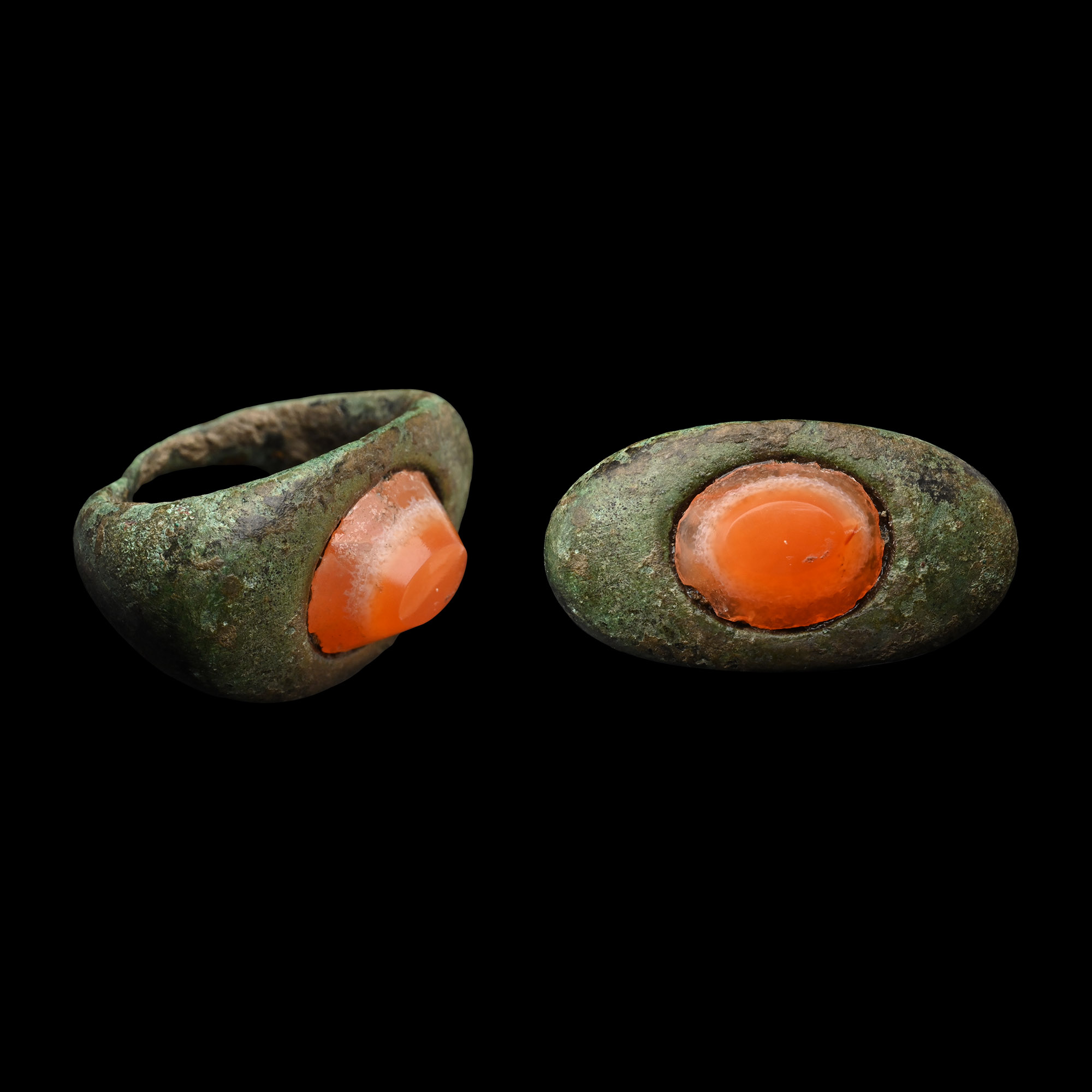
Roman Bronze Ring with Carnelian Gemstone Roman Bronze Ring with Carnelian Gemstone Roman Bronze Ring with Carnelian Gemstone
Use mousewheel to zoom in and out, click to enlarge
Details

LOT 0787

Roman Bronze Ring with Carnelian Gemstone

2ND-3RD CENTURY A.D.

1 1/4 in. (14.98 grams, 31.48 mm overall, 20.16 x 14.75 mm internal diameter (approximate size British J 1/2, USA 5, Europe 9.32, Japan 9)).

With thick shank, broad plaque, inset carnelian gemstone of truncated conical profile, a marriage. [No Reserve]

Provenance

From a private Tyneside collection, formed since the early 2000s.

Literature

Cf. Ruseva-Slokoska, L., Roman Jewellery, Sofia, 1991, item 241.

CONDITION
VETTING:

TimeLine Auctions follows a vetting process to ensure the authenticity and legality of all items, reinforcing our commitment to integrity and responsible trading. Each antiquity, antique, and coin lot undergoes thorough examination by a vetting committee of at least ten external specialists, professional trade association members, scientists, and archaeologists: Our Vetting Process


AUCTIONS:

TimeLine is a leading auction house specialising in antiquities, ancient art, collectables, natural history, coins, medals, and books. Our auctions offer museums, collectors, historians, and enthusiasts the opportunity to acquire unique and historically significant pieces.

LOT 0787

Roman Bronze Ring with Carnelian Gemstone

Sold for (Inc. bp): £78

Print page

RELATED LOTS
  • Roman or Gandharan Silver Cup
    Roman or Gandharan Silver Cup
    Circa late 1st century B.C.-early 1st century A.D.

    Estimate: £1,500 - 2,000 (+bp*)

    Opening Bid: £750

    Hemispherical in profile with rounded underside, thickened rim. 232 grams, 11.4 cm


    Acquired from a private UK collection prior to 1979. Ex Julian Sherrier collection, a leading figure in Gandharan art. with Christie's, New York, sale 2337, 14th September 2010, no.41 (part). Accompanied by the original Christie's lot ticket.

    Lot Details

  • Roman Bronze Ring with Lion
    Roman Bronze Ring with Lion
    2nd-4th century A.D.

    Sold for (Inc. bp): £26

    D-section hoop expanding at the shoulders, oval plaque bezel with a leaping lion facing left. 5.08 grams, 25.61 mm overall, 22.15 mm internal diameter (approximate size British P 1/2, USA 7 3/4, Europe 16.86, Japan 16)


    Ex Norri collection, Milton Keynes, UK, 1980s-1990s.

    Lot Details

  • Roman Bronze Winged Eros
    Roman Bronze Winged Eros
    1st century A.D.

    Sold for (Inc. bp): £13,000

    Modelled in the round in kneeling pose, nude, with the fingers of his left hand spread across his bent knee, head turned to the right and slightly tilted upwards; two large dorsal wings spread; the face fleshy with small eyes and nose, the hair with a wreath of curls framing the face; attachment panel behind the shoulders; mounted on a custom-made display stand. 1.38 kg total, 19 cm wide


    Ex F. Philips, Netherlands, before 1980s. with Jan Roelofs Antiquaries, Netherlands. Acquired on the European art market, 2023. Private collection, London. Accompanied by an academic report by Prof. Neritan Ceka. This lot has been checked against the Interpol Database of stolen works of art and is accompanied by search certificate number no.12930-245218.

    The image of the winged Eros held a special significance in Roman culture, embodying not only the god of love but also the elegance, refinement, and sophistication of the Classical tradition. His wings symbolised the fleeting nature of passion, while his youthful form carried connotations of vitality and beauty. To incorporate Eros into the decoration of luxury objects was to invoke divine favour and to align oneself with the cultivated ideals of the Graeco-Roman world. Bronzes of the 1st century A.D. represent the height of Roman metalworking, when elite households and sanctuaries commissioned works of remarkable artistry. Fittings such as this, finely cast and intended for a prestigious vessel, were both functional and symbolic: practical elements elevated to expressions of status and taste. Surviving examples are a testament to the technical mastery of Roman workshops and the desire of their patrons to surround themselves with imagery of the gods in even the smallest details of daily life.

    Lot Details

Stay up-to-date with the latest from TimeLine Auctions by joining our mailing list