
Loading, please wait...
LOT 0152
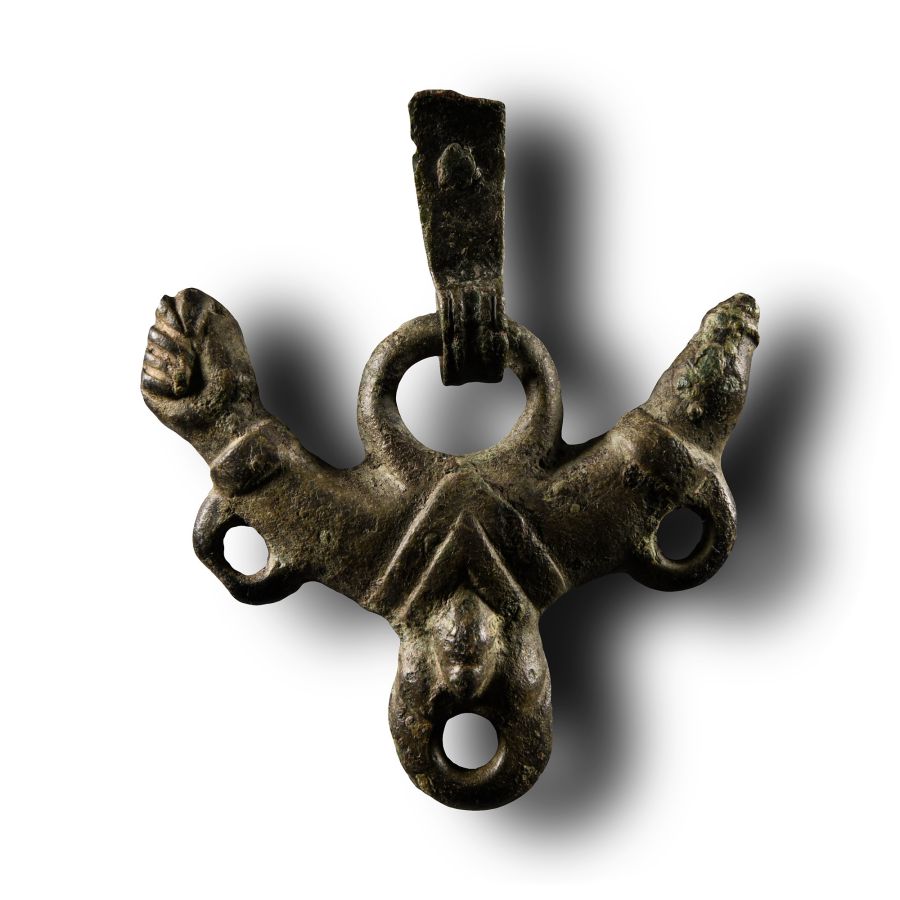
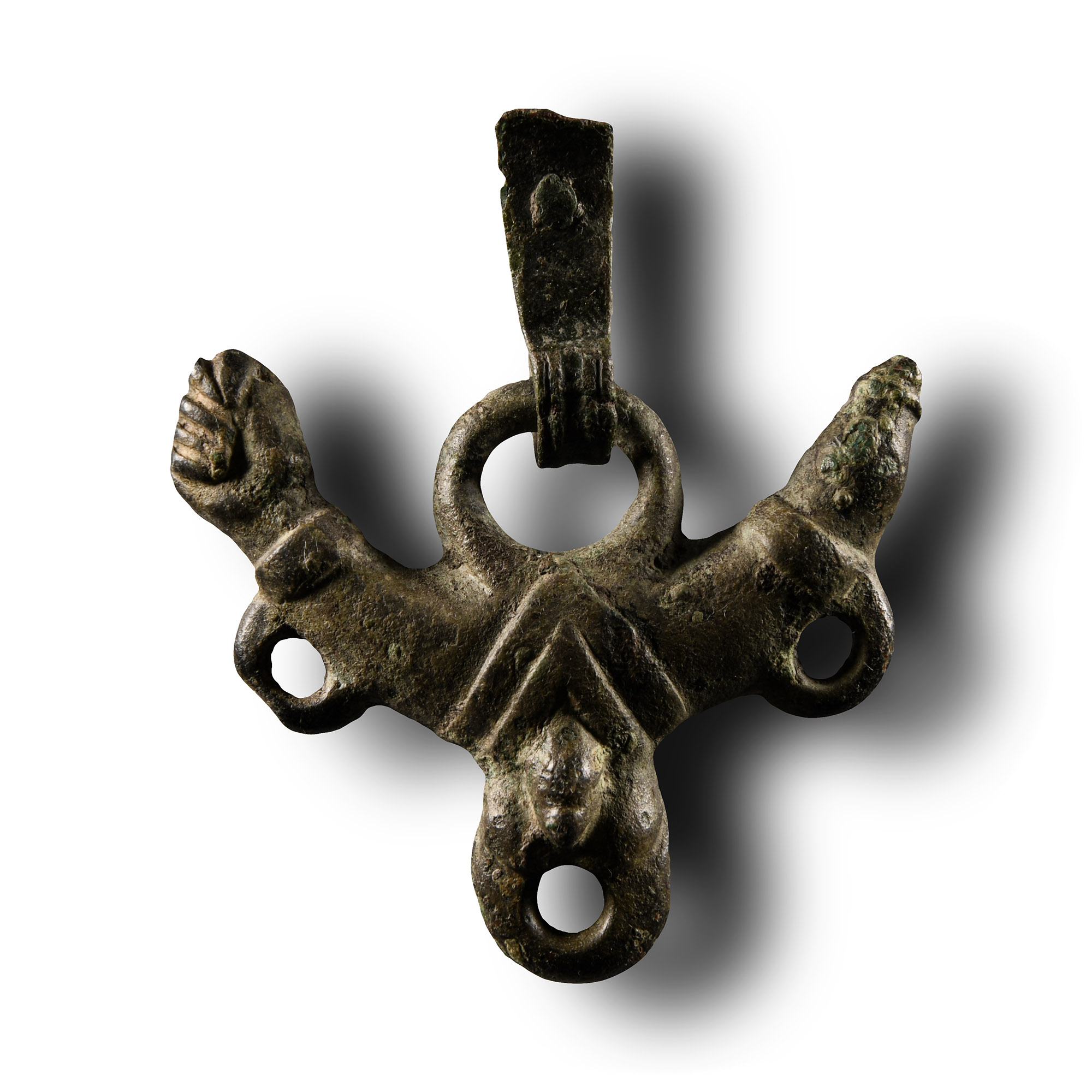
Roman Bronze Phallic Pendant
1ST-2ND CENTURY A.D.
2 5/8 in. (81.5 grams, 68 mm).
Amuletic fascinum formed as a crescent with phallus to the right, hand in the fica gesture to the left and male genitals below; each with a loop beneath for attachment of another pendant; large loop above and attachment strap with stud.
ProvenanceAcquired in Europe in 1990s.
European private collection.
Cf. Beutler, F. et al., Der Adler Roms. Carnuntum und der Armee der Cäsaren, Bad-Deutsch Altenberg, 2017, item 768, for type.
CONDITIONTimeLine Auctions follows a vetting process to ensure the authenticity and legality of all items, reinforcing our commitment to integrity and responsible trading. Each antiquity, antique, and coin lot undergoes thorough examination by a vetting committee of at least ten external specialists, professional trade association members, scientists, and archaeologists: Our Vetting Process
AUCTIONS:
TimeLine is a leading auction house specialising in antiquities, ancient art, collectables, natural history, coins, medals, and books. Our auctions offer museums, collectors, historians, and enthusiasts the opportunity to acquire unique and historically significant pieces.
LOT 0152
Roman Bronze Phallic Pendant
Estimate £1,000 - 1,400€1,160 - 1,620 (for guidance only)$1,350 - 1,890 (for guidance only)
-
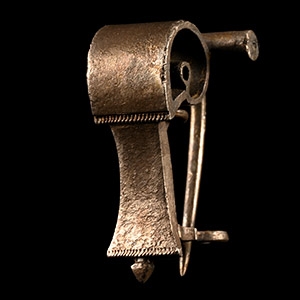
Roman Military Silver Knee Brooch
2nd century A.D.Sold for (Inc. bp): £325
Of 'knee type pattern' incorporating a 90 degree bend, the front plate with additional edge-notched decoration, complete with original pin. 16 grams, 34.7 mm
Ex Ancient Art, Eastpole Farm House, London, N14, early 2000s. From the private collection of Antony John Scammell (1937-2019). Accompanied by a copy of a certificate of authenticity from Ancient Art, London, UK. -
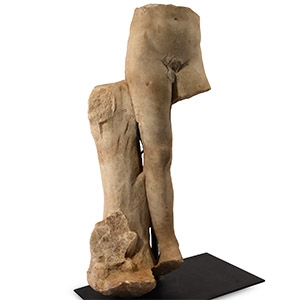
Life-Size Roman Marble Lower Torso
Circa 2nd century A.D.Estimate: £20,000 - 30,000 (+bp*)
Opening Bid: £9,850
Modelled in the round in cream-coloured marble; the hips and right leg of a slender male standing beside a column with the lower part of an animal at the base; the figure modelled with narrow hips and waist in contrapposto stance, genitals removed, muscular leg with slender ankle; adjacent column with remains of a branch or spur at the top, developing to a flared base with a crouching hare or rabbit; mounted on a custom-made stand. 101.4 kg total, 99 cm including stand
Ex Paris collection. French gallery, Paris, 1990-2000s. Accompanied by an academic report by Dr Raffaele D’Amato. This lot has been checked against the Interpol Database of stolen works of art and is accompanied by search certificate number no.12088-213904.
Despite the loss, the semi-circular rise that separated the ribcage from the abdomen highlights the muscles of a young athlete or a hero. The statue could represent many male heroes or deities (Reinach, 1897, p.210 no.2, 817 no.4), but, by comparison with a similar sculpture in the Brussels Museum, it could refer to a rare image of the handsome and ferocious hunter Hippolytus, son of Theseus and the Amazon Antiope, killed by the curse of his father due to Phaedra’s deception. The presence of the small hare or rabbit at the base of the column could confirm the hypothesis of a hunter hero, and finds its parallel with the small animals (gecko and panther) visible on the Brussels sculpture. -
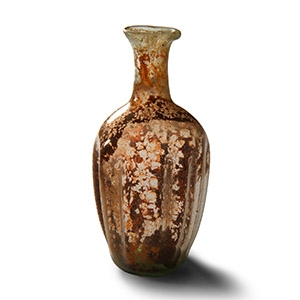
Roman Ribbed Glass Vessel
4th-5th century A.D.Sold for (Inc. bp): £130
With dimple base, radiating ribs to the bulb, gently tapering neck, flared rim with rolled edge. 20.11 grams, 95 mm
Acquired 1980-2015. Ex Abelita family collection.
