
Loading, please wait...
LOT 0638
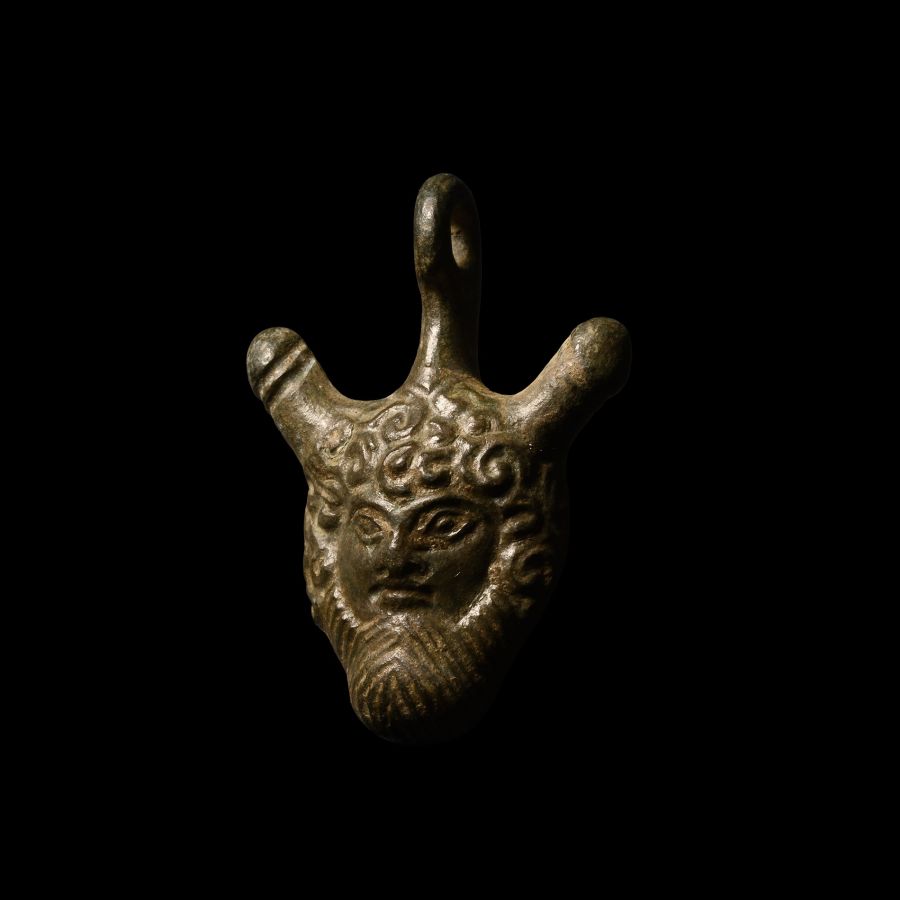
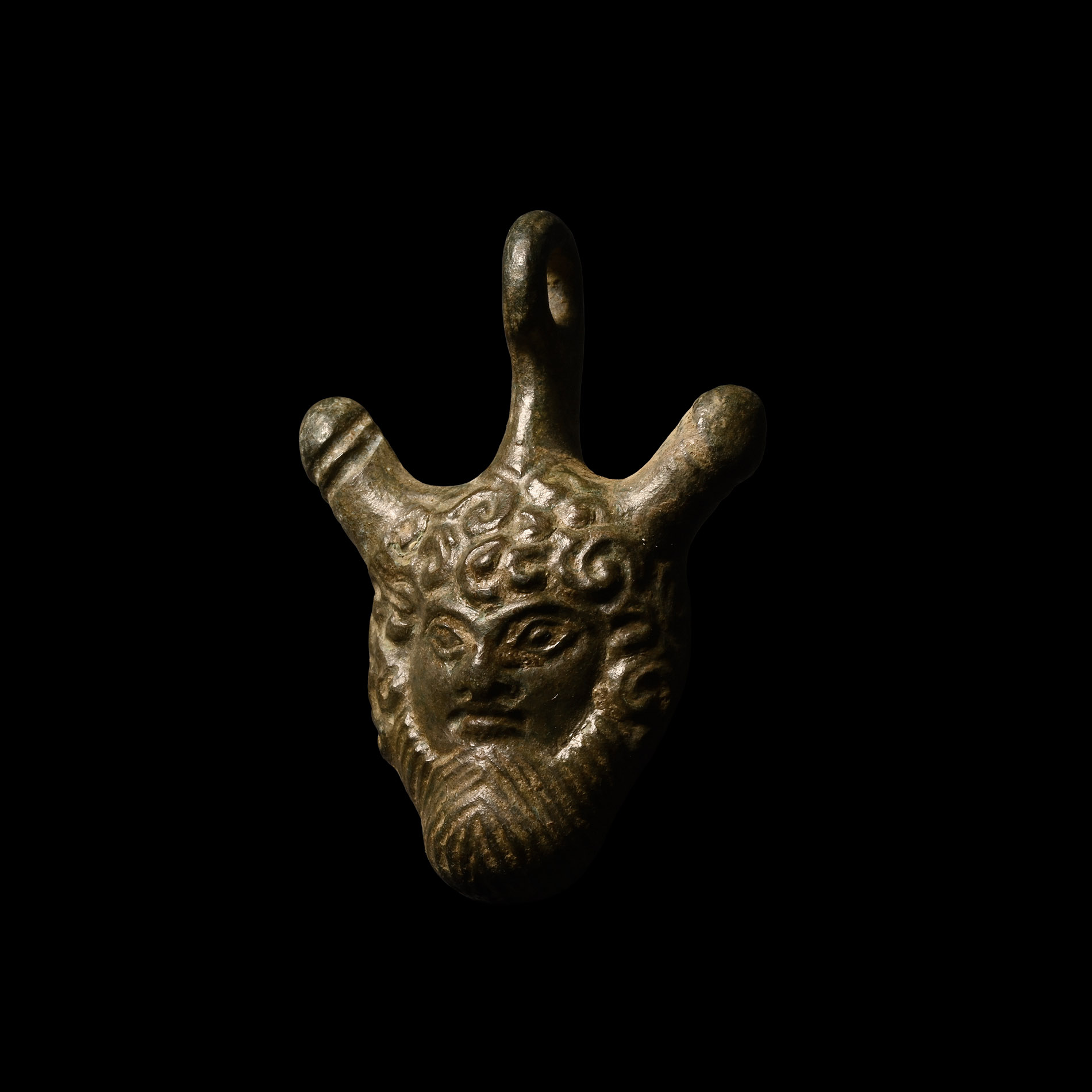
Roman Bronze Phallic Mask Pendant
1ST-2ND CENTURY A.D.
1 3/4 in. (25.6 grams, 45 mm).
Displaying the face of a bearded god, possibly Cernunnos or Pan, with curly hair and two horns in the shape of phallus; suspension ring to the top. [No Reserve]
ProvenanceAcquired in the 1990s.
Ex property of a UK gentleman.
The head displays typical features associated with Romano-Celtic art, such as the lentoid eyes and the schematic rendering of the hair and beard. The head could be that of Pan, god of the wild countryside and of fertility in nature, thus making the phalli-shaped horns appropriate. It could also represent the Celtic god Cernunnos, a Gallic deity whose worship is known from Britain and the Continent from a number of monuments, inscriptions and figurines, as well as on the famous Gundestrup cauldron found in a bog in Denmark. His name means "the Horned One", and is depicted as a bearded male wearing a torc around his neck and with large horns or antlers on his head. Representations of him are known from as early as the fourth century B.C. from the Paspardo rock carving at Val Camonica, Northern Italy. Other representations include the monument set up by Parisian sailors which was discovered underneath Notre Dame cathedral, and the relief carving from Cirencester where his legs are in the form of two snakes. The Celts' preoccupation with fecundity caused them on occasions to represent their male gods with oversized phalli, and a bronze figure of Mercury from Tongres, France, depicts the god with two phalli on his head.
CONDITIONTimeLine Auctions follows a vetting process to ensure the authenticity and legality of all items, reinforcing our commitment to integrity and responsible trading. Each antiquity, antique, and coin lot undergoes thorough examination by a vetting committee of at least ten external specialists, professional trade association members, scientists, and archaeologists: Our Vetting Process
AUCTIONS:
TimeLine is a leading auction house specialising in antiquities, ancient art, collectables, natural history, coins, medals, and books. Our auctions offer museums, collectors, historians, and enthusiasts the opportunity to acquire unique and historically significant pieces.
-
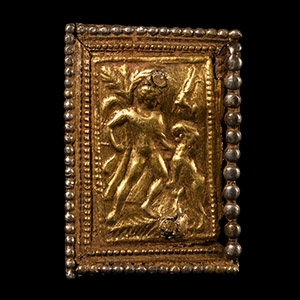
Roman Silver-Gilt Military Belt Plate with Hercules Killing the Nemean Lion
4th century A.D.Sold for (Inc. bp): £910
Comprising a repoussé panel with the nude hero wearing a mantle and killing the beast, a palm of victory underneath his feet, a dog attacking the lion from above, foliage around the scene; two fixing studs to the reverse; accompanied by a frame. 234 grams total, 53 x 37 mm (13 x 13 cm including frame)
Acquired 1980-2015. Ex Abelita family collection.
The belt fitting finds parallels with belt parts from Asia Minor, today in the British Museum, inv. EC 252-254. These kind of plates, decorative and engraved with classical scenes, can possibly be dated to the age of Theodosius I. The quality of decoration can support the thesis that they belonged to the officers of the Comitatus (the Imperial mobile army). -
.jpg)
Large Roman Sheet-Silver Brooch Pair
4th-5th century A.D.Sold for (Inc. bp): £374
Each formed as a figure-of-eight-shaped plaque with beaded edge and central bridge, bronze reinforcement to the reverse and ferrous attachment pin. 71.3 grams total, 15-15.2 cm
Fine condition, edge chipped.
Acquired on the European art market in the 1990s. Ex property of a Suffolk collector. -
.jpg)
Gemstone Group
Roman, circa 1st century A.D. and laterSold for (Inc. bp): £520
Comprising agate, carnelian, jasper and other stones, displaying intaglio busts and scenes including: Hercules wrestling the Nemean lion; female busts in profile; cockerel standing right; seated winged deity; an erotic scene; peacock or other bird; eagle grappling with a snake; two figures, possibly gladiators in combat; each accompanied by a museum-quality impression. 6.97 grams total, 11-15 mm
Ex property of a Bristol family collection formed between 1960-late 1970s. Two from a London collection, UK.
