Loading, please wait...
LOT 0717
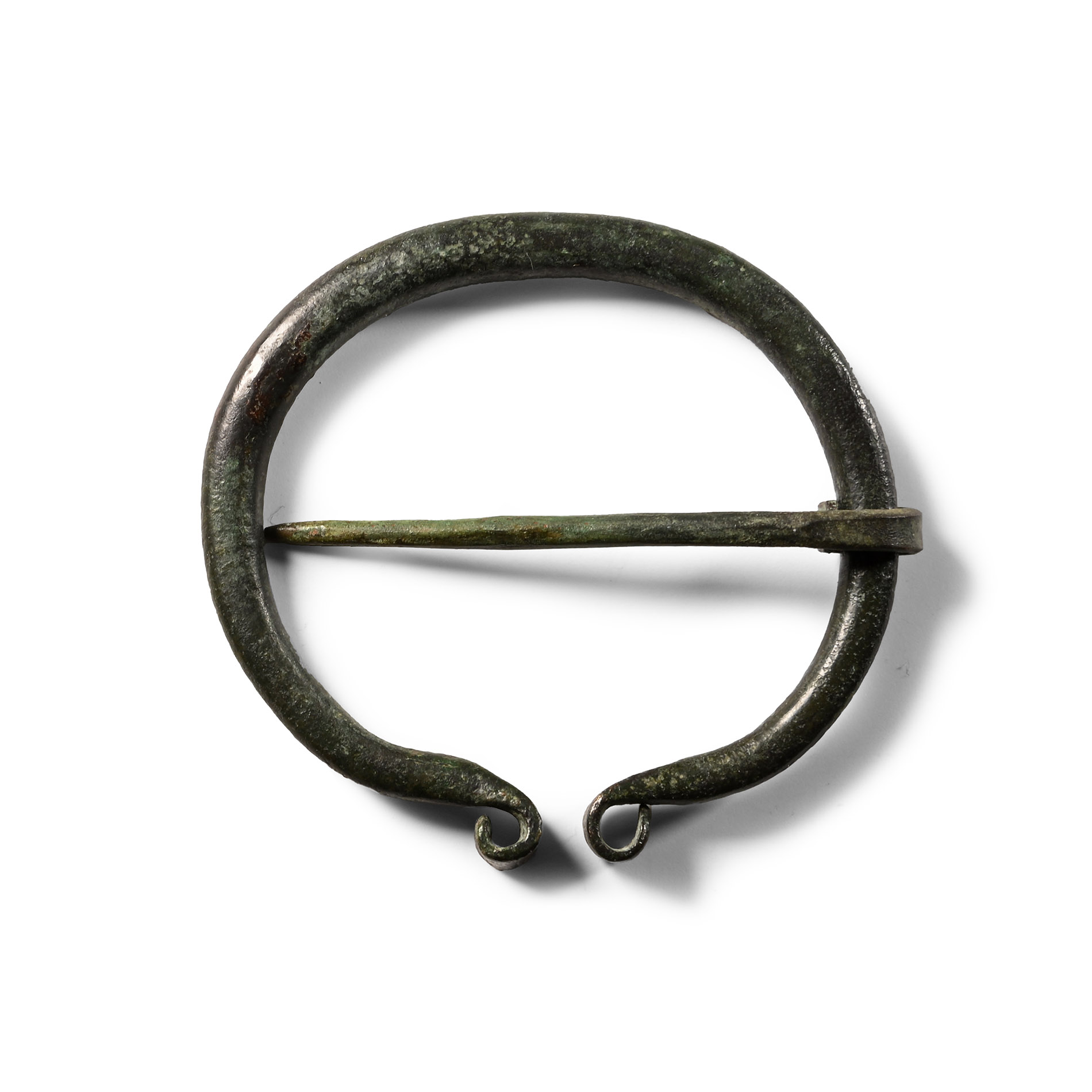
Roman Bronze Penannular Brooch
2ND-4TH CENTURY A.D.
2 1/4 in. (29.8 grams, 57 mm).
With round-section body and curved terminals, free-running pin. [No Reserve]
ProvenanceEx German art market, 2000s.
Acquired from an EU collector living in London.
From the collection of Surrey, UK, gentleman.
TimeLine Auctions follows a vetting process to ensure the authenticity and legality of all items, reinforcing our commitment to integrity and responsible trading. Each antiquity, antique, and coin lot undergoes thorough examination by a vetting committee of at least ten external specialists, professional trade association members, scientists, and archaeologists: Our Vetting Process
AUCTIONS:
TimeLine is a leading auction house specialising in antiquities, ancient art, collectables, natural history, coins, medals, and books. Our auctions offer museums, collectors, historians, and enthusiasts the opportunity to acquire unique and historically significant pieces.
-
Roman Glass Double Unguentarium
3rd-4th century A.D.Estimate: £400 - 600 (‡+bp*)
Opening Bid: £200
Pale green iridescent glass, two tapering tubes with rolled, everted rims, applied lateral triangular handles. 78 grams, 11 cm
Acquired in the mid 1980s-1990s. Private collection, Switzerland, thence by descent. Private collection, since the late 1990s. -
Large Late Roman Sigma-Shaped Marble Offering Table Top
Eastern Mediterranean, 4th-6th century A.D.Sold for (Inc. bp): £3,900
Semi-circular with raised and slightly everted edge, the top with a recessed area with a funnel-shaped outlet; for votive offerings within a church; restored. 84.5 kg including backplate, 91 cm wide
In general good condition, re-assembled.
Acquired in the late 1960s or early 1970s. Ex David Read collection. Accompanied by an academic report by Dr Raffaele D’Amato. This lot has been checked against the Interpol Database of stolen works of art and is accompanied by search certificate number no.12080-214035.
Marble tables such as the present example are called in archaeological terms sigma tables, in consideration of their resemblance to the Greek letter sigma. Sigma-shaped tables appeared in the banquet halls at the end of the 4th century and within Christian buildings from the following century. Most of the undecorated slabs were used as liturgical table tops for feasts to honour the deceased. This commemorative practice was known throughout the late Roman world in west and east, where it continued in the daily life of the citizens of the Eastern Roman Empire. In ecclesiastical settings, circular and sigma-shaped tables were used to collect offerings or for celebrating the agape, more generally as secondary furniture, while the rectangular form was preferred for use as an altar. -
Roman Bronze Folding Tripod Table with Busts of Bacchus and Panther
2nd century A.D.Estimate: £20,000 - 30,000 (‡+bp*)
Opening Bid: £11,111
With three extendable legs each topped with bust of Bacchus, his long hair collected in a crown of vine leaves and branches, wearing a panther skin exomis; the feet formed as feline paws; the middle part of the frontal leg formed as an S-curve topped with a panther's head with open jaws; restored. 9.9 kg, 101 cm
Traces of gilding over all the whole surface, fine condition, restored, excessively rare.
Ex collection of Dr Djafari (1900-1981), Kaiserslautern, Germany. Accompanied by an academic report by Dr Raffaele D’Amato. This lot has been checked against the Interpol Database of stolen works of art and is accompanied by search certificate number no.11801-206499.
Folding tripod stands were well known in the ancient world, in both Greek and Roman contexts. These folding supports for tables, bracers and cauldrons are known finds from important excavations in the Roman world, like Pompeii. The purpose of such folding stands varied: during the meal they were placed between the triclinary beds, and bowls and application plates were hung to the hooks at the back of the holders, here shaped like the heads of a Bacchus. They were also used for the fire in military encampments, or in the temples of the gods. Others were used as the support frames for bronze bowls, either for washing or for ritual purposes. Many were offered as funerary gifts, like the splendid example in the chariot grave of Környe. Roman folding tripods were also used in religious rituals (here clearly linked to the cult of the god of wine, as shown by the presence of panthers) and sacrifices. Burnt offerings and libations were offered to the gods in cauldrons that would have been attached to the hooks behind the heads on the upper section.