
Loading, please wait...
_900x900.jpg "Roman Bronze Panther Collection")
_200x200.jpg "Roman Bronze Panther Collection")
.jpg "Roman Bronze Panther Collection")
LOT 0139
Roman Bronze Panther Collection
1ST-4TH CENTURY A.D.
1 3/8 - 2 3/4 in. (97 grams total, 36-70 mm).
Comprising: a panther figure modelled sitting, semi-naturalistic detailing to the head and face, tail curled to one side of the body; fragmentary remains of the forequarters of a panther depicted in relief with stylised detailing; stylised panther figure modelled attacking, slightly curved profile, possibly a handle attachment. [3]
Provenance‘The Ancient Menagerie Collection’ formerly the property of a Cambridgeshire lady, collected since the 1990s and acquired from auctions and dealers throughout Europe and the USA, now ex London collection.
CONDITIONTimeLine Auctions follows a vetting process to ensure the authenticity and legality of all items, reinforcing our commitment to integrity and responsible trading. Each antiquity, antique, and coin lot undergoes thorough examination by a vetting committee of at least ten external specialists, professional trade association members, scientists, and archaeologists: Our Vetting Process
AUCTIONS:
TimeLine is a leading auction house specialising in antiquities, ancient art, collectables, natural history, coins, medals, and books. Our auctions offer museums, collectors, historians, and enthusiasts the opportunity to acquire unique and historically significant pieces.
LOT 0139
Roman Bronze Panther Collection
Estimate £600 - 800€700 - 930 (for guidance only)$810 - 1,080 (for guidance only)
-
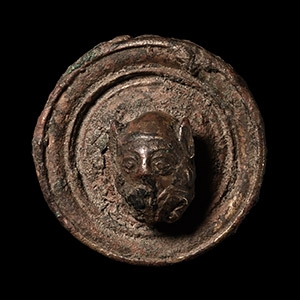
Romano-British Bronze Grotesque Head Mount
2nd-3rd century A.D.Sold for (Inc. bp): £104
The roundel with tiered borders, the grotesque head in high relief at the centre, modelled with semi-naturalistic detailing, full beard and pointed ears; remains of mounting lug to reverse. 39.3 grams, 36 mm wide
Found near Colchester, Essex, 2000. Property of an Essex gentleman. -
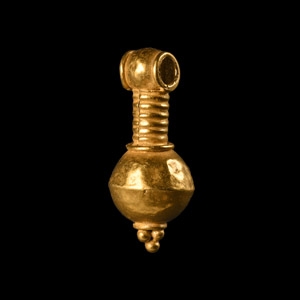
Roman Gold Pendant
1st-3rd century A.D.Sold for (Inc. bp): £286
Composed of a gold sphere with granule cluster below, ribbed shank and suspension loop with filigree borders; hollow-formed. 0.83 grams, 21 mm
With Persepolis Gallery, Mayfair, London, UK; in the 1980s. Ex private collection, London, UK. -
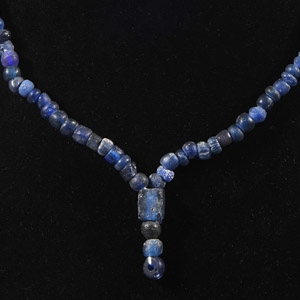
Roman Glass Bead Necklace
2nd-5th century A.D. or laterSold for (Inc. bp): £46
Composed of graduated glass beads of various shades of blue and type of bead, including carinated, oblate, coin-shaped and cuboid example, together with other types; restrung. 13.1 grams, 70 cm long
Ex W.J. collection, 1990s.
