
Loading, please wait...
LOT 0917
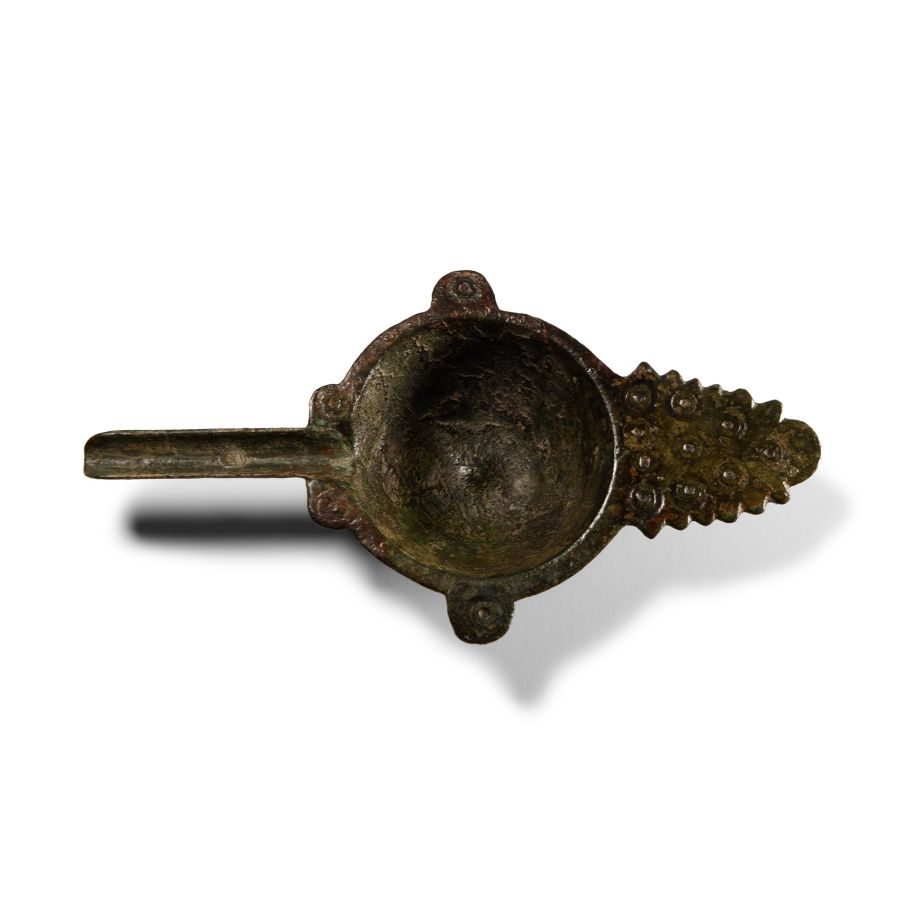
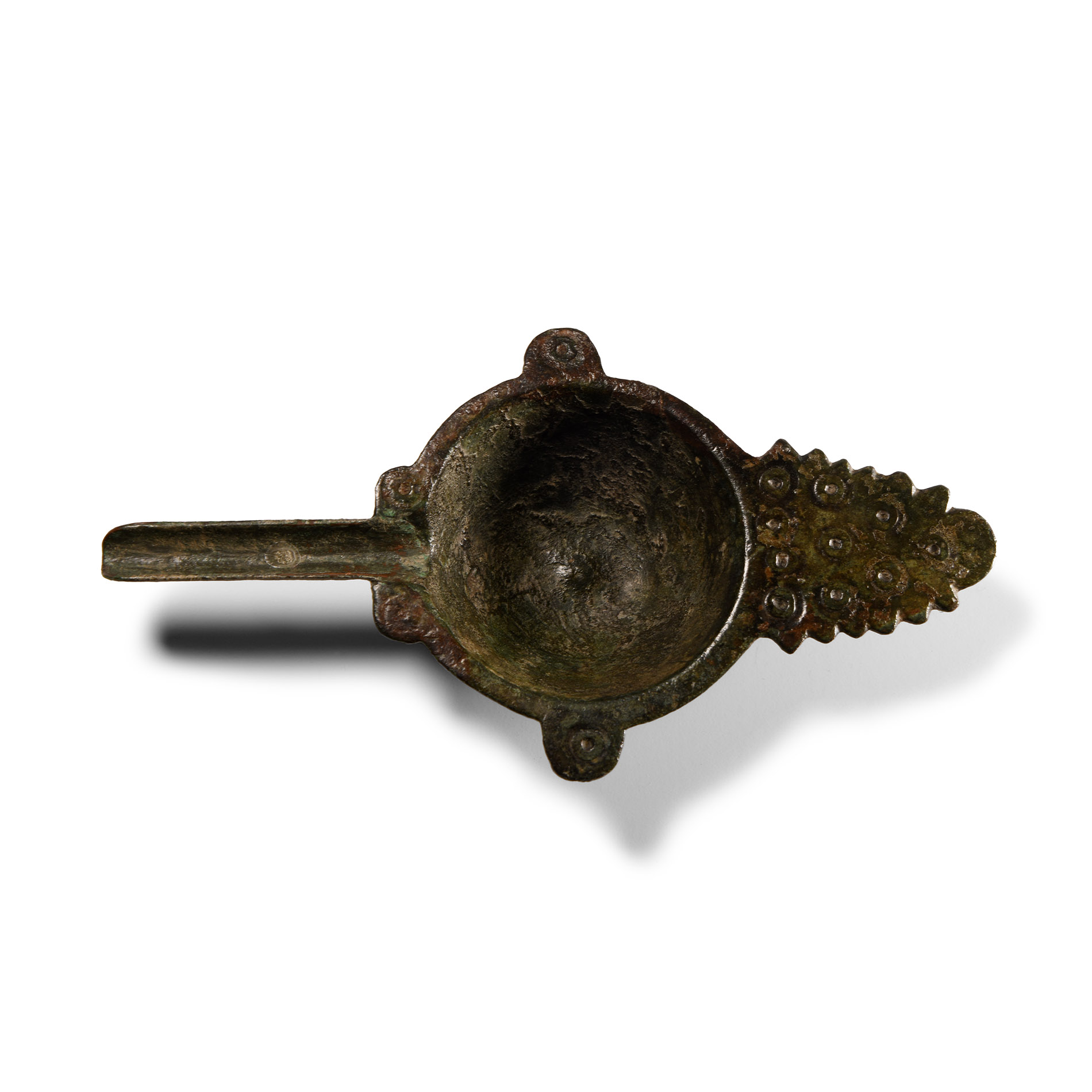
Roman Bronze Oil Lamp Filler
3RD-4TH CENTURY A.D.
6 1/8 in. (107 grams, 15.5 cm).
Decorative lamp filler with deep conical bowl, two lateral D-shaped lugs to the rim, U-section filler channel, flat handle to the rear with ring-and-dot detailing. [No Reserve]
ProvenanceFrom a collection acquired on the UK art market from various auction houses and collections mostly before 2000.
From an important Cambridgeshire estate; thence by descent.
TimeLine Auctions follows a vetting process to ensure the authenticity and legality of all items, reinforcing our commitment to integrity and responsible trading. Each antiquity, antique, and coin lot undergoes thorough examination by a vetting committee of at least ten external specialists, professional trade association members, scientists, and archaeologists: Our Vetting Process
AUCTIONS:
TimeLine is a leading auction house specialising in antiquities, ancient art, collectables, natural history, coins, medals, and books. Our auctions offer museums, collectors, historians, and enthusiasts the opportunity to acquire unique and historically significant pieces.
-
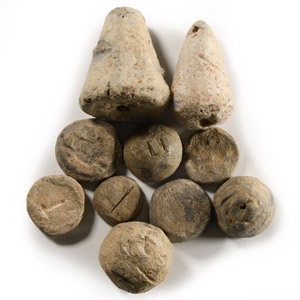
Roman and Later Lead Weight Collection
1st-18th century A.D.Sold for (Inc. bp): £20
Including tabular, plano-convex and conical types. 889 grams total, 20-45 mm
Found whilst fieldwalking in Somerset and Devon, UK. -

Roman Votive Hand to God Sabazios
2nd-3rd century A.D.Sold for (Inc. bp): £910
Hollow-formed right hand from a statuette, with fingers splayed and flat palm, good anatomical detailing. 362 grams, 12.1 cm
Private collection 1990s. Ex London, UK, gallery.
The votive character of the hand could link it to the God Sabazios, often associated with a number of archaeological finds depicting a bronze, right hand in the benedictio latina gesture. The hand appears to have had ritual significance and may have been affixed to a sceptre (as the one carried by Sabazios on a slab, one from Philippopolis, nowadays Plovdiv in Bulgaria). The association with Sabazios is sometimes suggested in similar hands, by the presence of a snake embossed around the circumference of the hand, because the iconic image of the god or hero on horseback battling the chthonic serpent, appears on Celtic-Roman votive columns, and with the coming of Christianity it was easily adapted to the representations of Saint George fighting the Dragon. -
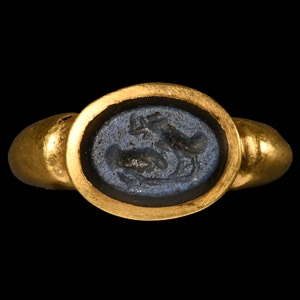
Roman Gold Ring with Pair of Birds on Nicolo Gemstone
2nd-3rd century A.D.Estimate: £1,500 - 2,000 (+bp*)
Opening Bid: £800
With a hollow-form hoop expanding at the shoulders, raised bezel set with a dark blue nicolo intaglio engraved with a pair of birds, one standing and the other stooped to pick something from the ground with its beak. 5.75 grams, 25.12 mm overall, 14.69 x 18.30 mm internal diameter (approximate size British J, USA 4 3/4, Europe 8.69, Japan 8)
From the collection of late AB, London, UK, 1990s. Accompanied by a previous catalogue information slip.
The type of ring (type II, variant I of Ruseva-Slokoska classification) is characterised by the ellipsoid hoop, rounded on the outside, widening to a horizontal triangular shape. The nicolo was often employed in rings of the 2nd-3rd century A.D.
