
Loading, please wait...
_900x900.jpg "Roman Bronze Neptune Statuette")
_200x200.jpg "Roman Bronze Neptune Statuette")
.jpg "Roman Bronze Neptune Statuette")
LOT 0723
Roman Bronze Neptune Statuette
1ST CENTURY B.C.-1ST CENTURY A.D.
2 3/8 in. (37 grams, 60 mm).
Standing nude with arms raised, legs in advancing pose. [No Reserve]
ProvenanceFrom a collection acquired on the UK art market from various auction houses and collections mostly before 2000.
From an important Cambridgeshire estate; thence by descent.
Cf. Boucher, S. & Tassinari, S., Musée de la Civilisation Gallo-Romaine a Lyon: Bronzes Antiques I. Inscriptions, Statuaire, Vaisselle, Lyon, 1976, item 54, for similar figure of Neptune, item 61, for similar figure of Sucellus.
FootnotesThe condition of the statuette does not allow a easy identification of its original characterization, but the position of the body shows a certain affinity with provincial statuettes of the god Neptune, especially produced in Gallo-Roman ateliers. Some statuettes of Sucellus, the Gallic divinity assimilated into the Roman Pantheon as the equivalent of the Dispater, brother of Jupiter, could possibly also bear resemblance with our statuette for the position of the body.
CONDITIONTimeLine Auctions follows a vetting process to ensure the authenticity and legality of all items, reinforcing our commitment to integrity and responsible trading. Each antiquity, antique, and coin lot undergoes thorough examination by a vetting committee of at least ten external specialists, professional trade association members, scientists, and archaeologists: Our Vetting Process
AUCTIONS:
TimeLine is a leading auction house specialising in antiquities, ancient art, collectables, natural history, coins, medals, and books. Our auctions offer museums, collectors, historians, and enthusiasts the opportunity to acquire unique and historically significant pieces.
-
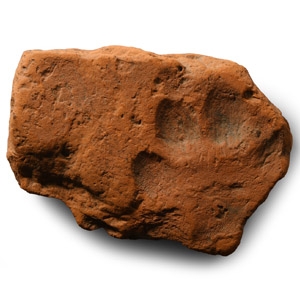
Roman Terracotta Roof Tile with Dog's Paw Print
1st-4th century A.D.Sold for (Inc. bp): £286
Fragment of flat-section tegula roof tile, with impressed paw-print from a dog walking on the tile while still wet. 137 grams, 10 cm
From the collection of the famous author, writer and speaker, Gordon Bailey, Essex, UK; formed since 1968. -
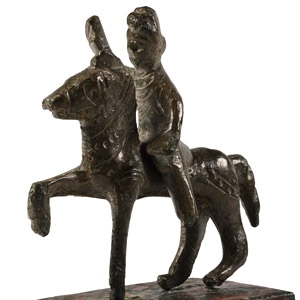
Romano-Celtic Bronze Horse and Rider
Circa 1st-2nd century A.D.Estimate: £300 - 400 (+bp*)
Opening Bid: £125
Modelled in the round, male with legs in straddling pose wearing a tight-fitting coat, left hand thrust forward and right arm raised with hand open; head with shoulder-length hair, horse in prancing pose with incised bridle, crupper and other harness and impressed pellets for medallions; provided with a contemporary stand. 113 grams total, 6.5 cm high
Private collection, Chichester, acquired before 2000. -
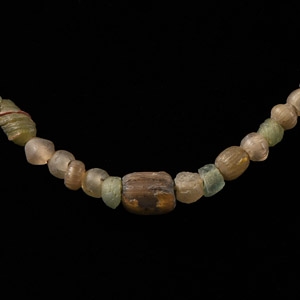
Roman Glass Bead Necklace String
1st-4th century A.D. and laterSold for (Inc. bp): £52
Restrung designer necklace string of graduated beads, mainly oblate and cylindrical types. 21.3 grams, 47.5 cm
Acquired 1980-2015. Ex Abelita family collection.
