
Loading, please wait...
LOT 0946
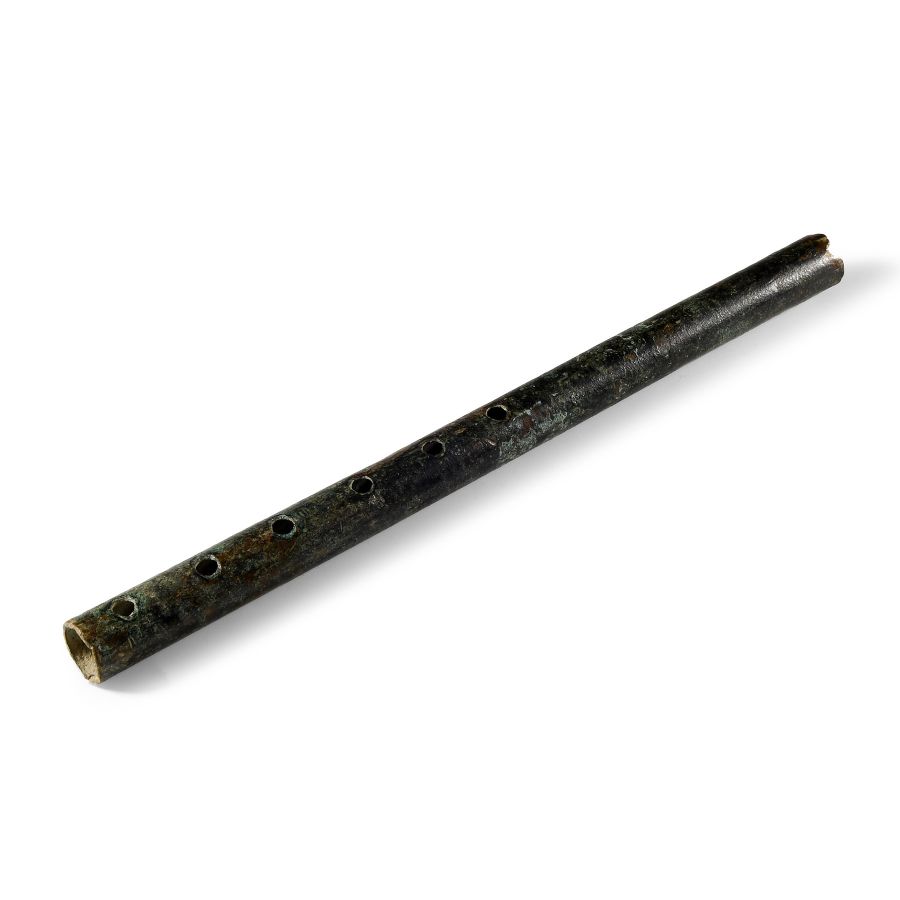
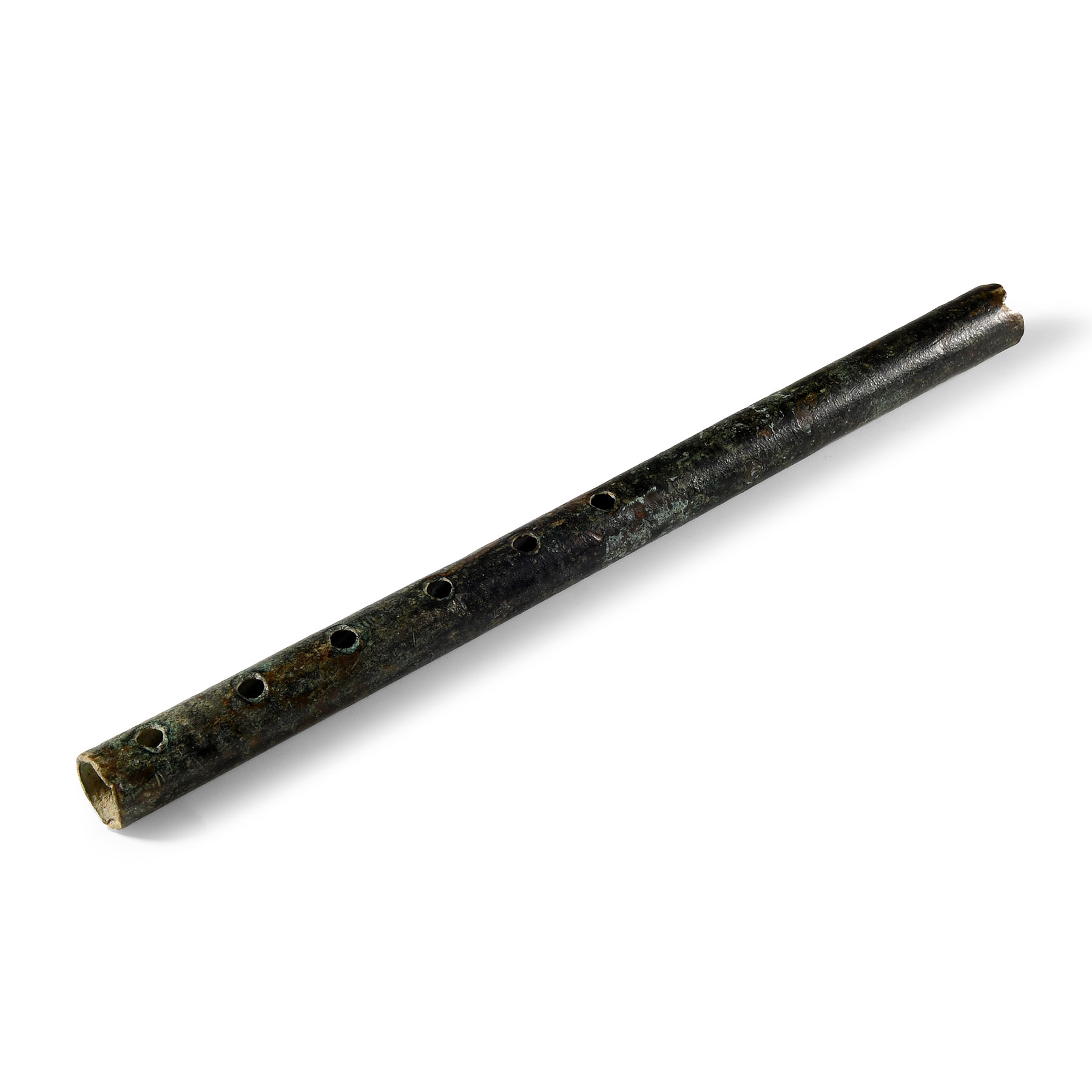
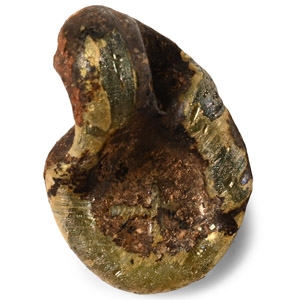
Roman Bronze Musical Flute
CIRCA 2ND-3RD CENTURY A.D.
9 in. (87 grams, 23 cm).
An extremely rare aulos or tibia with round-section body, six circular holes to one side and a D-shaped hole to the reverse.
ProvenanceFrom the late Alison Barker collection, a retired London barrister; from her collection formed early 1960s-1990s.
Accompanied by an academic report by Dr Raffaele D'Amato.
This lot has been checked against the Interpol Database of stolen works of art and is accompanied by search certificate number no.11055-184396.
See Daremberg, C.V. & Saglio, E. (eds.), Dictionnaire des Antiquités Grecques et Romaines, Paris, 1873-1917, fig.6965; see a cast of the Roman flute from Pompeii, in the Spurlock Museum of World Cultures (inventory 1916.07.0011); Wardle, M.A., Musical Instruments in the Roman World, London, 1981, for iconography (pp.35ff., 115ff. and especially pl.22), and original specimens from Pompeii, pls.1-2; the closest parallel in Palagyi, T., Facsady, A., Romains de Hongrie, Lyon, 2002, p.117, fig.259 (bronze tibia from Pannonia, Savaria, today Szombathely).
FootnotesThe flute was used for religious ceremonies and for entertainment. The pyrrhic, a war dance of Doric origin, was a rapid dance to the double flute, and made to resemble an action in battle.
CONDITIONTimeLine Auctions follows a vetting process to ensure the authenticity and legality of all items, reinforcing our commitment to integrity and responsible trading. Each antiquity, antique, and coin lot undergoes thorough examination by a vetting committee of at least ten external specialists, professional trade association members, scientists, and archaeologists: Our Vetting Process
AUCTIONS:
TimeLine is a leading auction house specialising in antiquities, ancient art, collectables, natural history, coins, medals, and books. Our auctions offer museums, collectors, historians, and enthusiasts the opportunity to acquire unique and historically significant pieces.
-
Roman Bronze and Silver Gladius Scabbard Mount Group
1st century A.D.Sold for (Inc. bp): £221
Including a scallop-shaped appliqué with scrolled tendrils and other types. 12.6 grams total, 36-49 mm
Ex German art market, 2000s. Acquired from an EU collector living in London. From the collection of Surrey, UK, gentleman. -
Late Roman Glass Pendant with Cross
4th-5th century A.D.Estimate: £100 - 140 (+bp*)
Opening Bid: £50
With impressed cross motif. 1.45 grams, 20 mm
Collected from 1970-1999. From the collection of the late Mr S.M., London, UK. -
.jpg)
Roman Green Glass Pilgrim's Flask
1st century A.D.Sold for (Inc. bp): £104
Amphoriskos with flat disc-shaped body, tubular neck with flared rim, two lateral knee-shaped handles to the shoulder. 12.4 grams, 58 mm
Acquired 1970s-1996. Property of a North American collector. London collection, 2016.
