
Loading, please wait...


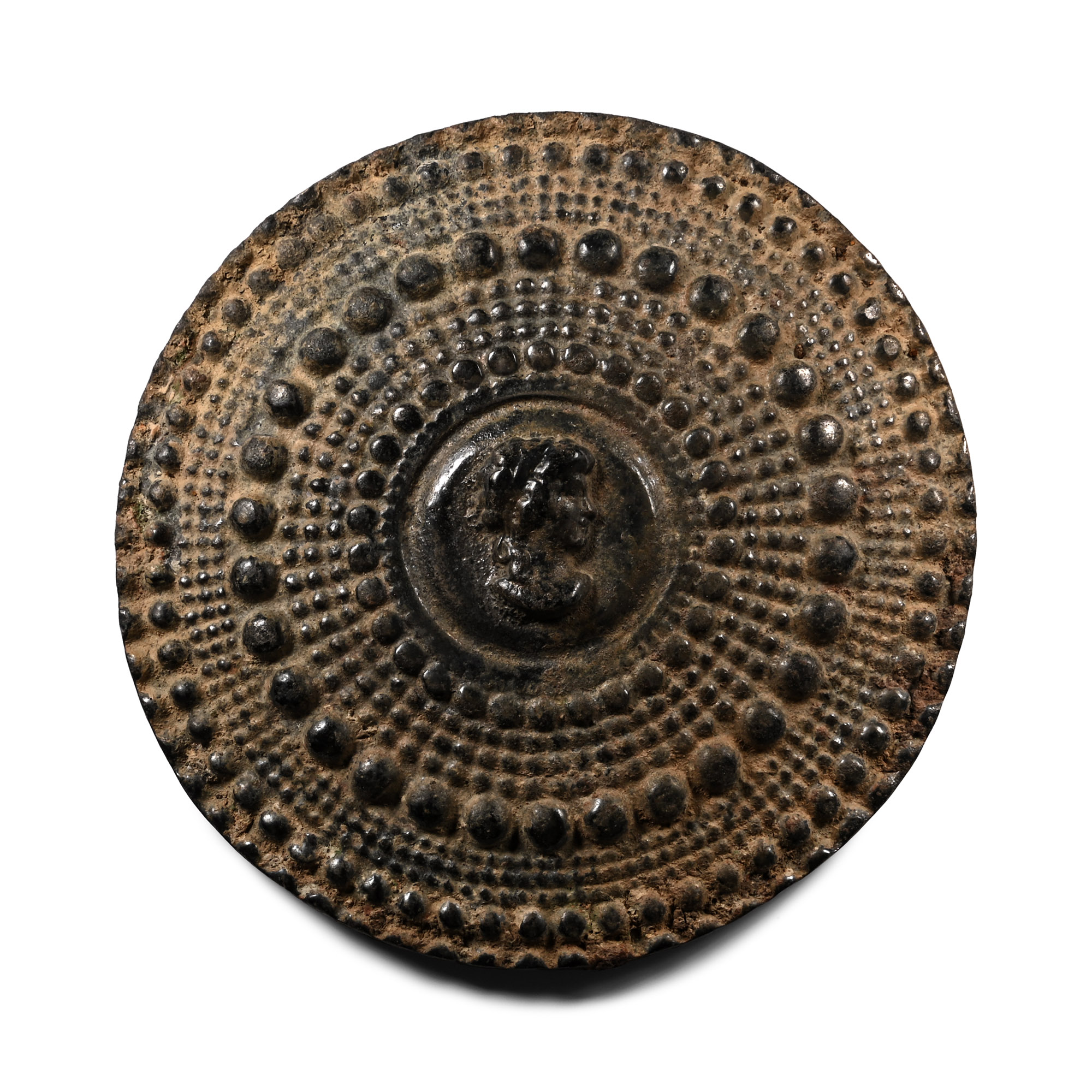
LOT 0167
Roman Bronze Military Roundel
1ST-3RD CENTURY A.D.
3 in. (120 grams, 77 mm).
Domed phalera with field of radiating bosses in varying sizes, central tondo with profile female bust; four attachment points to the reverse.
ProvenanceAcquired in the mid 1980s-1990s.
Private collection, Switzerland, thence by descent.
Private collection, since the late 1990s.
Cf. similar less ornate example in the British Museum under accession no.1854,0717.23.
CONDITIONTimeLine Auctions follows a vetting process to ensure the authenticity and legality of all items, reinforcing our commitment to integrity and responsible trading. Each antiquity, antique, and coin lot undergoes thorough examination by a vetting committee of at least ten external specialists, professional trade association members, scientists, and archaeologists: Our Vetting Process
AUCTIONS:
TimeLine is a leading auction house specialising in antiquities, ancient art, collectables, natural history, coins, medals, and books. Our auctions offer museums, collectors, historians, and enthusiasts the opportunity to acquire unique and historically significant pieces.
-
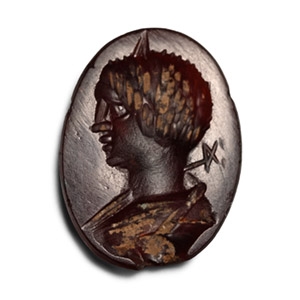
Roman Carnelian Bust of Mercury Gemstone
2nd-3rd century A.D.Sold for (Inc. bp): £286
Ellipsoid gemstone with chamfered rim, incuse profile bust of Mercury with wreath in his hair and star to the rear of the neck. 1.27 grams, 18 mm
From an old UK collection, 1980s. -
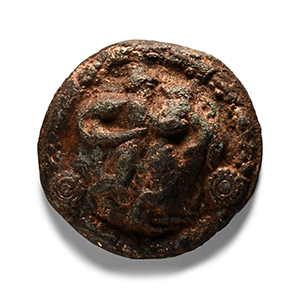
Roman Gilt Bronze Phalera with Theseus and the Minotaur
2nd century B.C.- 2nd century A.D.Sold for (Inc. bp): £182
Domed roundel with high-relief design of combat between a bearded hero and a monster, wreath and rosettes to the rim. 32 grams, 49 mm
Found near Sedgeford, Norfolk, UK, in the 1980s. Acquired in the late 1990s. Property of a Norfolk, UK, collector.
According to the legend, Theseus, prince of Athens, went to the island of Crete to kill a monster who was the son of queen Pasiphae and a wild bull, although officially he was the son of Minos and Pasiphae. Theseus chased him into the labyrinth, killed him and found his way out with the help of the comb of Ariadne, daughter of King Minos. The myth has its representation in the Archaic, Classical and Hellenistic period, and was widely depicted in the Graeco-Roman world. The present repoussé appliqué was probably used as a furniture or horse harness ornament. -
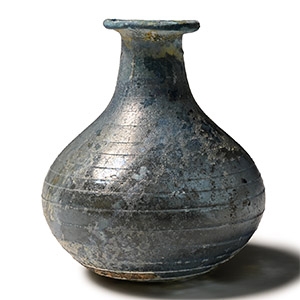
Roman Blue Glass Flask with Trail
3rd-4th century A.D.Estimate: £500 - 700 (+bp*)
Opening Bid: £250
Piriform in profile with slight dimple to base, squat body, tubular neck with flared and rolled mouth; fine applied spiral trail from shoulder to base. 8 grams, 62 mm
From an important London, UK, collection, 1970-1990s.
