
Loading, please wait...
LOT 1051
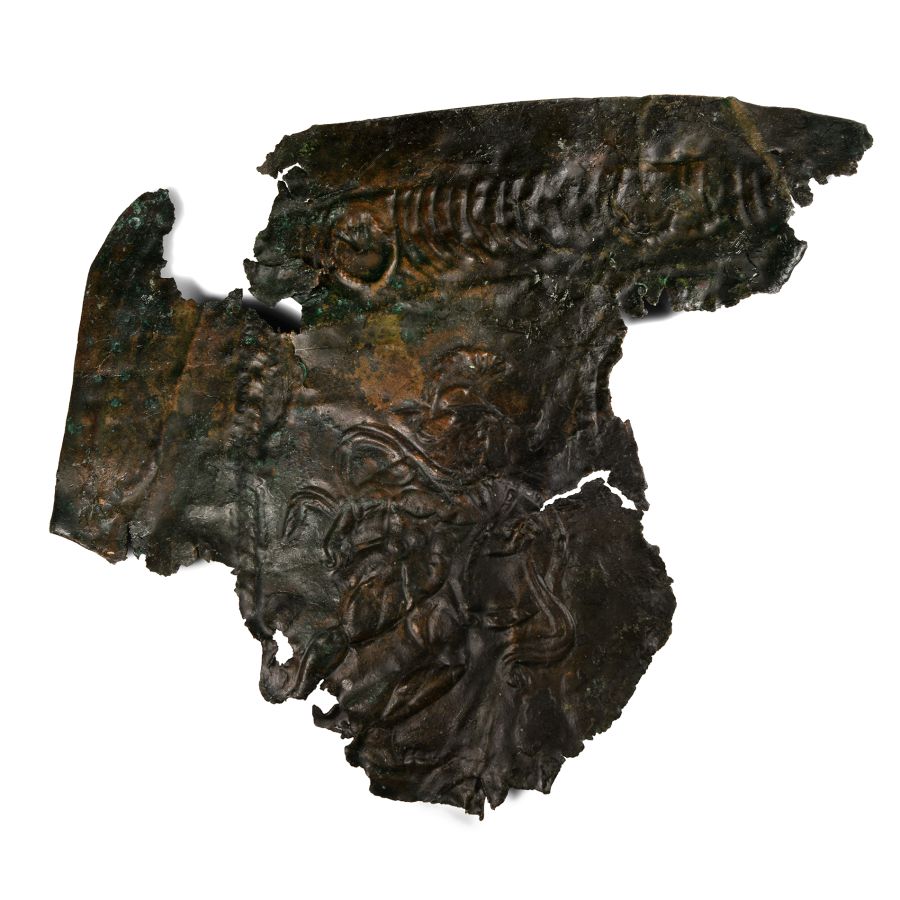
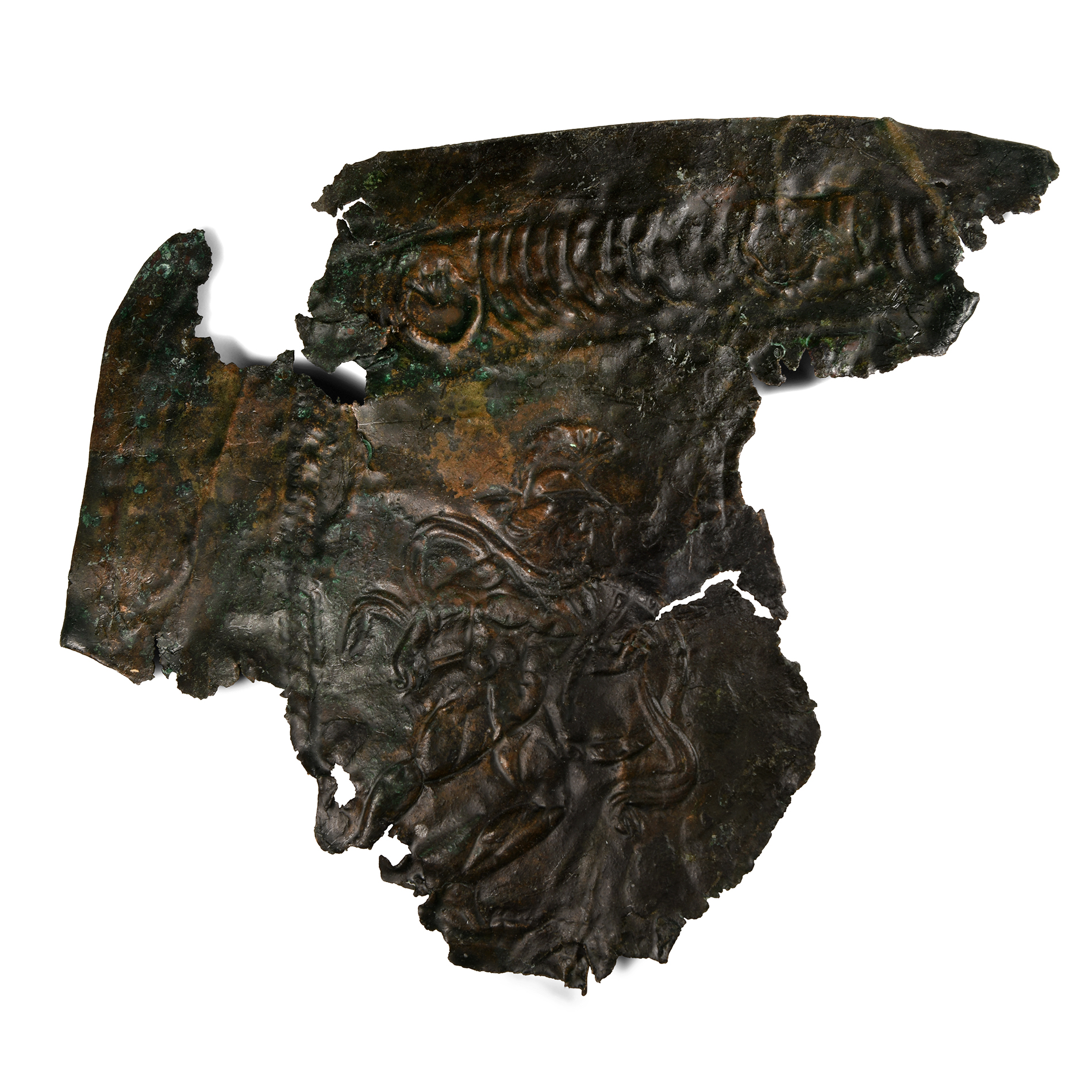
Roman Bronze Military Mask Helmet Section
3RD CENTURY A.D.
6 3/4 in. (55 grams, 17 cm wide).
From the upper part of the right side of the face mask, the upper edge with a band of embossed curved lines, probably representing stylised hairs, intertwined with laurel crown; embossed image of advancing Mars, the god of war, to the centre, depicted nude with military sagum, a pseudo-Corinthian helmet to the head and carrying a circular shield.
ProvenanceAcquired 1960s-1990s.
Late Alison Barker collection, a retired London barrister.
Cf. Robinson, R., The Armour of Imperial Rome, New York, 1975, pls.387-390; Garbsch, J., Römische Paraderustüngen, München, 1979; Born, H., Junkelmann, M., Römische Kampf-und Turnierrüstungen, Band VI, Sammlung Axel Guttmann, Mainz, 1997; D'Amato R., Negin, A., Decorated Roman Armour, London, 2017, fig.177.
FootnotesIn the decorative patterns of Roman helmets, Mars was among the most revered deities in the Imperial army. After Jupiter, he was the most aristocratic god of the old Italic religion, master of armament, who governed military service (militiae potens) and oversaw the training ground, for which he was named Campester. The emperor Augustus named him Ultor (‘Avenger’) and dedicated to him a luxurious temple in the centre of the forum in gratitude for his victory over the murderers of Caesar and, in addition, granted to him the privileges of the Capitoline Jupiter.
CONDITIONTimeLine Auctions follows a vetting process to ensure the authenticity and legality of all items, reinforcing our commitment to integrity and responsible trading. Each antiquity, antique, and coin lot undergoes thorough examination by a vetting committee of at least ten external specialists, professional trade association members, scientists, and archaeologists: Our Vetting Process
AUCTIONS:
TimeLine is a leading auction house specialising in antiquities, ancient art, collectables, natural history, coins, medals, and books. Our auctions offer museums, collectors, historians, and enthusiasts the opportunity to acquire unique and historically significant pieces.
-
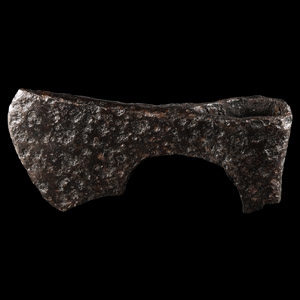
Viking Age Iron Bearded Axehead
9th-13th century A.D.Sold for (Inc. bp): £208
Finno-Ugrian with triangular-section blade widening to a broad bevelled edge with spur to the underside, socket with extended lower sleeve. 779 grams, 17.5 cm
Acquired 1971-1972. From the collection of the vendor's father. Property of a London, UK, collector.
During their struggles against Germans and Teutonic Knights, deceased pagans were often cremated along with damaged or ceremonially sacrificed weaponry. If swords were generally reserved for the military elite, the side axe was one of the most commonly used weapons. -
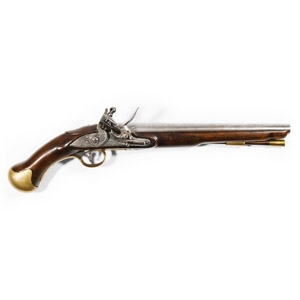
Tower Long Sea Service Flintlock Pistol
1800 A.D.Estimate: £3,000 - 4,000 (+bp*)
Opening Bid: £1,278
Napoleonic era with 30cm (12") round smooth bore barrel of .56" bore with London proof marks, the lock with 'TOWER', 'crown-over-GR' and 'crown-over-broad-arrow' marks fitted with brass-tipped wood ramrod and wood full stock and butt with brass butt cap, trigger guard, side plate and ferrule with steel belt hook; action working to half and full cock. 1.40 kg, 49 cm
Acquired from Andrew Bottomley, UK. The Kusmirek Collection, UK. Accompanied by a copy of the Bottomley listing. This lot has been checked against the Interpol Database of stolen works of art and is accompanied by search certificate no.204079.
Sold as an exempt item under Section 58 (2) of the Firearms Act, 1968, to be held as a curiosity or ornament. No license required but buyer must be over 18 years of age. Overseas bidders should note that, due to UK regulations governing export of all firearms, overseas buyers will need to make arrangements for shipping this lot out of the UK directly, by air freight, with a specialist company or agent. -
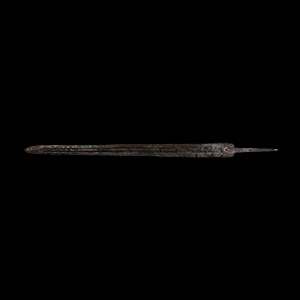
Roman Iron Spatha Sword
3rd-4th century A.D.Sold for (Inc. bp): £975
Comprising a wide double-edged blade of Illerup-Wyhl typology; blood channels and later inlays to both sides. 652 grams, 83 cm
Acquired 1990s-early 2000s. East Anglian private collection.
Specimens of Roman spathae of 2nd-3rd centuries have been found in large numbers in Danish bogs (Nydam, Straubing, Thorsberg, Illerup). The Straubing-Nydam type shows straight and convergent cutting edges, the width of which is reduced along the blade.
