
Loading, please wait...
_900x900.jpg "Roman Bronze Military Knee Brooch Collection")
_200x200.jpg "Roman Bronze Military Knee Brooch Collection")
.jpg "Roman Bronze Military Knee Brooch Collection")
LOT 0790
Roman Bronze Military Knee Brooch Collection
2ND-3RD CENTURIES A.D.
1 1/8 - 1 1/2 in. (66 grams total, 29-39 mm).
Comprising examples with sprung pins or hinged pins and catch plates to reverses. [6, No Reserve]
ProvenanceEx property of an Austrian private collector since the 1970s.
LiteratureSee Mackreth, D.F., Brooches in Late Iron Age and Roman Britain, Oxford, 2011, figs.7546, 7621, 12545, for the type.
FootnotesThe knee brooches, especially in Britain, are connected to military sites, like the Hadrian’s Wall. The British types evolved after the continental versions appeared in Britannia, possibly having been imported by Noricum’s soldiers.
CONDITIONTimeLine Auctions follows a vetting process to ensure the authenticity and legality of all items, reinforcing our commitment to integrity and responsible trading. Each antiquity, antique, and coin lot undergoes thorough examination by a vetting committee of at least ten external specialists, professional trade association members, scientists, and archaeologists: Our Vetting Process
AUCTIONS:
TimeLine is a leading auction house specialising in antiquities, ancient art, collectables, natural history, coins, medals, and books. Our auctions offer museums, collectors, historians, and enthusiasts the opportunity to acquire unique and historically significant pieces.
-
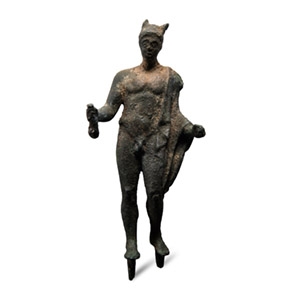
Roman Bronze Statuette of Mercury
1st-2nd century A.D.Estimate: £700 - 900 (+bp*)
Opening Bid: £350
Modelled standing nude wearing the winged petasos and with a bag of coins in his extended right hand, mantle over his left shoulder; attachment peg to the underside of each foot. 209 grams, 12.6 cm
English private collection. -
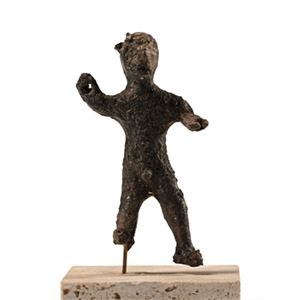
Roman Bronze Votive Statuette
1st century B.C.-1st century A.D.Sold for (Inc. bp): £78
Standing nude figure of a warrior with left hand extended, pierced to accept the grip of a shield, right hand raised, pierced to accept the shaft of a spear; mounted on a custom-made stand. 117 grams total, 82 mm including stand
From a collection acquired on the UK art market from various auction houses and collections mostly before 2000. From an important Cambridgeshire estate; thence by descent. -
.jpg)
Roman 'British' Ring Gemstone with Portrait
Circa 2nd century A.D.Sold for (Inc. bp): £46
Ellipsoid glass insert with profile portrait bust to one face. 2.11 grams, 14 mm
Found UK. From the collection of C. Sullivan, UK, 1990s.
The same portrait appears on 'horse and rider' plate brooches.
