
Loading, please wait...
LOT 1084
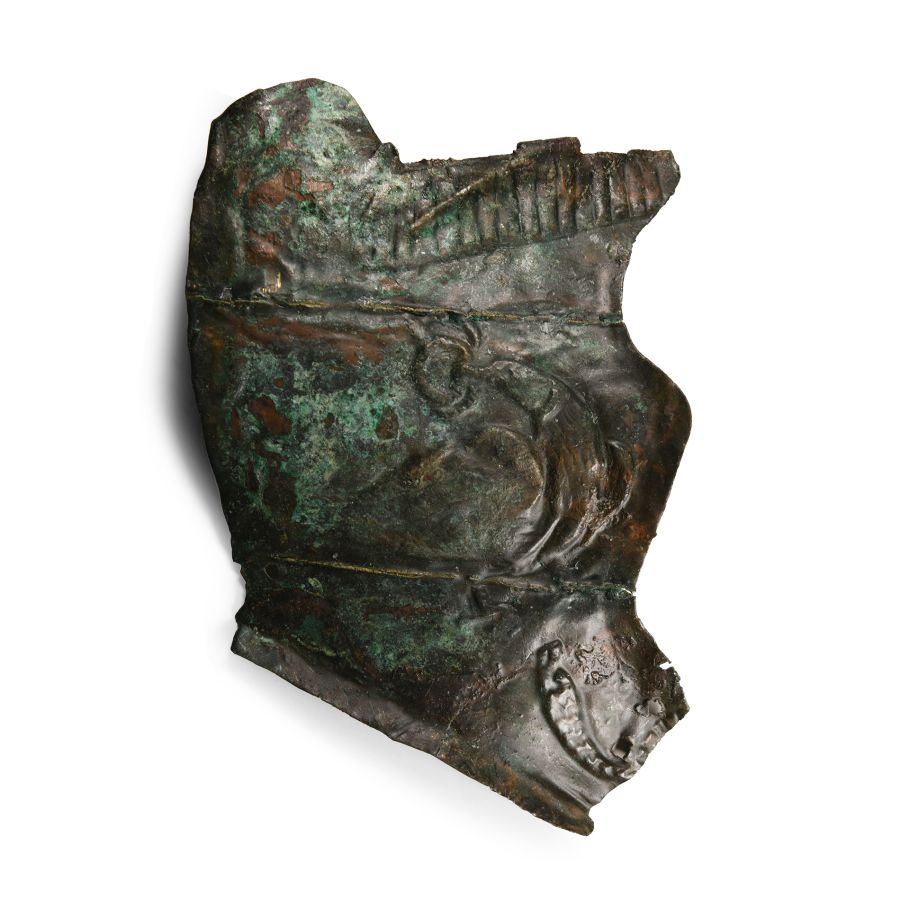
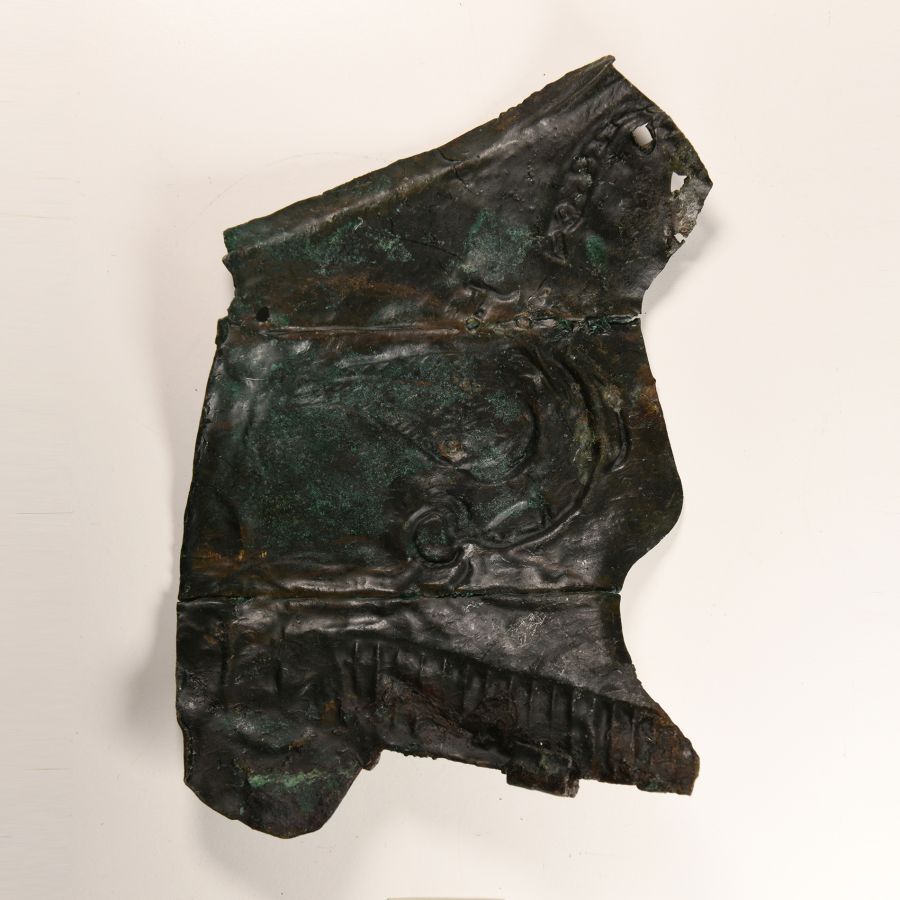
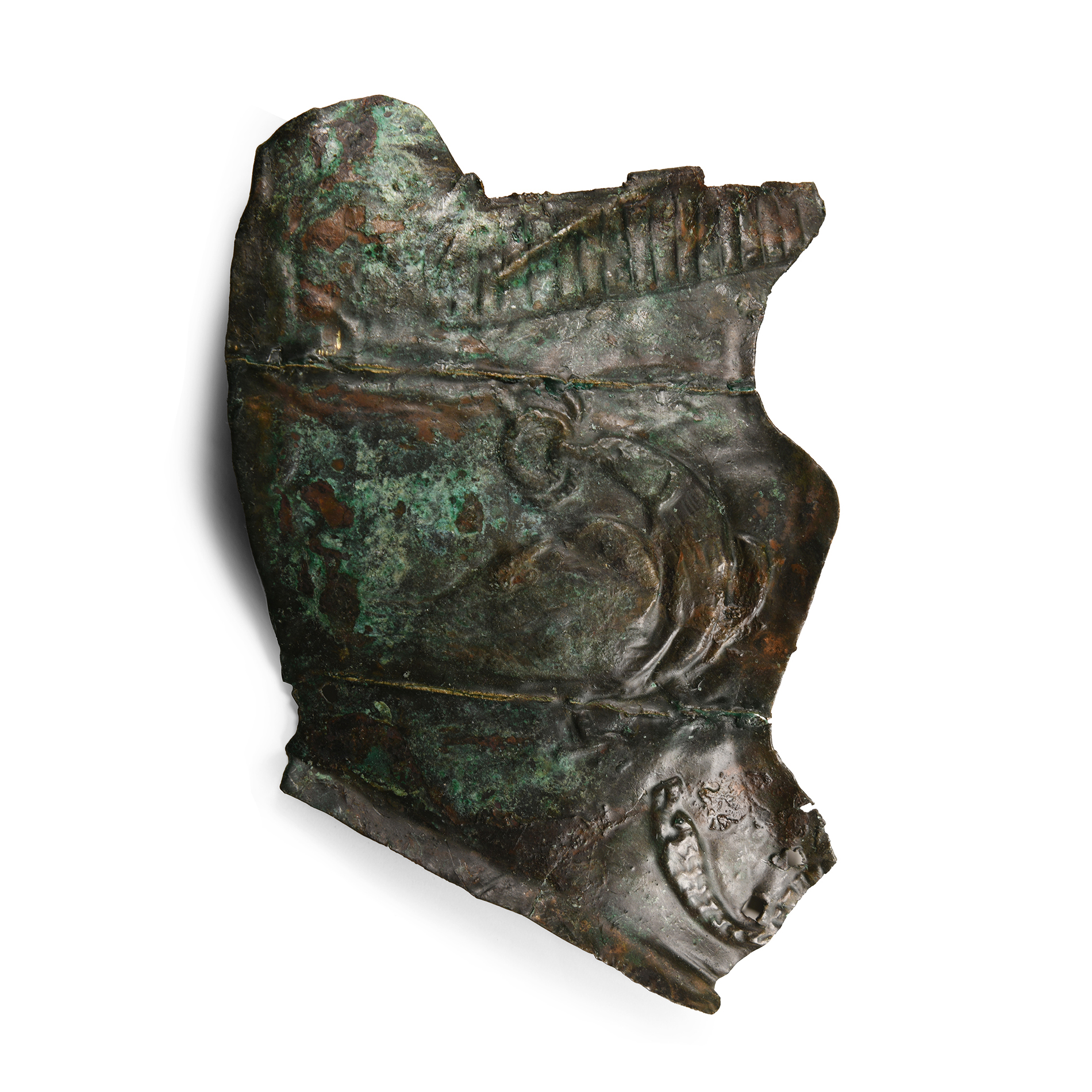
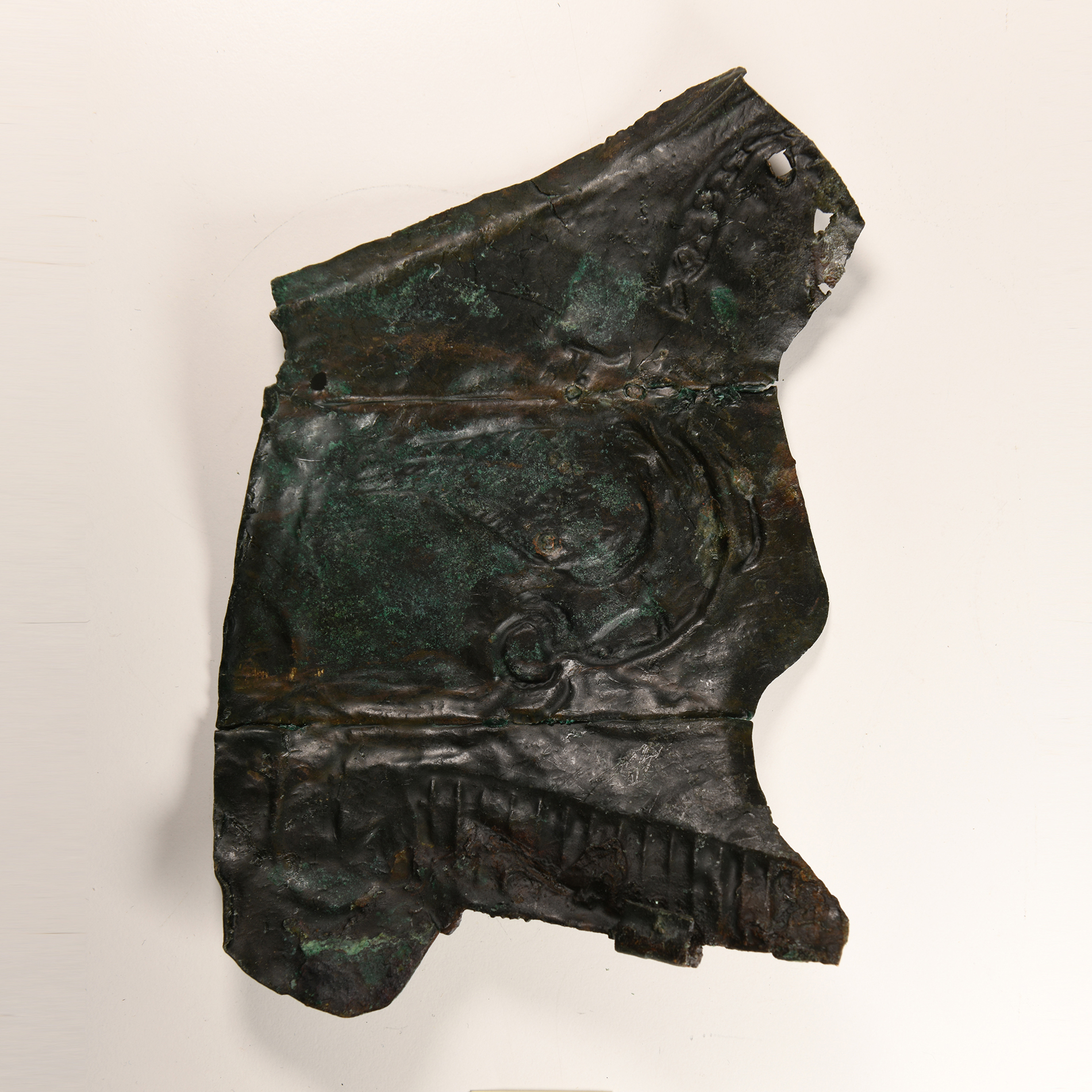
Roman Bronze Military Helmet Section
3RD CENTURY A.D.
7 3/4 in. (87 grams, 19.7 cm).
From the right side of the face mask, the upper edge with an embossed band of diagonal lines, Jupiter’s eagle embossed to the centre, looking back and holding a laurel crown in its beak; a hole for the fastening thongs at ear-level.
ProvenanceAcquired 1960s-1990s.
Late Alison Barker collection, a retired London barrister.
See Robinson, R., The Armour of Imperial Rome, New York, 1975; Garbsch, J., Römische Paraderustüngen, München, 1979; Born, H., Junkelmann, M., Römische Kampf-und Turnierrüstungen, Band VI, Sammlung Axel Guttmann, Mainz, 1997; D'Amato R., Negin, A., Decorated Roman Armour, London, 2017, especially figs.61, 273, 274.
FootnotesThe decoration of Roman weaponry contained themes that were directly associated with state propaganda, as well as with the Imperial cult. As the god-protector of the state and the army, Jupiter was the most esteemed. The combination of an eagle (helmet), Minerva and bust of Mars (armour) can also be understood as an image of dii militares.
CONDITIONTimeLine Auctions follows a vetting process to ensure the authenticity and legality of all items, reinforcing our commitment to integrity and responsible trading. Each antiquity, antique, and coin lot undergoes thorough examination by a vetting committee of at least ten external specialists, professional trade association members, scientists, and archaeologists: Our Vetting Process
AUCTIONS:
TimeLine is a leading auction house specialising in antiquities, ancient art, collectables, natural history, coins, medals, and books. Our auctions offer museums, collectors, historians, and enthusiasts the opportunity to acquire unique and historically significant pieces.
-
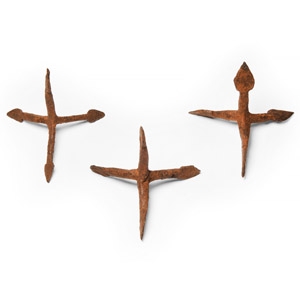
Byzantine Iron Anti-Cavalry Caltrop Trivoloi Group
11th-14th century A.D.Sold for (Inc. bp): £169
Comprising three caltrops, hand-forged with square-section in the form of four welded arrowheads. 34 grams total, 50 mm each
Acquired on the German art market around 2000. From the collection of Surrey, UK, gentleman.
Caltrops were a kind of 'landmine' of the ancient world an mentioned in the Classical period. Nevertheless, they turned into real military weapons only in Dark Ages. Their systematic and wide use by the Eastern Romans, who called it tribolos, is noticeable. In 1082, Emperor Alexios Komnenos used caltrops against the Norman cavalry in the Balkans. Anna Komnena tells us in detail of her father’s intentions: ‘He marched against Bohemond with a new idea for victory. He had iron caltrops made and since he expected the battle to take place on the next day, the evening before scattered them over the plain between the two armies at the point where he guessed that the Kelts (the Normans) would make a heavy cavalry attack. The plan was to frustrate the first and irresistible charge when the caltrops pierced the horses’ hooves.’ Unfortunately for the Romans the Normans avoided battle on the ‘minefield’, outflanked the enemy and gained victory. -

German Closed Iron Helm
Circa 1560 A.D.Sold for (Inc. bp): £4,940
An armet with rounded one-piece skull raising to a roped medial comb, visor, prow shaped upper bevor and bevor attached by common pivots, each secured at the right side by a spring-catch, the visor with stepped centrally divided visor-slit and two gorget-plates. 2 kg, 31 cm high
Acquired on the European art market. The Kusmirek Collection, UK. Accompanied by a copy of an invoice. Accompanied by an academic report by Dr Raffaele D'Amato This lot has been checked against the Interpol Database of stolen works of art and is accompanied by search certificate number no.11767-203981.
The term armet is generally used to denote a visored helmet of particular construction, one in which large cheekpieces are hinged to the base of the bowl just above the ears and close in front of the chin. From about 1515 A.D., the Germans produced a variant armet where the downward extension of the skull was made much wider, reaching as far forward as the ears. The cheekpieces on this type of helmet opened sideways, on vertical hinges on the edges of this wider neck element. -

Large Byzantine Silver Archer's Ring
14th-15th century A.D.Estimate: £600 - 800 (+bp*)
Opening Bid: £240
Comprising a hoop with reserved triangular ornament on the edges and triangular plaque with foliage motifs, raised central panel with frond motif. 22.61 grams, 34.77 mm overall, 25.16 mm internal diameter
Acquired in the 1990s. Ex Cambridgeshire, UK, collection.
Archer rings in Late Byzantium and the medieval Balkans were connected with the employment of the powerful composite bow, but very often, in the 14th century they served as insignia of rank for aristocratic noblemen. Archaeological findings of archers’ rings originate mainly from fortified towns, including mining centres. Many were made in bone, simple in design and undecorated. In contrast, the ones made in bronze and silver were usually decorated in rather uniform style, consisting of floral motifs on the head, mostly tulip and foliage, and linear motifs around the edges. This decoration combined Turkish, Central European and Eastern Roman traditional patterns.
