
Loading, please wait...
LOT 1082
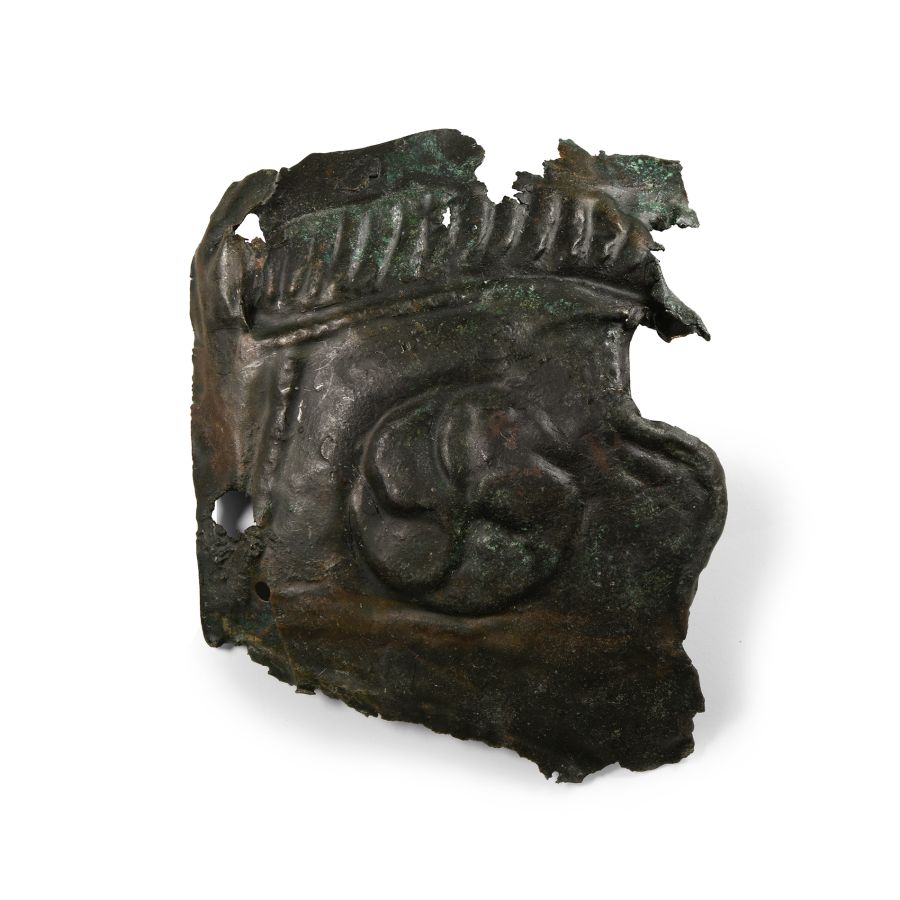
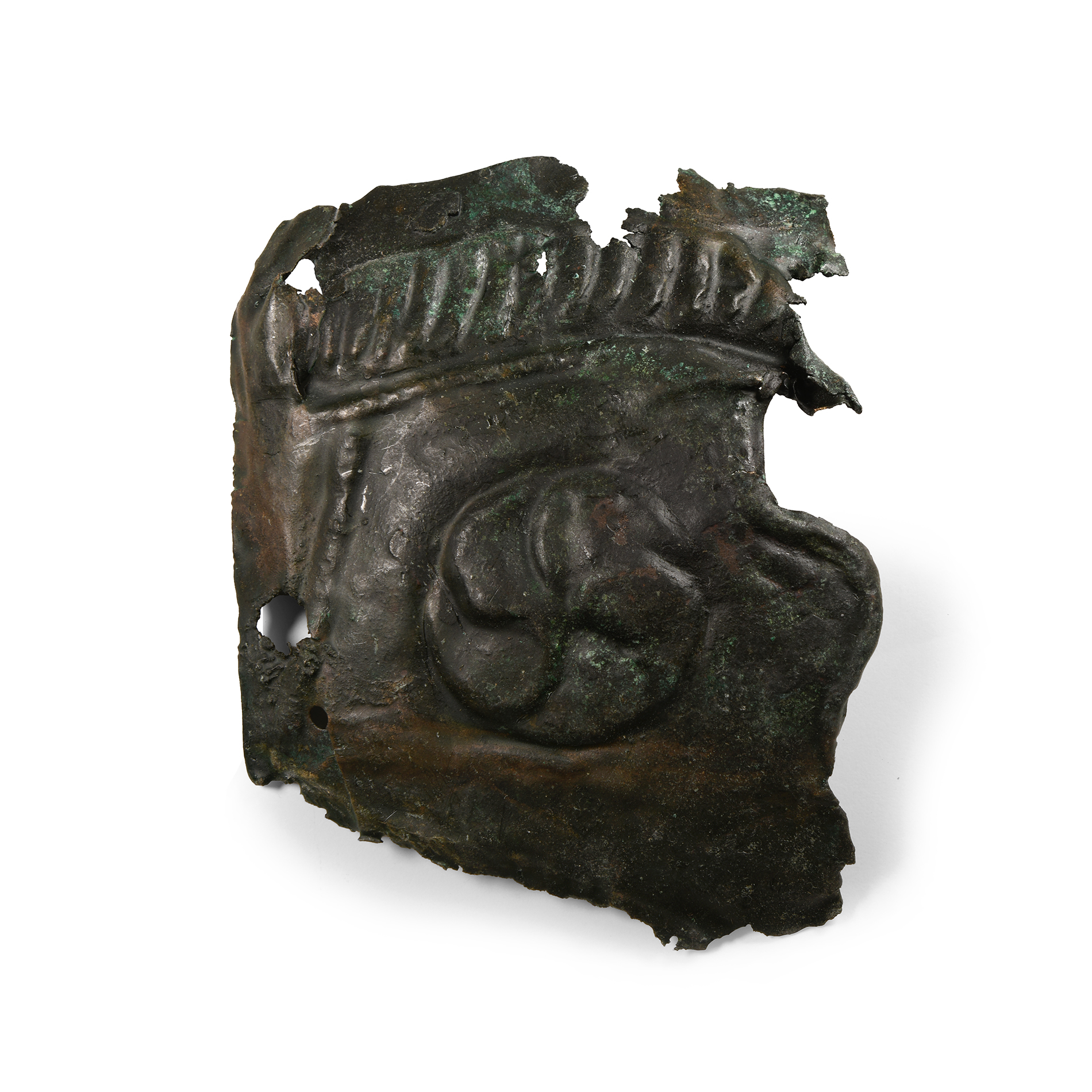
Roman Bronze Military Helmet Face Guard Section
3RD CENTURY A.D.
5 1/8 in. (75 grams, 13 cm high).
From the right side of the face mask, the upper edge with a band of embossed diagonal lines, probably intending to represent stylised hair, embossed spiral to the centre, a symbol clearly connected with the worship of the sun; a hole for the fastening thongs at ear-level which originally linked the face-guard to the bowl.
ProvenanceAcquired 1960s-1990s.
Late Alison Barker collection, a retired London barrister.
See Robinson, R., The Armour of Imperial Rome, New York, 1975; Garbsch, J., Römische Paraderustüngen, München, 1979; Born, H., Junkelmann, M., Römische Kampf-und Turnierrüstungen, Band VI, Sammlung Axel Guttmann, Mainz, 1997; D'Amato R., Negin, A.,Decorated Roman Armour, London, 2017.
FootnotesThe spiral decoration of the face-guard is connected with the solar cult. The spiral represents the rotary movement of the sun, and the spiral is probably the oldest known spiritual symbol connected with the sun, together with the swastika or tetragammadion. The connection can also be seen in Celtic art, where the representation of the spiral also follows the path of the sun, describing the movements of the heavenly body over the course of a solar year. The third century was characterised by diffusion of the solar cult, the Sol Invictus, among the Roman soldiers, with its symbols often represented on arms and weapons as an apotropaic element of protection.
CONDITIONTimeLine Auctions follows a vetting process to ensure the authenticity and legality of all items, reinforcing our commitment to integrity and responsible trading. Each antiquity, antique, and coin lot undergoes thorough examination by a vetting committee of at least ten external specialists, professional trade association members, scientists, and archaeologists: Our Vetting Process
AUCTIONS:
TimeLine is a leading auction house specialising in antiquities, ancient art, collectables, natural history, coins, medals, and books. Our auctions offer museums, collectors, historians, and enthusiasts the opportunity to acquire unique and historically significant pieces.
-
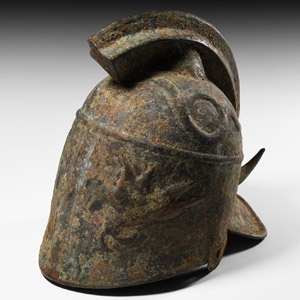
Greek Style Bronze Helmet
20th century A.D.Sold for (Inc. bp): £130
Featuring hammered helmet detailing together with mythical creatures and coiled snakes. 1.5 kg, 30.5 cm high
Acquired 1990s-early 2000s. East Anglian private collection.
The helmet is modelled upon the pseudo-Corinthian models of antiquity. The gryphon represented refers to the wars between these mythological creatures and the Arimaspes. -
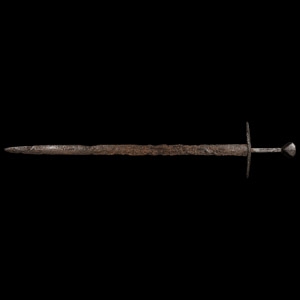
Medieval Iron Hand-And-A-Half Sword
Circa 14th-15th century A.D.Sold for (Inc. bp): £1,820
Of Oakeshott type XVIIIa or b with a strongly tapering blade of flattened diamond-section without fullers; the lower guard gently curving towards the blade, long grip; pommel of style T1 in the form of a truncated wedge. 1.35 kg, 1.07 m
Acquired 1971-1972. From the collection of the vendor's father. Property of a London, UK, collector. Accompanied by an academic report by Dr Raffaele D'Amato. This lot has been checked against the Interpol Database of stolen works of art and is accompanied by searcher certificate number no.11759-202773. -
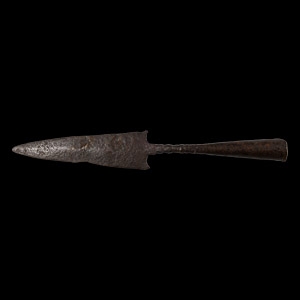
Ummayad Bronze Spearhead
7th-8th century A.D.Estimate: £300 - 400 (+bp*)
Opening Bid: £133
Formed with a broadly triangular blade, narrow neck and tapering round-section socket. 245 grams, 34 cm
Ex old English collection. The Kusmirek Collection, UK.
The basic Arabic term for a spear or lance, whether used by cavalry or infantry, was rumh. In the 7th century it normally would have been ten or twelve cubits long, i.e. four and a half metres.
