
Loading, please wait...
_900x900.jpg "Roman Bronze Military Belt Mount Group")
_200x200.jpg "Roman Bronze Military Belt Mount Group")
.jpg "Roman Bronze Military Belt Mount Group")
LOT 0678
Roman Bronze Military Belt Mount Group
CIRCA 2ND-3RD CENTURY A.D.
1 1/4 - 1 3/8 in. (12.2 grams total, 31-34 mm).
Group of three rectangular mounts each with a beaded border and low-relief motif. [3, No Reserve]
ProvenanceProperty of the vendor's grandfather, thence by family descent, circa 1985.
From the private collection of a New York, USA gentleman.
TimeLine Auctions follows a vetting process to ensure the authenticity and legality of all items, reinforcing our commitment to integrity and responsible trading. Each antiquity, antique, and coin lot undergoes thorough examination by a vetting committee of at least ten external specialists, professional trade association members, scientists, and archaeologists: Our Vetting Process
AUCTIONS:
TimeLine is a leading auction house specialising in antiquities, ancient art, collectables, natural history, coins, medals, and books. Our auctions offer museums, collectors, historians, and enthusiasts the opportunity to acquire unique and historically significant pieces.
-
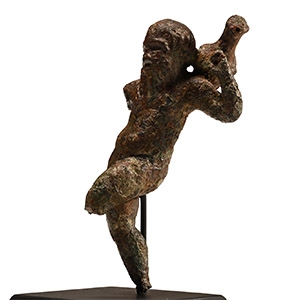
Roman Bronze Drunken Silenus Statuette
1st century B.C.-2nd century A.D.Sold for (Inc. bp): £260
Modelled nude supporting an amphora of wine on his left shoulder, holding the loop handle in his left hand; the right leg raised stepping forward; mounted on a custom-made stand. 201 grams total, 10.4 cm including stand
From a collection acquired on the UK art market from various auction houses and collections mostly before 2000. From an important Cambridgeshire estate; thence by descent. -
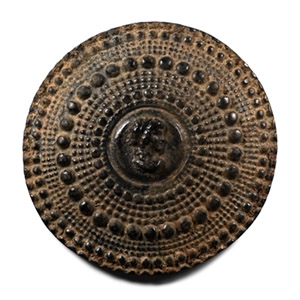
Roman Bronze Military Roundel
1st-3rd century A.D.Sold for (Inc. bp): £1,105
Domed phalera with field of radiating bosses in varying sizes, central tondo with profile female bust; four attachment points to the reverse. 120 grams, 77 mm
Acquired in the mid 1980s-1990s. Private collection, Switzerland, thence by descent. Private collection, since the late 1990s. -
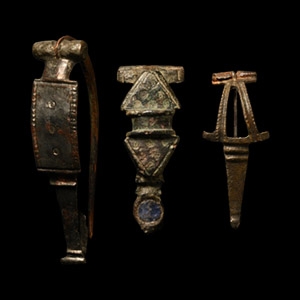
Roman Bronze Brooch Collection
2nd-3rd century A.D.Sold for (Inc. bp): £195
Including T-shaped, aucissa and other types; all complete with pins. 13 grams total, 35-50 mm
Property of the vendor's grandfather, thence by family descent, circa 1985. From the private collection of a New York, USA gentleman.
