
Loading, please wait...
LOT 0813
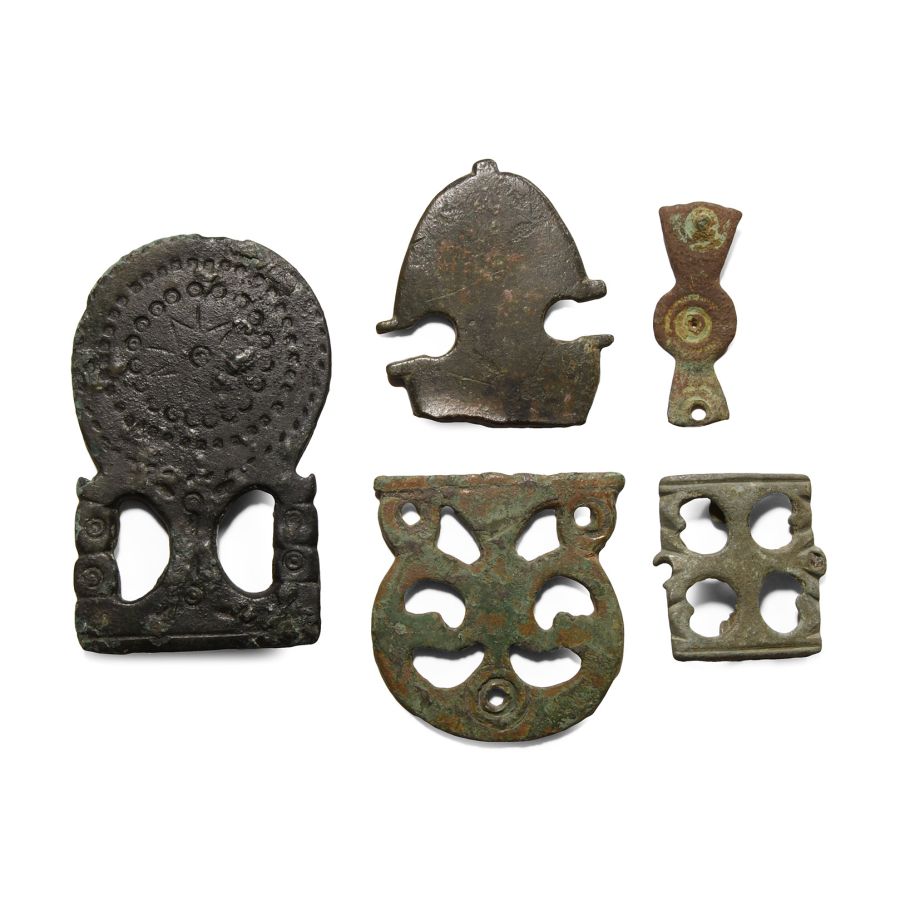
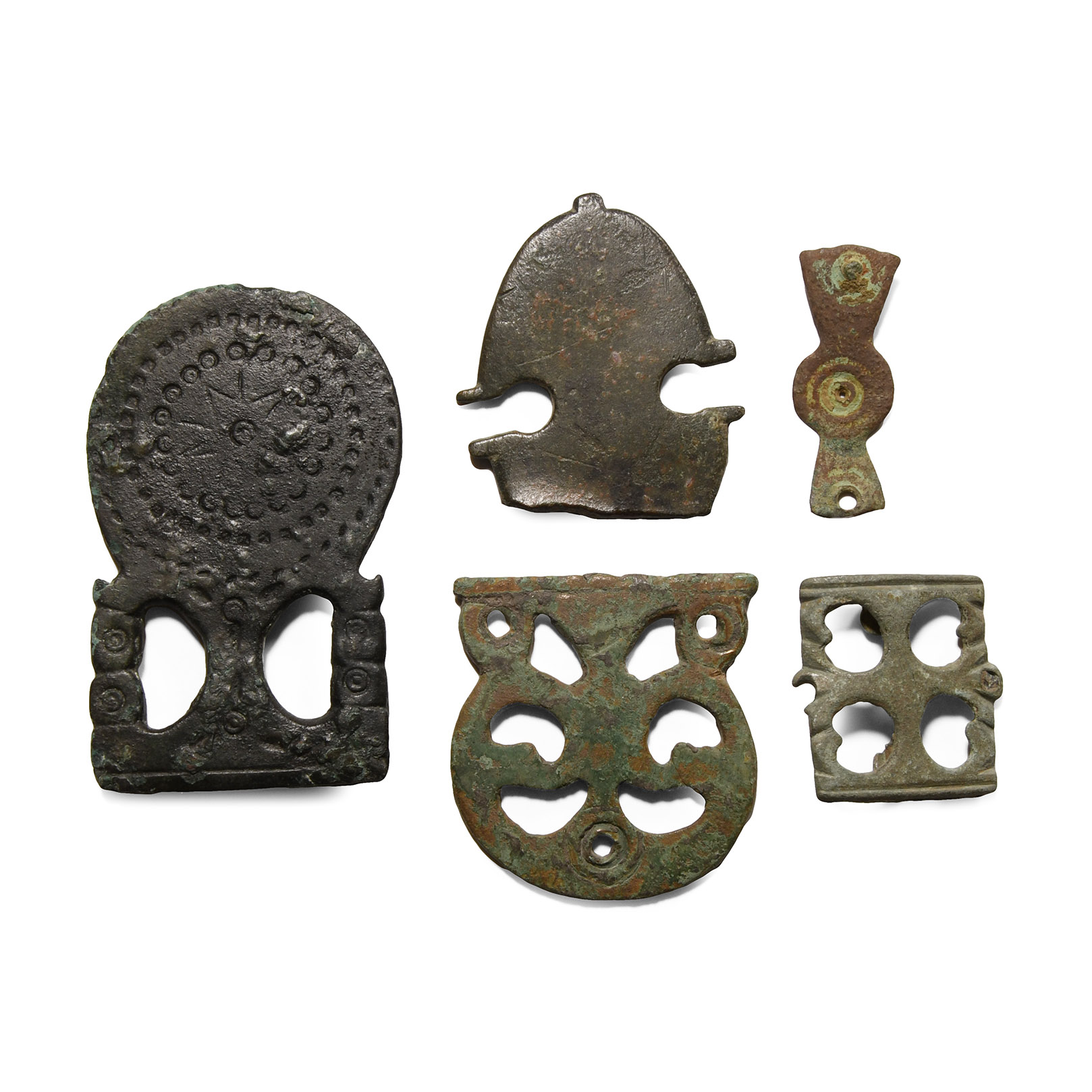
Roman Bronze Military Belt Mount Collection
4TH-5TH CENTURY A.D.
1 1/8- 2 1/2 in. (75 grams total, 29-66 mm).
Comprising: an amphora-shaped strap end decorated with rings and dots, the centre ornamented by a star surrounded by small dots and circles; a shield-shaped strap end, with a concave crescent on each side; an openwork decorated fitting with a kidney shaped motif in each quarter; a shield-shaped decorated strap end, with kidney-shaped openwork design; and a propeller shaped mount. [5, No Reserve]
ProvenanceFrom the collection of the famous author, writer and speaker, Gordon Bailey, Essex, UK; formed since 1968.
PublishedBailey, G., Detector Finds 7, Witham, 2011, pp.67 and 70, fig.1; Detector Finds 6, pp.41,54, for all items except the belt propeller.
LiteratureCf. Bailey, G., Detector Finds 6, fig.C11.7, for a similar belt propeller.
FootnotesIn Britain like in all of the West, all the elements intended for the embellishment of belts and harnesses also evolved towards new forms, the geometry of which bears witness to strong Germanic influences. Beside the typical propeller stiffener belts (Richborough), probably of Danubian origin, we have less ornate wide-belt types, represented by the Winchester example. Belt-plaques of triangular shape, often gilded, beast-shaped at the extremity, were excavated in the south of Britain (Cirencester). Rigid belt-plates with the buckle shaped like a dolphin came from Richborough, Wye and Sleaford (class 3, type B, Sommer), Tripontium, Mucking, Wycombe, Alwalton (type I-B, Hawkes, also in Richborough) and type Mainz, Savgar, Totanés (Colchester, often with associated propeller stiffeners). Type Hawkes I-A and I-B present similarities with the Simancas typologies, found in Lankhills. The type Tirig is attested at Lydney Park, the Böhme A in Richborough. Strap ends are usually heart-shaped or amphora-shaped (Richborough). These belt fittings were characteristic of the Roman army in Britain at the beginning of the 5th century.
CONDITIONTimeLine Auctions follows a vetting process to ensure the authenticity and legality of all items, reinforcing our commitment to integrity and responsible trading. Each antiquity, antique, and coin lot undergoes thorough examination by a vetting committee of at least ten external specialists, professional trade association members, scientists, and archaeologists: Our Vetting Process
AUCTIONS:
TimeLine is a leading auction house specialising in antiquities, ancient art, collectables, natural history, coins, medals, and books. Our auctions offer museums, collectors, historians, and enthusiasts the opportunity to acquire unique and historically significant pieces.
-
Roman Bronze Ring Bezel Group
1st century B.C.-1st century A.D.Sold for (Inc. bp): £46
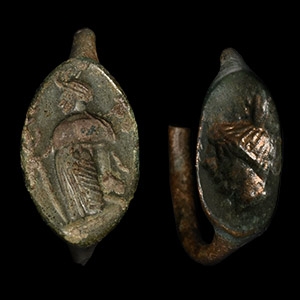
Comprising: vesica-shaped bezel with incise togate standing figure with sceptre; ellipsoid bezel with profile bust. 4.51 grams total, 20-21 mm
Property of the vendor's grandfather, thence by family descent, circa 1985. From the private collection of a New York, USA gentleman. -
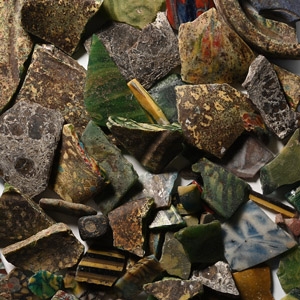
Roman Mosaic Glass Fragment Collection
1st century B.C.-1st century A.D.Sold for (Inc. bp): £169
Comprising fragments from various different types of vessels, mostly polychrome mosaic glass, and examples with trails. 137 grams total, 7-60 mm
From the collection of Mr N.A., Brussels, 1970s. -
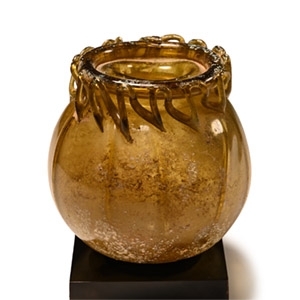
Roman Translucent Glass Jar with Gallery
3rd-4th century A.D.Sold for (Inc. bp): £546
Globular in profile with wide double-stepped rolled rim, applied wavy line trails forming a gallery from rim to body, pinched diagonal ribs to outer face and dimple to the underside; supplied with a custom-made stand. 46 grams, 74 mm wide (125 grams, 85 mm high including stand)
From the glass collection of a London gentleman, UK, 1990s.
