
Loading, please wait...
LOT 0136
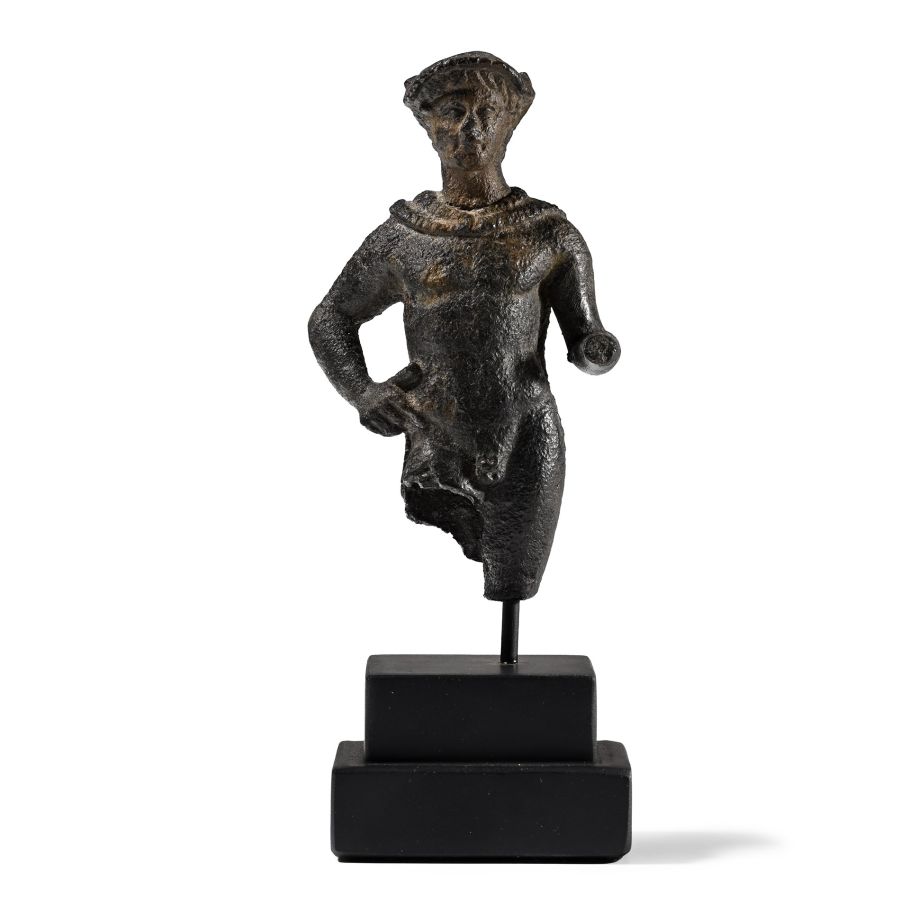
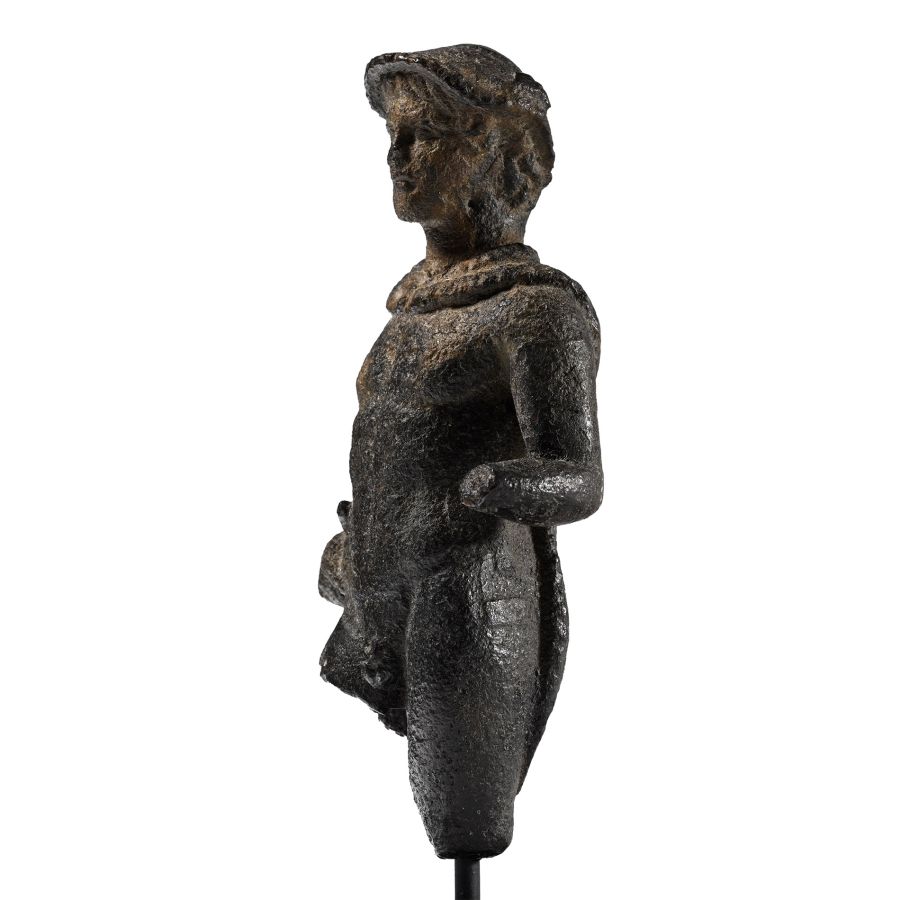
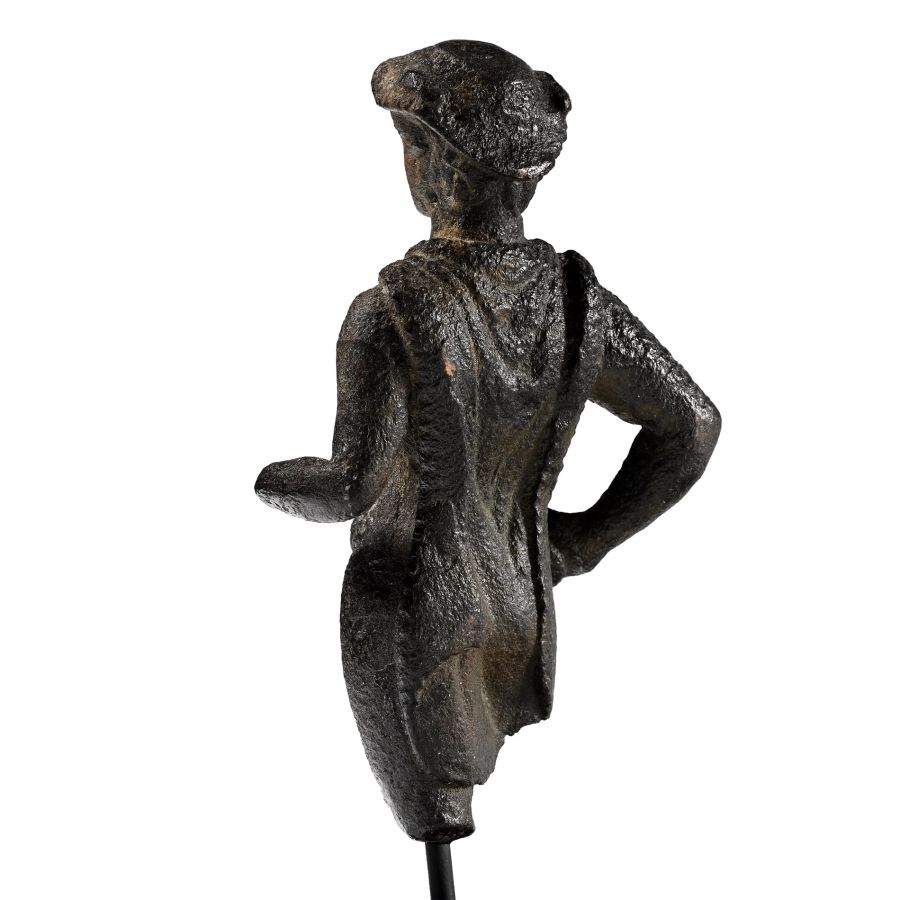
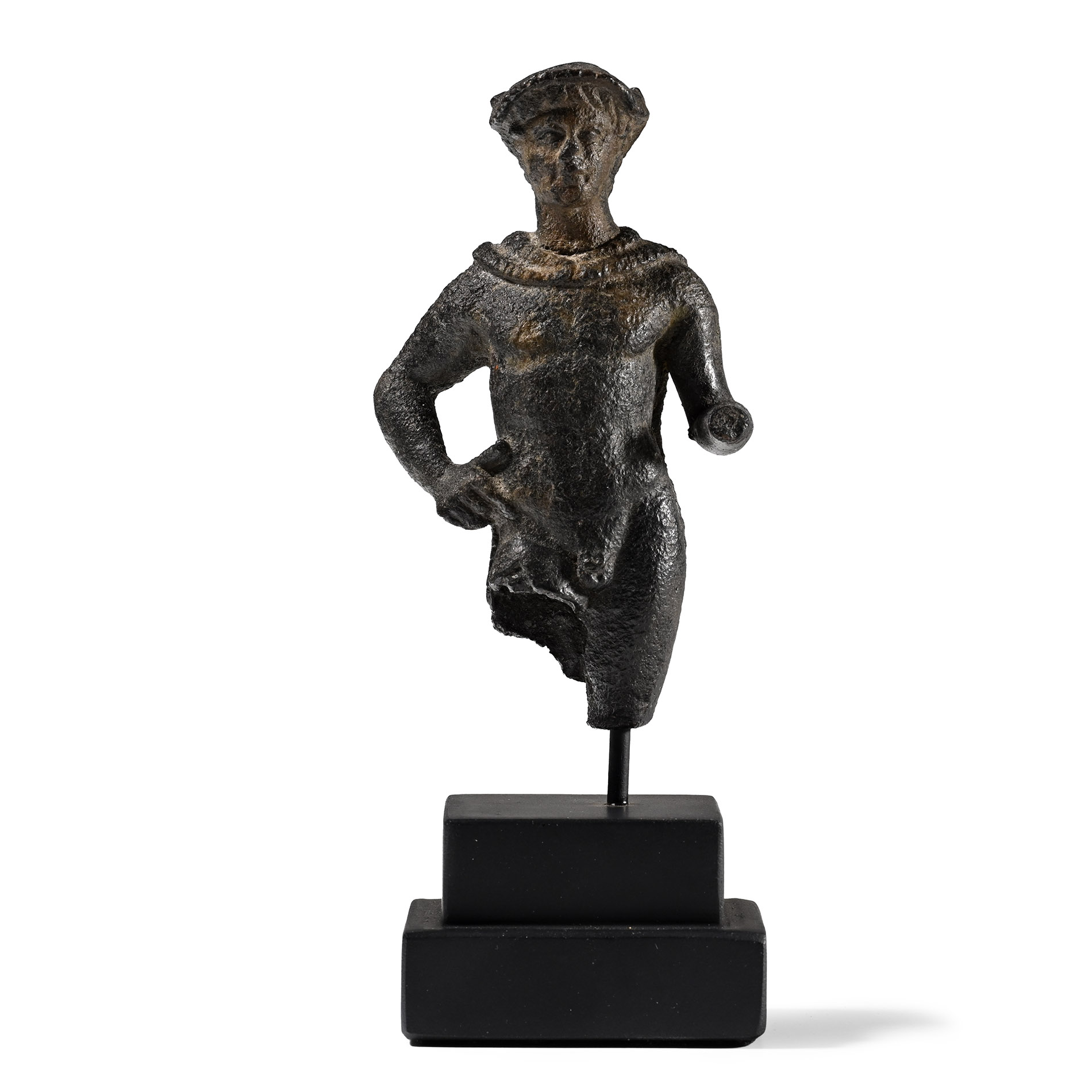
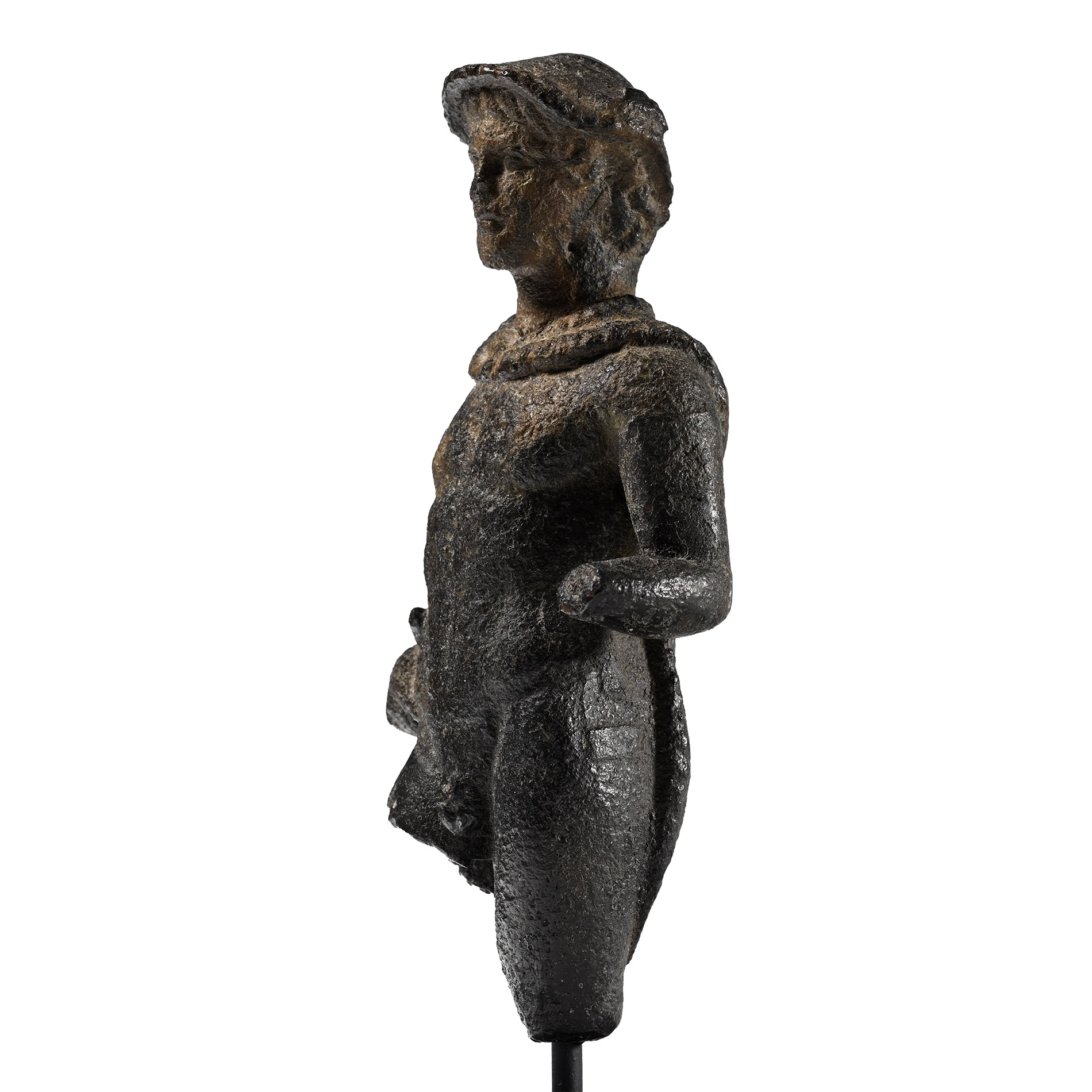
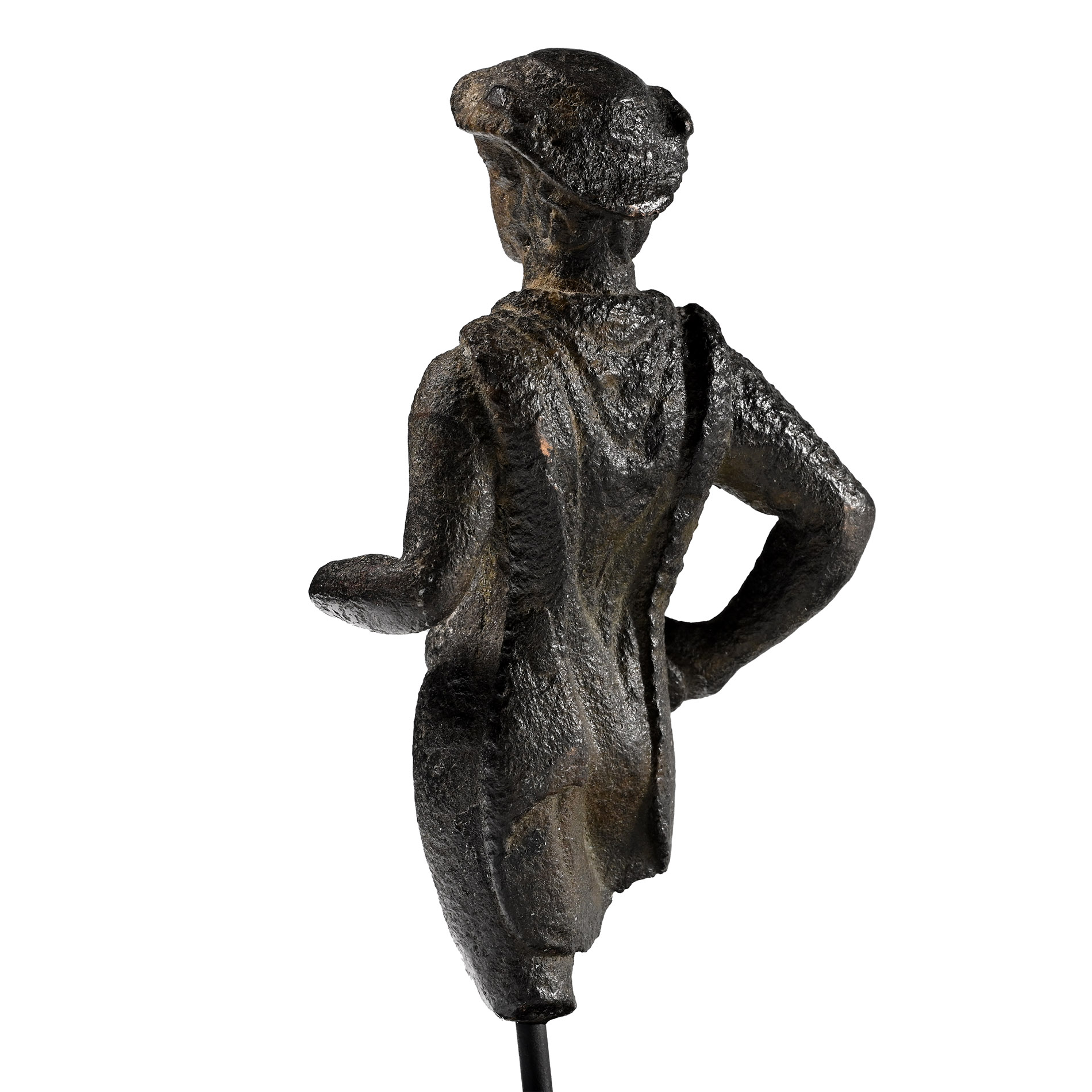
Roman Bronze Mercury Statuette
1ST CENTURY A.D.
6 3/4 in. (778 grams total, 17.2 cm including stand).
The figure standing nude with right hand pressed against the hip, left arm bent and forearm extended; narrow chlamys worn across the shoulders and down the back terminating at the rear of the knees; the facial features modelled in some detail with slight oversized eyes, perhaps to accept a silver inlay; petasos to the head with vestigial lateral wings; mounted on a custom-made stand. [No Reserve]
ProvenanceAcquired from Simon Shipp, circa 1997.
Believed to be published in an old Den of Antiquity catalogue.
From an important Cambridgeshire estate; thence by descent.
Cf. Boucher, S. & Tassinari, S., Musée de la Civilisation Gallo-Romaine a Lyon: Bronzes Antiques I. Inscriptions, Statuaire, Vaisselle Lyon, 1976, items 47, 50, for type.
CONDITIONTimeLine Auctions follows a vetting process to ensure the authenticity and legality of all items, reinforcing our commitment to integrity and responsible trading. Each antiquity, antique, and coin lot undergoes thorough examination by a vetting committee of at least ten external specialists, professional trade association members, scientists, and archaeologists: Our Vetting Process
AUCTIONS:
TimeLine is a leading auction house specialising in antiquities, ancient art, collectables, natural history, coins, medals, and books. Our auctions offer museums, collectors, historians, and enthusiasts the opportunity to acquire unique and historically significant pieces.
-

Roman Mixed Artefact Group
1st-3rd century A.D.Sold for (Inc. bp): £104
Comprising a lunar pendant with incised linear ornament and suspension loop; votive foot; coin of Claudius; coin of Maximian, London mint; tweezers with simple linear ornament; remains of an equal-arm brooch; lid from a seal box; discoid stud; remains of an implement; bezel and shoulders from a finger ring; stamped lead bar, possibly reading 'IOVIA' 'MARIN'(?). 60 grams total, 18-50 mm
Acquired on the UK market, 1990s. Property of a retired academic. -
Roman Glass Bracelet Group
3rd-4th century A.D.Sold for (Inc. bp): £91
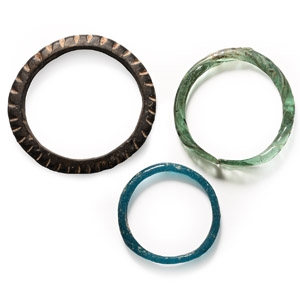
Comprising: a turquoise D-section bangle with a flattened panel to the upper face; an opaque round-section twisted bracelet with flattened terminals; a dark brown ceramic(?) keeled bangle with notched edges. 31.18 grams total, 50-70 mm
Collected from 1970-1999. From the collection of the late Mr S.M., London, UK. -
Roman Bronze Military Belt Mount Collection
4th-5th century A.D.Sold for (Inc. bp): £85
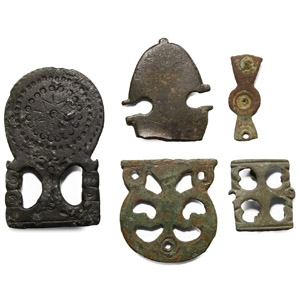
Comprising: an amphora-shaped strap end decorated with rings and dots, the centre ornamented by a star surrounded by small dots and circles; a shield-shaped strap end, with a concave crescent on each side; an openwork decorated fitting with a kidney shaped motif in each quarter; a shield-shaped decorated strap end, with kidney-shaped openwork design; and a propeller shaped mount. 75 grams total, 29-66 mm
From the collection of the famous author, writer and speaker, Gordon Bailey, Essex, UK; formed since 1968.
In Britain like in all of the West, all the elements intended for the embellishment of belts and harnesses also evolved towards new forms, the geometry of which bears witness to strong Germanic influences. Beside the typical propeller stiffener belts (Richborough), probably of Danubian origin, we have less ornate wide-belt types, represented by the Winchester example. Belt-plaques of triangular shape, often gilded, beast-shaped at the extremity, were excavated in the south of Britain (Cirencester). Rigid belt-plates with the buckle shaped like a dolphin came from Richborough, Wye and Sleaford (class 3, type B, Sommer), Tripontium, Mucking, Wycombe, Alwalton (type I-B, Hawkes, also in Richborough) and type Mainz, Savgar, Totanés (Colchester, often with associated propeller stiffeners). Type Hawkes I-A and I-B present similarities with the Simancas typologies, found in Lankhills. The type Tirig is attested at Lydney Park, the Böhme A in Richborough. Strap ends are usually heart-shaped or amphora-shaped (Richborough). These belt fittings were characteristic of the Roman army in Britain at the beginning of the 5th century.
