
Loading, please wait...
_900x900.jpg "Roman Bronze Mars Rider Statuette")
_200x200.jpg "Roman Bronze Mars Rider Statuette")
.jpg "Roman Bronze Mars Rider Statuette")
LOT 0889
Roman Bronze Mars Rider Statuette
2ND-3RD CENTURY A.D.
2 3/8 in. (35.6 grams, 60 mm).
Modelled in the round, nude male with legs in straddling pose, left hand thrust forward and right arm raised with hand open; head exaggerated with shoulder-length hair and crested helmet. [No Reserve]
ProvenanceFrom a collection acquired on the UK art market from various auction houses and collections mostly before 2000.
From an important Cambridgeshire estate; thence by descent.
Cf. Boucher, S., Recherches sur les Bronzes Figurés de Gaule Pré-Romaine et Romaine, Rome, 1976, item 354, for type; Mackintosh, M., The Divine Horseman in the Art of the Western Roman Empire,The Open University, 1991, fig.7, bronze rider from Brigstock.
FootnotesThe pseudo-Corinthian or Apulo-Corinthian helmet, here represented on the head of the divinity, was originally a legionary helmet, then became, in the Late Consular Age, an officer's helmet, then a typical attribute of military commanders and then of the war god, Mars. However, this statuette of Mars has strong Celtic connotations, as evidenced by the torques around the neck and the warrior god's hair.
CONDITIONTimeLine Auctions follows a vetting process to ensure the authenticity and legality of all items, reinforcing our commitment to integrity and responsible trading. Each antiquity, antique, and coin lot undergoes thorough examination by a vetting committee of at least ten external specialists, professional trade association members, scientists, and archaeologists: Our Vetting Process
AUCTIONS:
TimeLine is a leading auction house specialising in antiquities, ancient art, collectables, natural history, coins, medals, and books. Our auctions offer museums, collectors, historians, and enthusiasts the opportunity to acquire unique and historically significant pieces.
-
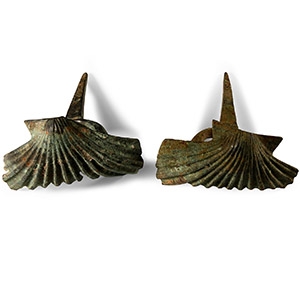
Roman Bronze Scallop Shell Attachment Pair
Circa 2nd-3rd century A.D.Estimate: £1,000 - 1,400 (+bp*)
Opening Bid: £535
Each composed of shell-shaped body with a D-shaped lug to reverse, the lug with tapering spike to the centre. 343 grams total, 12.5 cm each
Private collection, Rosenheim, Germany, 1960s.
This pair could have been used as a double key or door lock, based on comparison with some keys from the territory of Gaul (Boucher, 1971, pp.200-201). They comprised a strong ring with polygonal-section stem and a rectangular point. -
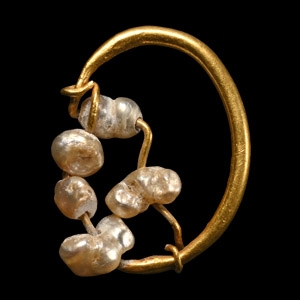
Roman Gold Earring with Pearls
3rd century A.D.Sold for (Inc. bp): £520
Gold wire hoop with hook-and-eye closure, threaded with seed pearls. 1.99 grams, 20 mm
Ex H. Norry collection, 1980s-1990s. -
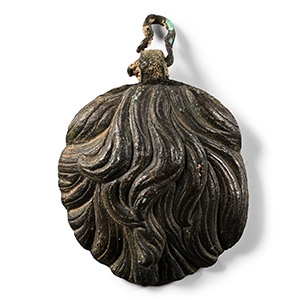
Roman Bronze Oil Lamp Lid
1st-2nd century A.D.Sold for (Inc. bp): £156
A domed lid with a loop to the edge; the upper face with intricate hair design showing voluminous, carefully rendered curls. 61 grams, 72 mm
From the collection of a gentleman, acquired on the London art market in the 1990s.
