
Loading, please wait...
LOT 0859
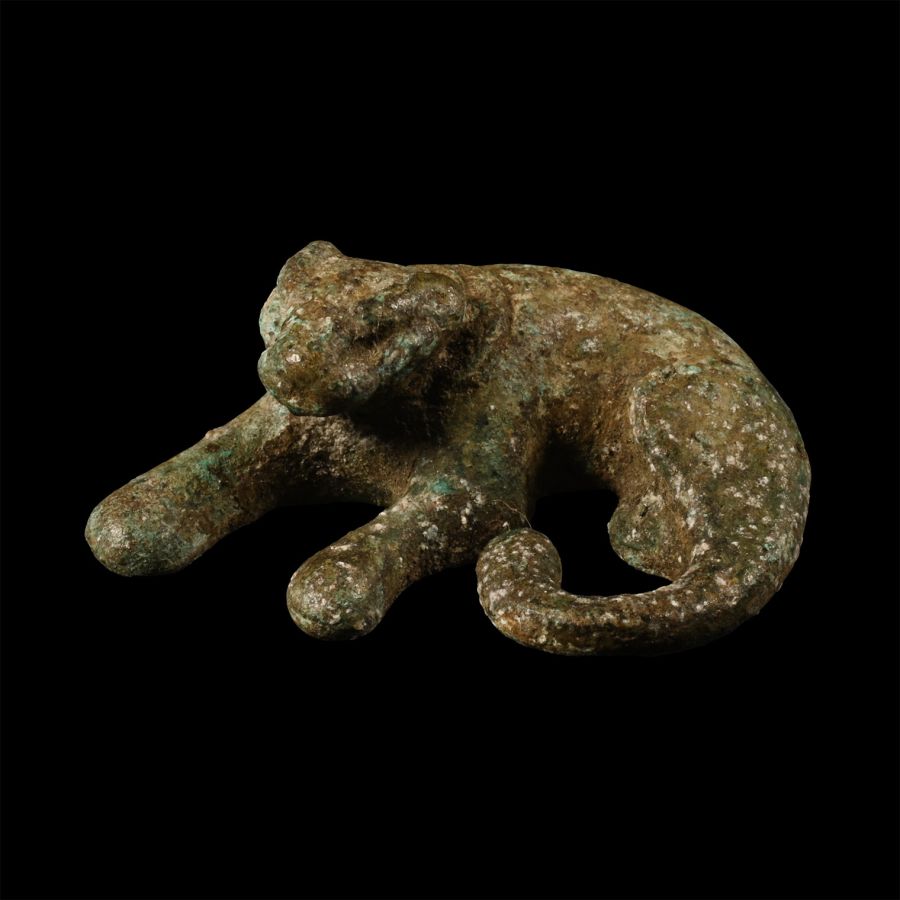
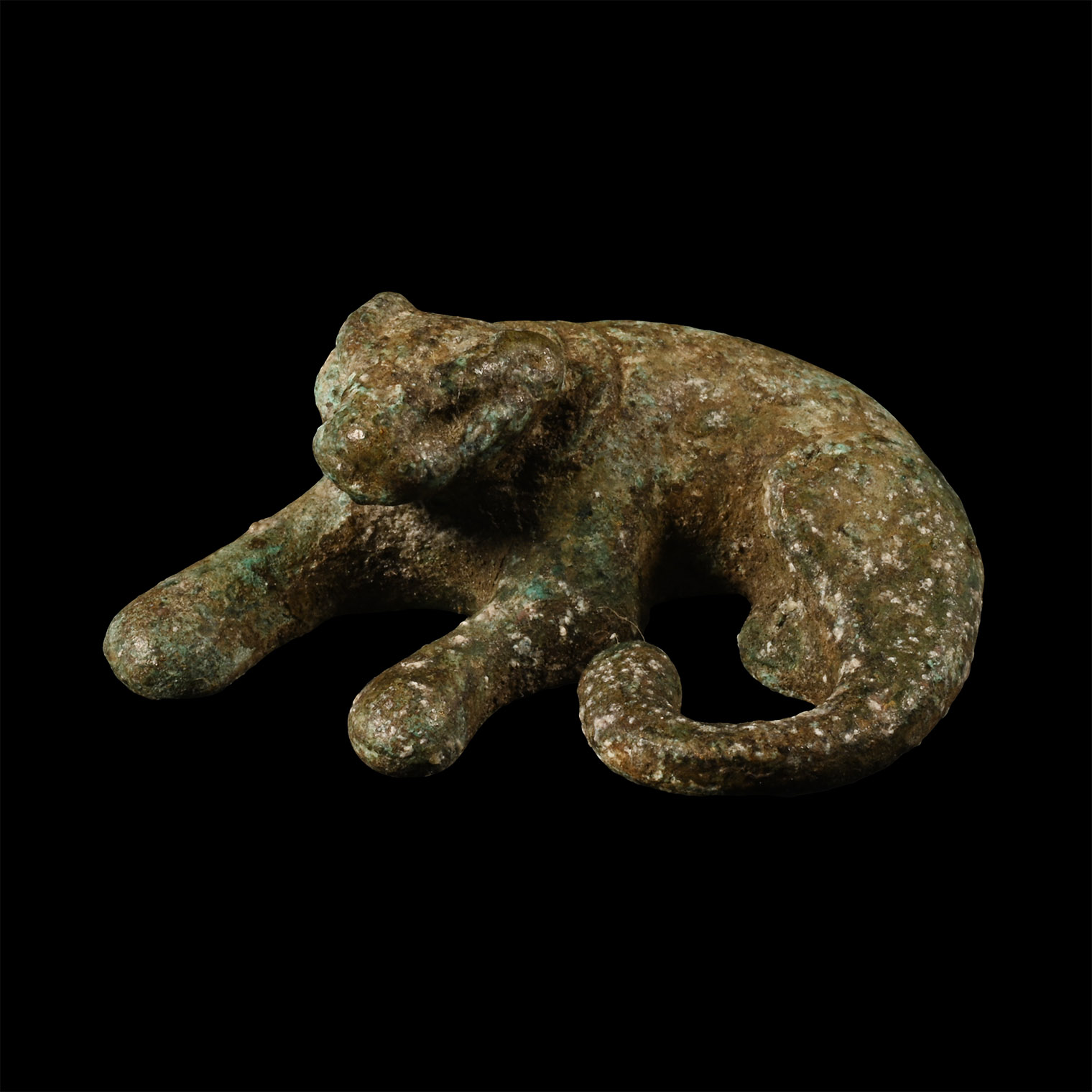
Roman Bronze Laying Panther Statuette
1ST-3RD CENTURY A.D.
1 1/2 in. (25 grams, 38 mm).
Modelled in the round laying flat on its side with forelegs extended; low-relief collar to the neck. [No Reserve]
ProvenanceFrom a collection acquired on the UK art market from various auction houses and collections mostly before 2000.
From an important Cambridgeshire estate; thence by descent.
Cf. Durham, E., Metal Figurines in Roman Britain, vol. 2, Reading, 2010, pl.297, for type.
FootnotesThe presence of the collar suggests that the model represents a panther used in the gladiatorial animal-fighting games.
CONDITIONTimeLine Auctions follows a vetting process to ensure the authenticity and legality of all items, reinforcing our commitment to integrity and responsible trading. Each antiquity, antique, and coin lot undergoes thorough examination by a vetting committee of at least ten external specialists, professional trade association members, scientists, and archaeologists: Our Vetting Process
AUCTIONS:
TimeLine is a leading auction house specialising in antiquities, ancient art, collectables, natural history, coins, medals, and books. Our auctions offer museums, collectors, historians, and enthusiasts the opportunity to acquire unique and historically significant pieces.
-
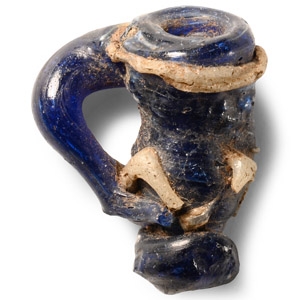
Miniature Roman Blue and White Glass Juglet
1st-4th century A.D.Sold for (Inc. bp): £117
Amulet formed with a tubular body and loop handle, applied white glass trail. 3.6 grams, 23 mm
Collected from 1969-1999. From the collection of the late Mr S.M., London, UK. -
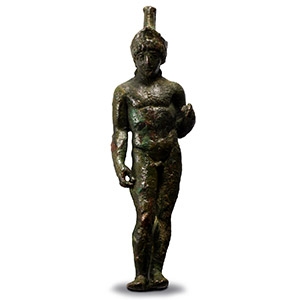
Roman Bronze Statue of Mars Gradivus
1st century B.C.-1st century A.D.Estimate: £4,000 - 6,000 (‡+bp*)
Opening Bid: £2,000
Modelled in the round as a young beardless warrior hero with muscular body and rounded shoulders; wearing a high-crested pseudo-Attic helmet with a diadem; the hair arranged in orderly locks over his brow; the bent left hand would originally have held a shield and the extended right hand a spear. 278 grams, 13.5 cm high
Ex collection of Dr Djafari (1900-1981), Kaiserslautern, Germany. Accompanied by an academic report by Dr Raffaele D'Amato. This lot has been checked against the Interpol Database of stolen works of art and is accompanied by search certificate number no.11812-206498.
This statue of Mars Gradivus, the marching god of war, was probably a cult offering. The statuette still presents an archaic Etruscan hairstyle, being part of the Italic statuettes of the god produced as votive offering to the temples or for private lararia. A Gallo-Roman period temple dedicated to the cult of Mars with a similar statuette has recently been found in Brittany. -
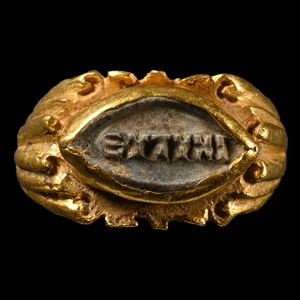
Roman Gold 'Good Fortune' Cameo Ring
3rd century A.D.Sold for (Inc. bp): £2,106
Composed of an angular hoop with sloping, fluted shoulders; raised lenticular bezel set with glass paste, raised Greek inscription 'EYTYKI', translating to 'good fortune', a wish for good luck for the bearer. 6.21 grams, 19.03 mm overall, 11.88 x 15.57 mm internal diameter (approximate size British D 1/2, USA 2, Europe 1.78, Japan 1)
From the late Alison Barker collection, 1970-1990. Accompanied by a previous catalogue information slip.
The ring belongs to the type III, variant 2 of the Ruseva-Slokoska classification. They are characterised by a flat band widening towards the trapezium-shaped oblique shoulders, cut to resemble leaves, shaped with vertical grooves and hatches at the extremities. The augural inscription 'EYTYKI' was usual in the augural rings, given for a donative or in occasion of the passage from puberty to adolescence.
