
Loading, please wait...
LOT 0791
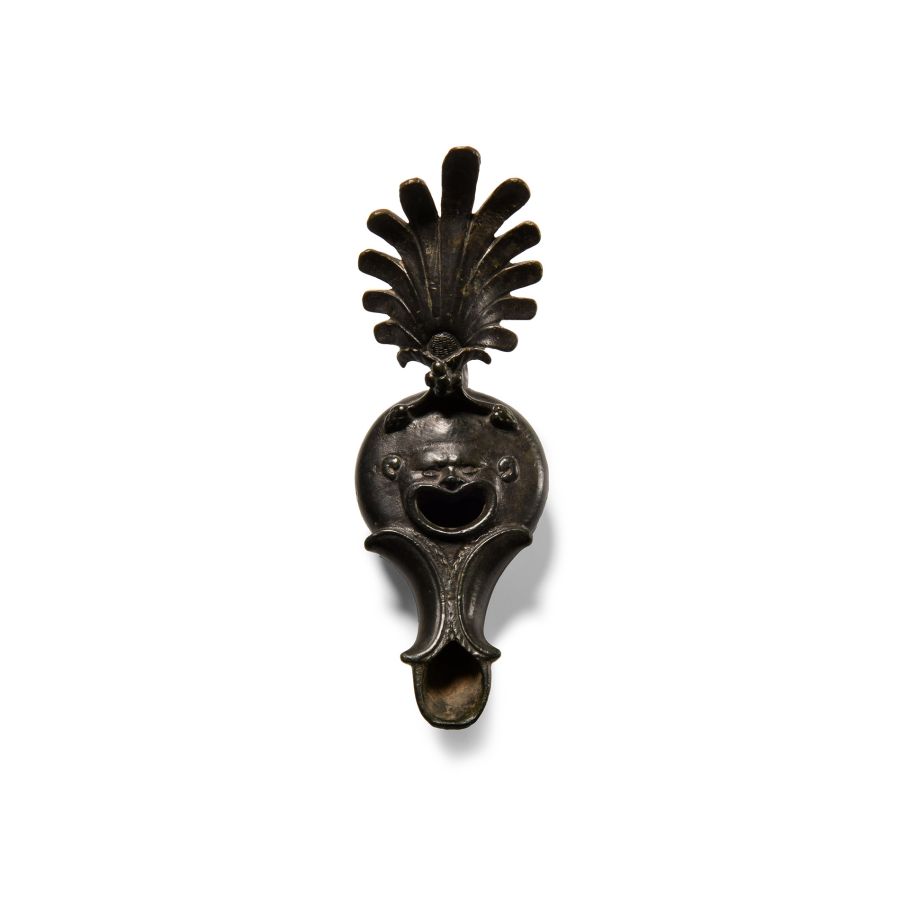
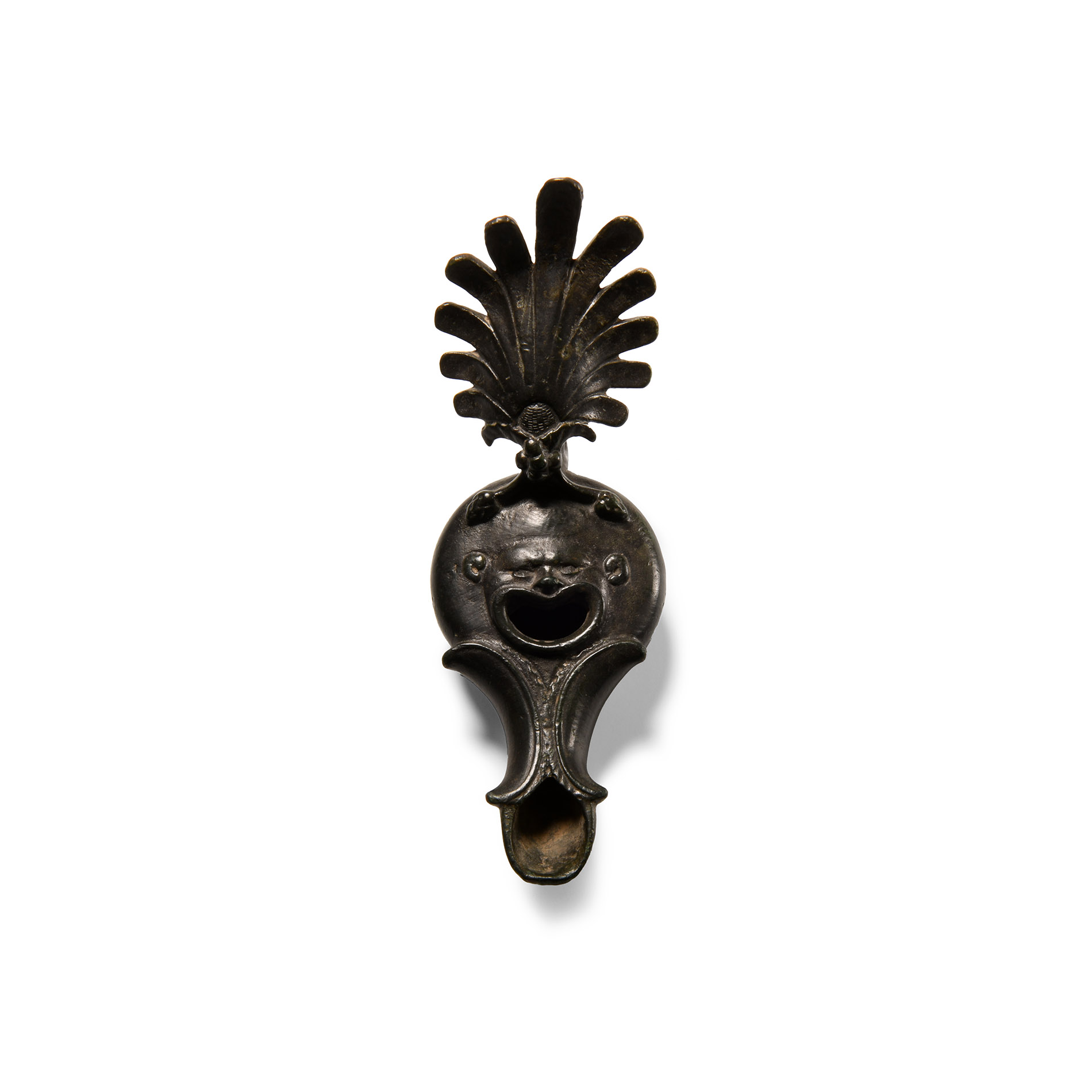
Roman Bronze Lamp with Theatrical Mask
1ST-2ND CENTURY A.D.
5 1/4 in. (220 grams, 13.3 cm).
Nozzle with quasi-volutes, theatrical mask surrounding the central opening; ring-handle with palmette attachment; base moulded.
ProvenanceAcquired from Weber, Kohl.
Ex private collection, Rhemish, Germany.
with Gorny & Mosch, 14 December 2010, lot 499.
Private collection, Europe.
This lot has been checked against the Interpol Database of stolen works of art and is accompanied by search certificate number no.11800-206492.
Cf. Walters, H.B., Catalogue of the Greek and Roman lamps in the British Museum, London, 1914, no.1468, for the type.
FootnotesThe principal parts of a lamp were the body or reservoir which contained the oil (infundibulum); the flat circular top (discus) on which the design, if any, was placed, sometimes with an ornamented rim (margo), the nozzle, with a hole for the insertion of the wick (rostrum, nasus, myxus), the wick, known as ellydinium, the handle (ansa, manubrium).
CONDITIONTimeLine Auctions follows a vetting process to ensure the authenticity and legality of all items, reinforcing our commitment to integrity and responsible trading. Each antiquity, antique, and coin lot undergoes thorough examination by a vetting committee of at least ten external specialists, professional trade association members, scientists, and archaeologists: Our Vetting Process
AUCTIONS:
TimeLine is a leading auction house specialising in antiquities, ancient art, collectables, natural history, coins, medals, and books. Our auctions offer museums, collectors, historians, and enthusiasts the opportunity to acquire unique and historically significant pieces.
LOT 0791
Roman Bronze Lamp with Theatrical Mask
Estimate £2,500 - 3,500€2,900 - 4,060 (for guidance only)$3,380 - 4,730 (for guidance only)
-
.jpg)
Roman Yellow Glass Flask
Circa 3rd-4th century A.D.Estimate: £1,800 - 2,400 (+bp*)
Opening Bid: £1,000
Mould-blown from translucent glass, the globular body on a circular flat base tapering at the shoulders to a cylindrical neck with an everted rim; a single applied handle; the body decorated with a horizontal band of a continuous Vitruvian wave framed by a double circumferential line, decorative ridges above and below; accompanied by a custom-made display stand. 16.7 grams, 66 mm (33.9 grams total, 79.4 mm high including stand)
From the property of the late Mr SM, London, UK, 1948-2000. Ex J.L. collection Surrey, UK.
The pitcher belongs to a late Roman group decorated with granulated circles forming like volutes. The shape of these globular pitchers is well known since the 1st-2nd century A.D., with the rim folded up and the handle applied to the shoulders, but the decoration is more typical of a later age. -
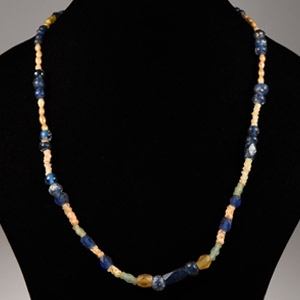
Roman Glass Bead Necklace
1st-4th century A.D.Sold for (Inc. bp): £338
Restrung group of bicones, faceted glass, oblates and rounded glass beads in various colours some with frosted surfaces. 42 grams, 69 cm long
with a London, UK gallery 1971. -
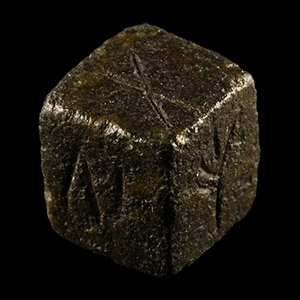
Romano-British Bronze Military 'Caister Fort' Gaming Dice with Mystical Symbols
Circa 1st century A.D.Sold for (Inc. bp): £546
Cuboid die with five sides bearing incised symbols: ring-and-dot (or theta Θ), 'IV' (for 'four'), saltire (or 'X' for 'ten'), frond with four spurs to each side, similar with one spur to each side. 4.5 grams, 8.7 mm
Found by the Roman fort at Caister, east of Norwich, Norfolk, UK, prior to 1998. Acquired from Richard Gladdle, 9th June 1998. From the important private collection of dice and gaming pieces of Colin Narbeth, London, UK, collection no.42. Accompanied by a Colin Narbeth catalogue identification card. Accompanied by a copy of the relevant Celtic & Roman Artefacts book pages where this object is published.
The conventional Roman dice were made in bone or lead, with dots representing numbers from 1 to 6. Roman dice from the Romano-British settlements are often poorly made and often had opposite sides that do not add up to 7. This dice is unique in the panorama of the Romano-British dice, because the symbols probably represent an alternative to the simple numerical dimples which appear on most dices.
