
Loading, please wait...
_900x900.jpg "Roman Bronze Jupiter Dolichenus Statuette")
_200x200.jpg "Roman Bronze Jupiter Dolichenus Statuette")
.jpg "Roman Bronze Jupiter Dolichenus Statuette")
LOT 0700
Roman Bronze Jupiter Dolichenus Statuette
CIRCA 2ND CENTURY A.D.
2 1/2 in. (36 grams, 62 mm).
Modelled in the round standing wearing a crested helmet, muscle-cuirass with tunic beneath, short pteruges and greaves; left hand raised to hold a spear, right hand with gladius resting on the forearm. [No Reserve]
ProvenanceFrom a collection acquired on the UK art market from various auction houses and collections mostly before 2000.
From an important Cambridgeshire estate; thence by descent.
Cf. for similar examples Beutler, F. et al., Der Adler Roms. Carnuntum und die Armee der Cäsaren, Bad-Deutsch-Altenburg, 2017, item 65;
for the Jupiter Dolichenus cult see Kusseven, P., The Cult of Iupiter Dolichenus: origins and iconography, Ankara, 2007, p.120, fig.B15.
The cult of Jupiter Dolichenus was a variant of worship of Zeus from Asia Minor whose mystery cult was widespread in the Roman Empire from the early 2nd to mid-3rd centuries A.D., especially in the military. The god is usually represented mounting a bull, with the double axe (labrys or bipennis) in his right raised hand, and dressed in the military attire of a Roman general.
CONDITIONTimeLine Auctions follows a vetting process to ensure the authenticity and legality of all items, reinforcing our commitment to integrity and responsible trading. Each antiquity, antique, and coin lot undergoes thorough examination by a vetting committee of at least ten external specialists, professional trade association members, scientists, and archaeologists: Our Vetting Process
AUCTIONS:
TimeLine is a leading auction house specialising in antiquities, ancient art, collectables, natural history, coins, medals, and books. Our auctions offer museums, collectors, historians, and enthusiasts the opportunity to acquire unique and historically significant pieces.
-
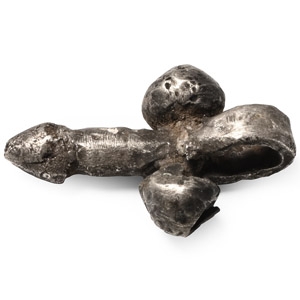
Roman Silver Phallic Pendant
1st-3rd century A.D.Sold for (Inc. bp): £117
Comprising a slender body with lateral testes, suspension loop behind. 4.44 grams, 23 mm
Ex German art market, 2000s. Acquired from an EU collector living in London. From the collection of Surrey, UK, gentleman. -
.jpg)
Roman 'British' Ring Gemstone with Portrait
Circa 2nd century A.D.Sold for (Inc. bp): £46
Ellipsoid glass insert with profile portrait bust to one face. 2.11 grams, 14 mm
Found UK. From the collection of C. Sullivan, UK, 1990s.
The same portrait appears on 'horse and rider' plate brooches. -
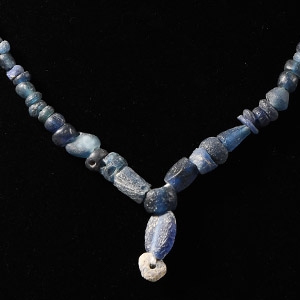
Roman Blue Glass Bead Necklace String
1st-4th century A.D. and laterSold for (Inc. bp): £26
Restrung designer necklace of graduated annular and tubular beads with a milky blue oval pendant. 15.07 grams, 38 cm
Acquired 1980-2015. Ex Abelita family collection.
