
Loading, please wait...
_900x900.jpg "Roman Bronze Jupiter Dolichenus Eagle on the Head of a Stag")
_200x200.jpg "Roman Bronze Jupiter Dolichenus Eagle on the Head of a Stag")
_900x900.jpg "Roman Bronze Jupiter Dolichenus Eagle on the Head of a Stag")
_200x200.jpg "Roman Bronze Jupiter Dolichenus Eagle on the Head of a Stag")
_900x900.jpg "Roman Bronze Jupiter Dolichenus Eagle on the Head of a Stag")
_200x200.jpg "Roman Bronze Jupiter Dolichenus Eagle on the Head of a Stag")
.jpg "Roman Bronze Jupiter Dolichenus Eagle on the Head of a Stag")
.jpg "Roman Bronze Jupiter Dolichenus Eagle on the Head of a Stag")
.jpg "Roman Bronze Jupiter Dolichenus Eagle on the Head of a Stag")
LOT 0173
Roman Bronze Jupiter Dolichenus Eagle on the Head of a Stag
2ND CENTURY A.D.
3 7/8 in. (5 7/8 in.) (544 grams, 97 mm (621 grams total, 15 cm high including stand)).
The eagle modelled in the round standing on top of a large head of a stag with curving antlers touching the bird's wings, the eagle with its legs held apart and its long talons spread across the head, the wings slightly raised and the head turned to the right whilst gazing down towards the stag; detailed plumage; accompanied by a custom-made display stand.
ProvenanceAcquired in 1997 from a Canadian dealership.
From a North American gentleman's collection.
This lot has been cleared against the Art Loss Register database, and is accompanied by an illustrated lot declaration signed by the Head of the Antiquities Department, Dr Raffaele D'Amato.
Cf. statuette in bronze of the same typology in Getty Museum, inventory no. 78.AC.336.
FootnotesThe motif of an eagle and a stag or a deer is typically associated with the God Jupiter/Zeus Dolichenus and his wife Juno Dolichena, name derived from his sanctuary in Doliche, Anatolia. Jupiter Dolichenus was a soldier god, usually portrayed wearing full military attire and standing on a bull, while his consort would have been shown standing on a deer or stag.
CONDITIONTimeLine Auctions follows a vetting process to ensure the authenticity and legality of all items, reinforcing our commitment to integrity and responsible trading. Each antiquity, antique, and coin lot undergoes thorough examination by a vetting committee of at least ten external specialists, professional trade association members, scientists, and archaeologists: Our Vetting Process
AUCTIONS:
TimeLine is a leading auction house specialising in antiquities, ancient art, collectables, natural history, coins, medals, and books. Our auctions offer museums, collectors, historians, and enthusiasts the opportunity to acquire unique and historically significant pieces.
LOT 0173
Roman Bronze Jupiter Dolichenus Eagle on the Head of a Stag
Sold for (Inc. bp): £1,690
-
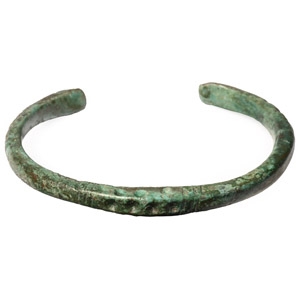
Late Roman Bronze Bracelet with Beast-Heads
4th-5th century A.D.Sold for (Inc. bp): £52
Rectangular-section penannular body with punched pellet and linear decoration, terminals fashioned as stylised beast-heads with simple eye detailing and a pellet on the head. 20.6 grams, 62 mm
Ex German art market, 2000s. Acquired from an EU collector living in London. From the collection of a Surrey, UK, gentleman. This lot is accompanied by an illustrated lot declaration signed by the Head of the Antiquities Department, Dr Raffaele D'Amato. -
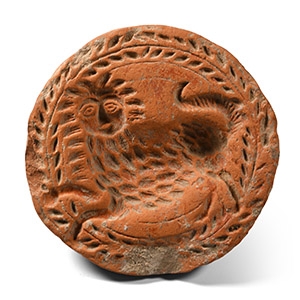
Late Roman Terracotta Bread Stamp with Lion
4th-6th century A.D.Sold for (Inc. bp): £260
Discoid in plan with integral stub handle, central figure of a stylised leaping lion with its head turned, wreath surrounding. 393 grams, 11.2 cm wide
with Galerie Rhéa, Zurich, Switzerland. This lot is accompanied by an illustrated lot declaration signed by the Head of the Antiquities Department, Dr Raffaele D'Amato. -
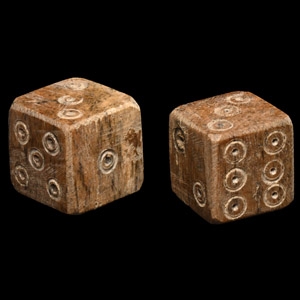
Roman Bone Dice Pair
1st-4th century A.D.Sold for (Inc. bp): £364
Each cuboid with ring-and-dot markings arranged 1:6, 2:5; 3:4. 7.48 grams, 12 mm each
Ex German art market, 2000s. Acquired from an EU collector living in London. From the collection of a Surrey, UK, gentleman. This lot is accompanied by an illustrated lot declaration signed by the Head of the Antiquities Department, Dr Raffaele D'Amato.
