
Loading, please wait...
LOT 0161
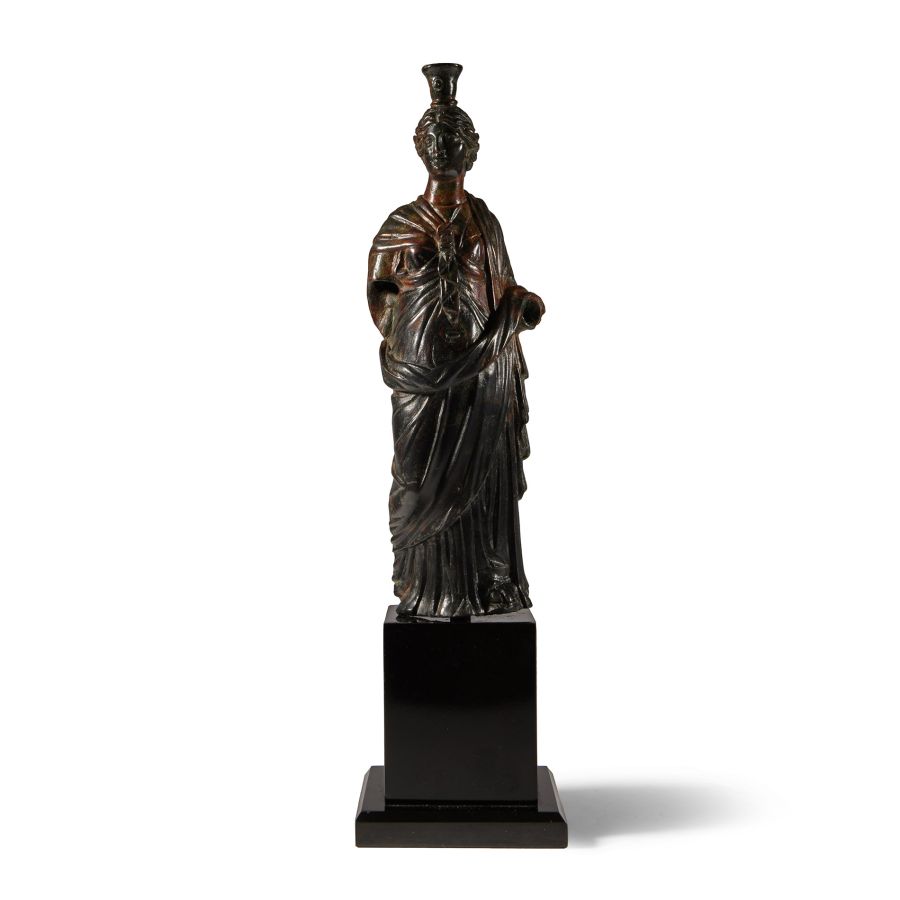
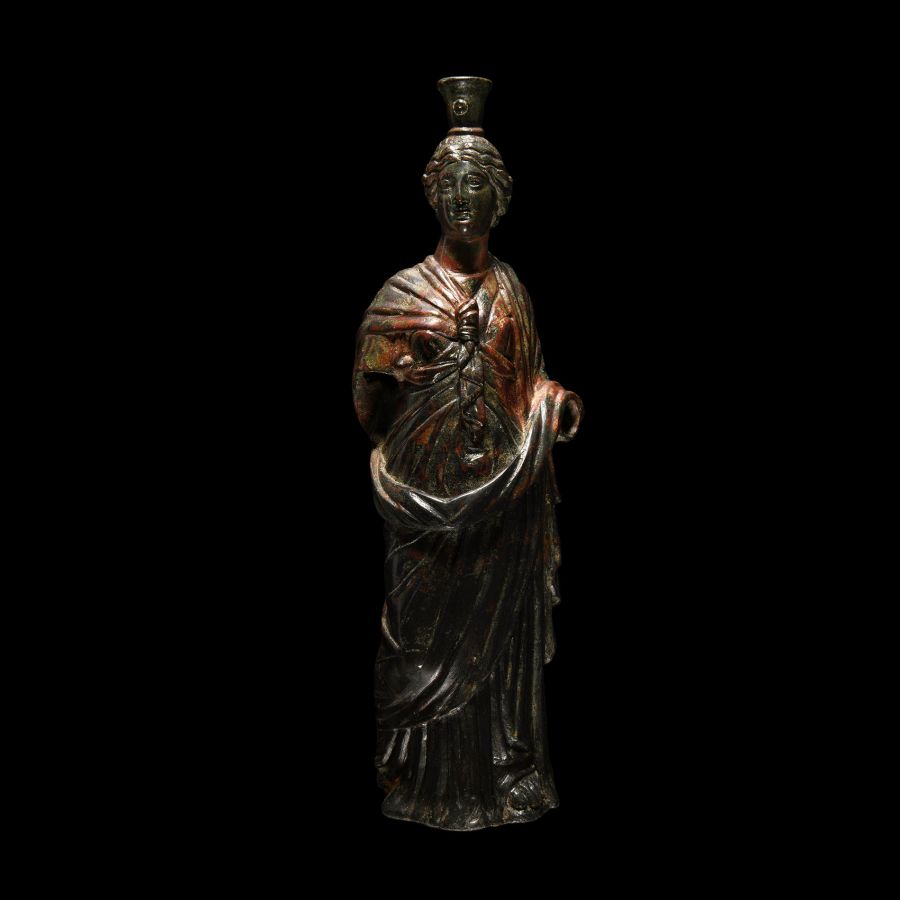
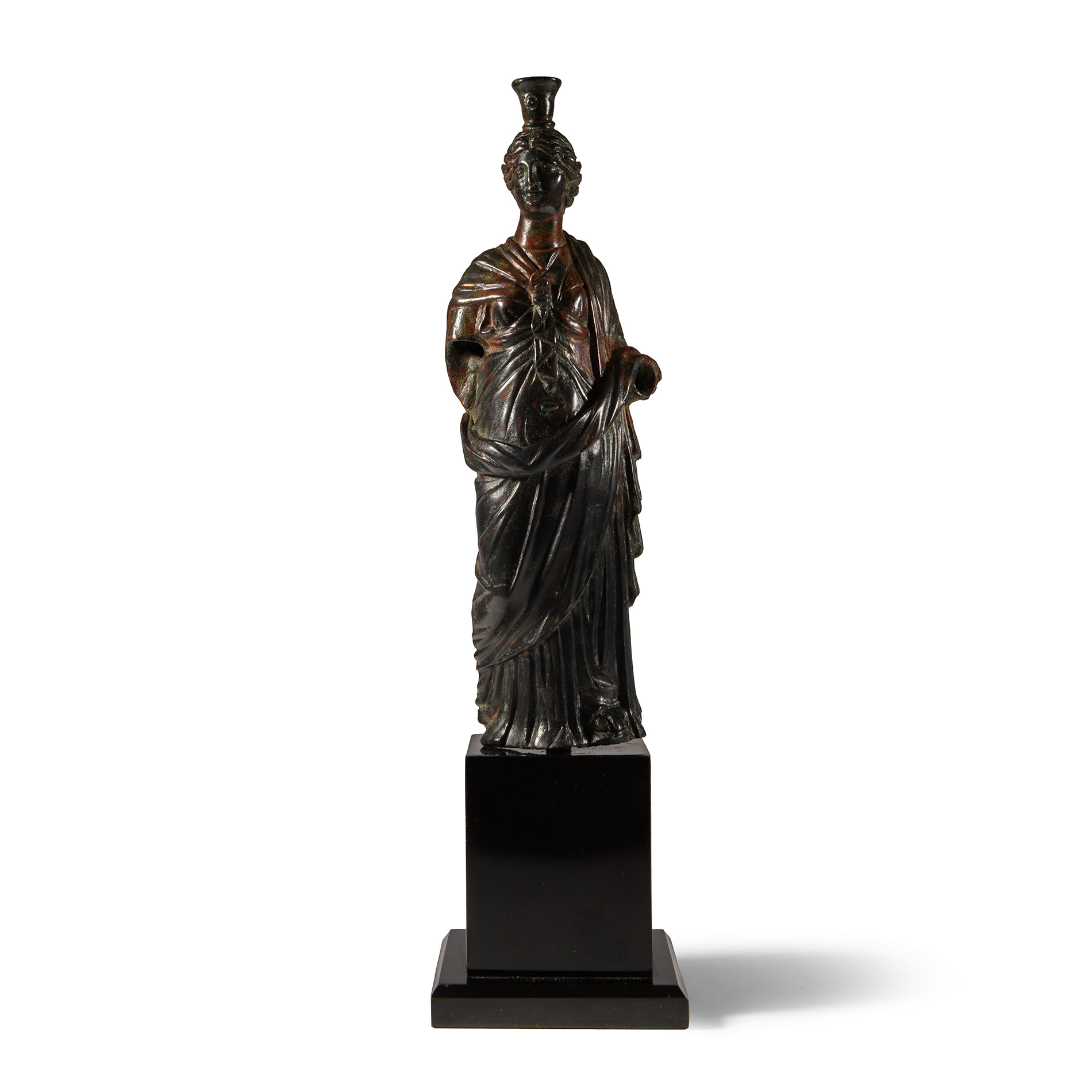
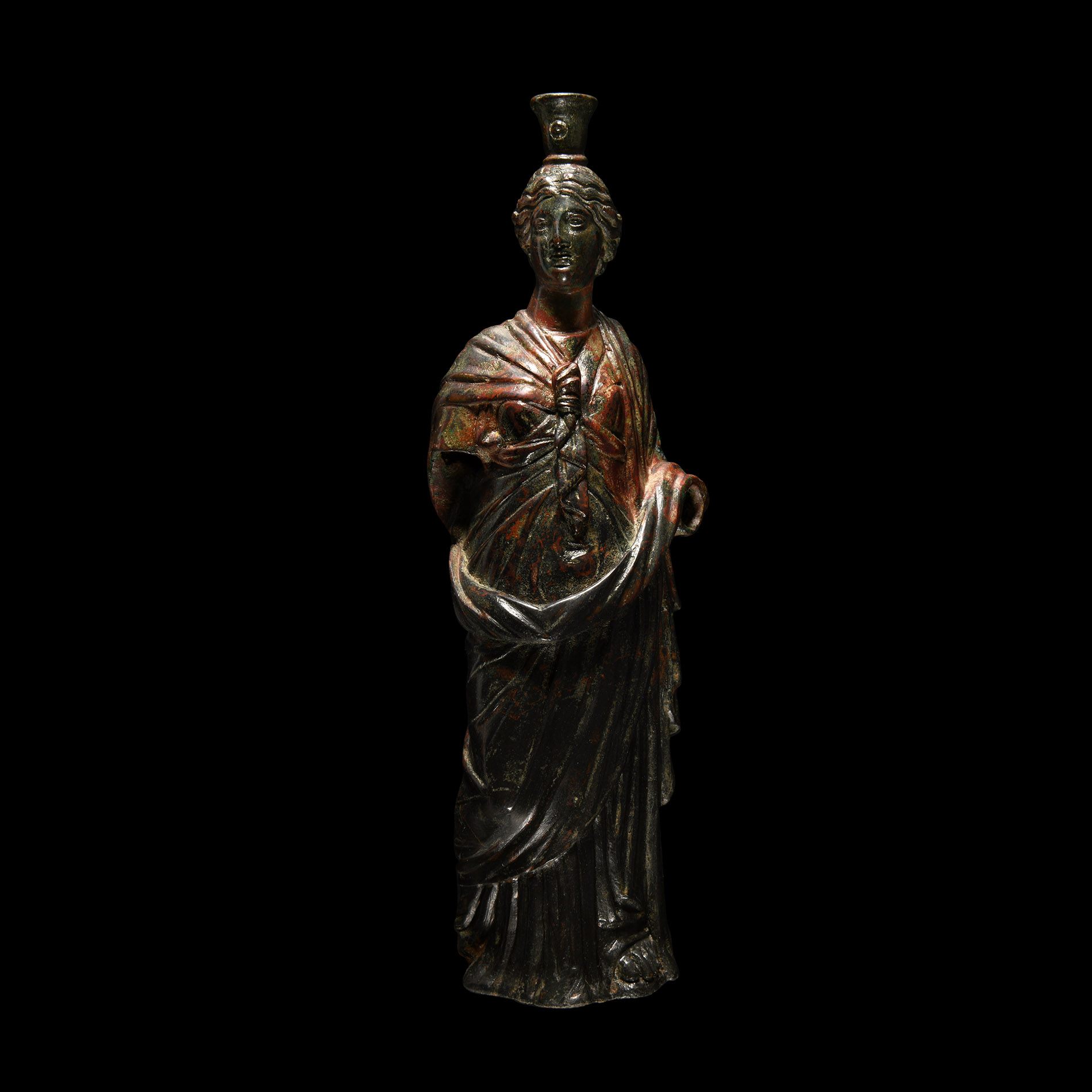
Roman Bronze Isis-Fortuna Lar Statuette
1ST CENTURY A.D.
8 in. (11 in.) (1.22 kg total, 20.5 cm high (28 cm high including stand)).
The goddess standing in contrapposto pose with her weight on her left leg, her right leg bent and pulled back; wearing an Ionic chiton and himation secured by a characteristic knot tied between her breasts, the folds cascading to the floor; the toes of her left foot emerging from below the flaring hem of her robe; her centre-parted wavy locks locks fastened with a band, pulled back in a chignon at the nape of her neck and surmounted by a tall modius; mounted on a custom-made display stand.
ProvenanceAcquired in Israel, 1990s.
Ex Sasson Ancient Art, Jerusalem.
with Christie's, New York, 13 December 2013, no.139 (US$ 50,000-$80,000).
Accompanied by a copy of the relevant Christie's catalogue pages.
Accompanied by an academic report by Dr Raffaele D’Amato.
This lot has been checked against the Interpol Database of stolen works of art and is accompanied by search certificate number no. 12017-213617.
Cf. for a similar Roman statuette Reinach, S., Repertoire de la statuarie grecque et romaine, Paris, 1930, pp.247-248, 254 no.3, esp.261 no.1; similar item in the Metropolitan Museum of Art, New York, under accession no.96.9.409 (Tyche-Fortuna); in the Walters Art Museum, accession no.54.943; for the typologies of Tyche cf. Boucher, S., Tassinari, S., Bronze Antiques du Musée de la civilisation Gallo-Romaine a Lyon, 1. Inscriptions, Statuaire, Vaisselle, Lyon, 1976, nos.20-21; Boucher, S., Recherches sur les bronzes figurés de Gaule Pré-Romaine et Romaine, Rome, 1976; for discussion on the use of such statues as Lares see Sharpe, H., F., ‘Bronze Statuettes from the Athenian Agora: Evidence for Domestic Cults in Roman Greece,’ in Hesperia: The Journal of the American School of Classical Studies at Athens, Vol. 83, no.1, January-March 2014, pp.143-187.
FootnotesThese statuettes were used in the service of domestic cults and reflect native Greek or Roman cult practices. The Roman household shrine, or lararium, received its name from the lares, the guardian spirits of the house and household, who were frequently displayed in the shrine, either in painted or sculpted form. This was prevalent in all the corners of the empire, also in the East and in Greece. Studies of bronze statuettes found in Roman provinces have shown how regional variations of lararia figures reflect the mixed religious beliefs of the inhabitants.
CONDITIONTimeLine Auctions follows a vetting process to ensure the authenticity and legality of all items, reinforcing our commitment to integrity and responsible trading. Each antiquity, antique, and coin lot undergoes thorough examination by a vetting committee of at least ten external specialists, professional trade association members, scientists, and archaeologists: Our Vetting Process
AUCTIONS:
TimeLine is a leading auction house specialising in antiquities, ancient art, collectables, natural history, coins, medals, and books. Our auctions offer museums, collectors, historians, and enthusiasts the opportunity to acquire unique and historically significant pieces.
-
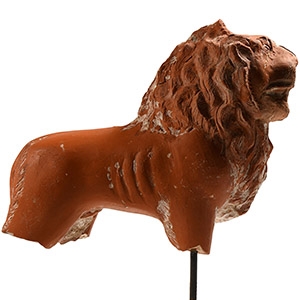
Roman Terracotta Lion Rhyton
Late 2nd-early 3rd century A.D.Estimate: £5,000 - 7,000 (‡+bp*)
Opening Bid: £2,222
Modelled naturalistically in the round in an advancing pose with face, muzzle and tooth detailing within the open mouth, the tufts of the animal's mature mane individually rendered; filling hole on the back; the mouth open acting as a spout; North African workmanship; mounted on a custom-made display stand. 1.5 kg total, 20.5 cm high including stand
with Sotheby’s London, 9 December 1994, no.221. Accompanied by an academic report by Dr Raffaele D’Amato. Accompanied by copies of relevant Sotheby's catalogue pages. This lot has been checked against the Interpol Database of stolen works of art and is accompanied by search certificate number no.11797-206532.
The lion was famously featured in many ancient myths, perhaps the most famous being that of Hercules (Herakles) slaying the Nemean lion for his first labour, but it was also linked with the cult of the goddess Cybele, where it is usually represented sculptured in relief on either side of her throne. -
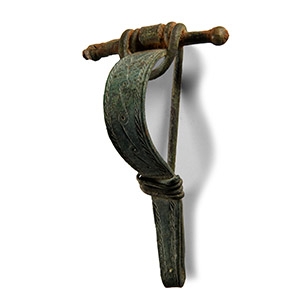
Large Roman Decorated Bronze Bow Brooch
2nd-3rd century A.D.Sold for (Inc. bp): £85
P-shaped with wide bow and foot, hatched to the edges with ring-and-dot ornament to the centre of the bow, bar above to hold the sprung pin, foot returning to form the catchplate, the upper edge of which is hammered into a flat wire coiled around the bottom of the bow. 56 grams, 95 mm
Ex property of an Austrian private collector since the 1970s. -
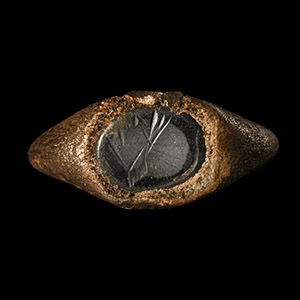
Roman Silver Ring with Profile Bust Gemstone
Circa 2nd century A.D.Sold for (Inc. bp): £91
With later inset stone intaglio of a profile helmetted bust. 2.95 grams, 21.16 mm overall, 16.87 mm internal diameter (approximate size British H 1/2, USA 4, Europe 6.81, Japan 6)
Acquired between the 1960s-early 1990s. From an old UK private collector from Worthing, West Sussex, UK. Property of K.P., a Cornish lady collector, UK.
