
Loading, please wait...
_900x900.jpg "Roman Bronze Horse Head Whorl Brooch")
_200x200.jpg "Roman Bronze Horse Head Whorl Brooch")
.jpg "Roman Bronze Horse Head Whorl Brooch")
LOT 0838
Roman Bronze Horse Head Whorl Brooch
3RD-4TH CENTURY A.D.
1 3/4 in. (16.7 grams, 45 mm).
Swastika-shaped fibula with horse-head decoration, each head with punched ring-and-dot eye, a similar motif to the centre. [No Reserve]
ProvenanceAcquired before 2000.
From the collection of a European gentleman living in the UK.
Cf. Petcu, R., ‘Swastika-shaped fibulae with horse-head decorations (Almgren 232) from the Roman period in Dobrudja (Moesia Inferior)’ in Studia Antiqua et Archaeologica, 25(1); pp.113–122, fig.4.
FootnotesIn the 3rd century A.D., several examples of fibulae in the shape of four horses’ heads forming a swastika (type Almgren 232) seem to be related to the creation of the Illyrian cavalry corps in Roman army. Many examples of these military fibulae were found in ancient Roman Dacia (Romania), in Roman Illyricum and Moesia.
CONDITIONTimeLine Auctions follows a vetting process to ensure the authenticity and legality of all items, reinforcing our commitment to integrity and responsible trading. Each antiquity, antique, and coin lot undergoes thorough examination by a vetting committee of at least ten external specialists, professional trade association members, scientists, and archaeologists: Our Vetting Process
AUCTIONS:
TimeLine is a leading auction house specialising in antiquities, ancient art, collectables, natural history, coins, medals, and books. Our auctions offer museums, collectors, historians, and enthusiasts the opportunity to acquire unique and historically significant pieces.
-
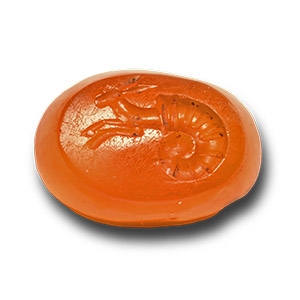
Roman Carnelian Gemstone with Sea Creature
Circa 2nd-3rd century A.D.Sold for (Inc. bp): £416
With intaglio capricorn with forelegs extended; supplied with a museum-quality impression. 0.5 grams, 10 mm
Acquired on the London art market in the late 1980s-1990s. From the family collection of an East London, UK, gentleman. -
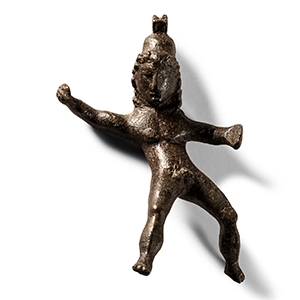
Roman Bronze Mars Rider Statuette
2nd-3rd century A.D.Sold for (Inc. bp): £111
Modelled in the round, nude male with legs in straddling pose, left hand thrust forward and right arm raised with hand open; head exaggerated with shoulder-length hair and crested helmet. 35.6 grams, 60 mm
From a collection acquired on the UK art market from various auction houses and collections mostly before 2000. From an important Cambridgeshire estate; thence by descent. -
.jpg)
Roman Silver Statuette Collection
2nd-3rd century A.D.Sold for (Inc. bp): £221
Modelled standing on polygonal bases, comprising: a male figure with full head of hair and beard, dressed in a floor-length robe and holding a patera; a male figure dressed in full-length robe, wearing a hat and holding a palm(?), one arm absent; a female figure standing in floor-length robes, possibly holding a cornucopia and rudder, suspension loop to reverse. 24.5 grams total, 24-38 mm
Fine condition.
Acquired in the late 1980s-early 1990s. From an important North West London collection.
