
Loading, please wait...
LOT 0129
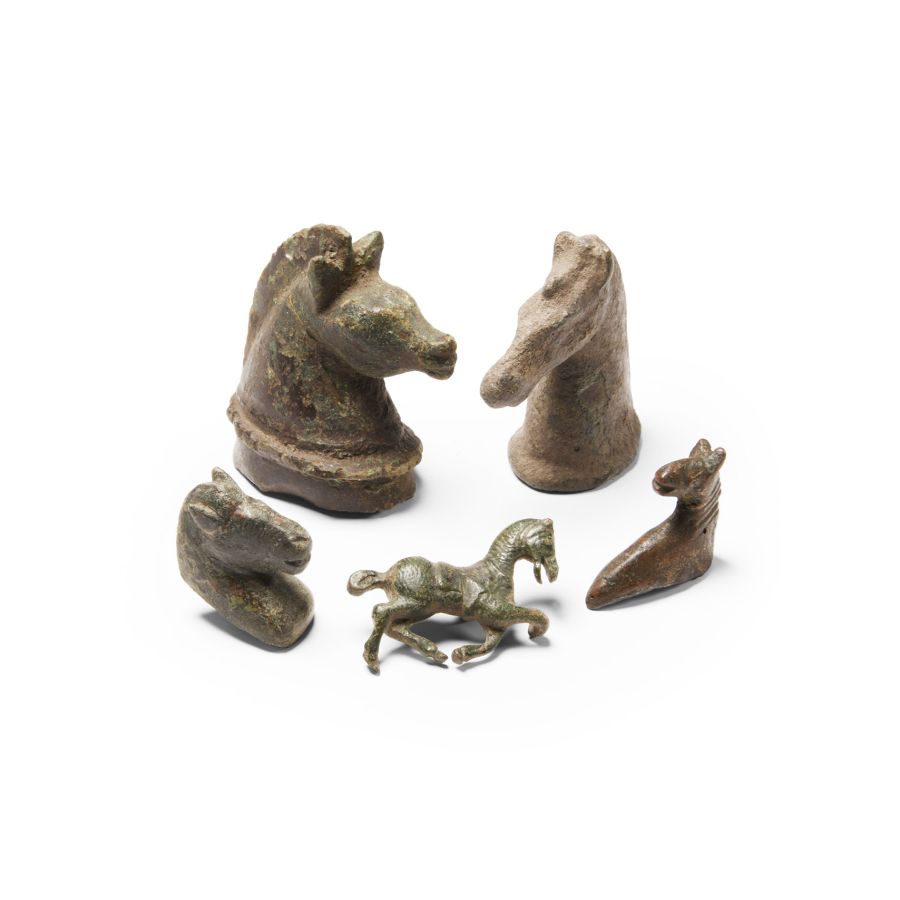
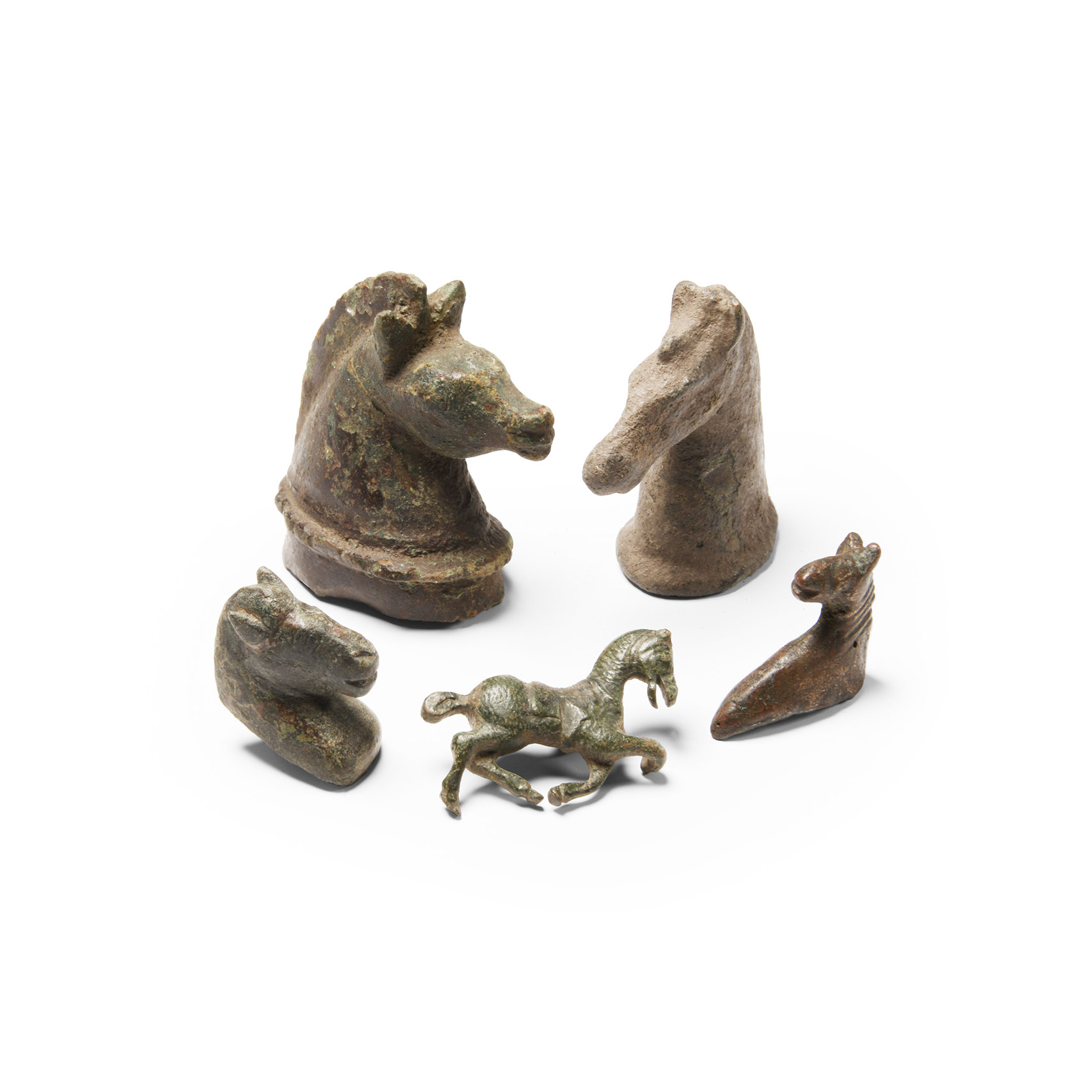
Roman Bronze Horse Collection
1ST-4TH CENTURY A.D.
1 - 2 in. (235 grams total, 24-51 mm).
Four horse head mounts modelled with naturalistic and semi-naturalistic detailing; one standing figure wearing a saddle and head collar. [5]
Provenance‘The Ancient Menagerie Collection’ formerly the property of a Cambridgeshire lady, collected since the 1990s and acquired from auctions and dealers throughout Europe and the USA, now ex London collection.
CONDITIONTimeLine Auctions follows a vetting process to ensure the authenticity and legality of all items, reinforcing our commitment to integrity and responsible trading. Each antiquity, antique, and coin lot undergoes thorough examination by a vetting committee of at least ten external specialists, professional trade association members, scientists, and archaeologists: Our Vetting Process
AUCTIONS:
TimeLine is a leading auction house specialising in antiquities, ancient art, collectables, natural history, coins, medals, and books. Our auctions offer museums, collectors, historians, and enthusiasts the opportunity to acquire unique and historically significant pieces.
LOT 0129
Roman Bronze Horse Collection
Estimate £600 - 800€700 - 930 (for guidance only)$810 - 1,080 (for guidance only)
-
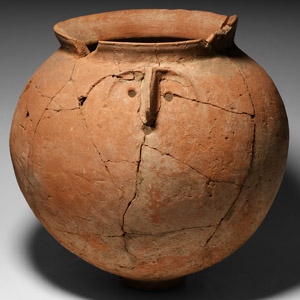
Roman Ceramic Military Cremation Face Urn
1st-2nd century A.D.Sold for (Inc. bp): £455
For the deposition of ashes (absent), with bulbous body, everted rim and discoid foot, a stylised human face to the upper body expressed with three circular holes for the eyes and mouth, pinched nose in high-relief and raised eyebrows; repaired. 5.13 kg, 34 cm wide
Acquired 1960s-1990s. Late Alison Barker collection, a retired London barrister.
Cremation was the usual burial practice in early Roman Britain and whilst it was common for larger ceramic or glass domestic vessels to be reused as cinerary urns, this particular type was created specifically for the purpose and was strongly associated with military contexts in Britain. After death, an individual would have been cremated on a pyre, the ashes gathered once the fire had gone out, and finally placed into the pot. The pot may then have been placed into a small 'tile tomb' buried beneath the ground. The face clearly has symbolic meaning; it may represent the deceased or a god, or may have served an apotropaic function, intended to ward-off evil spirits. The exact meaning of the face would have been clearer when the vessel was in situ alongside other associated burial goods. Although there are similarities in style across the known sample of Roman face pots, each is unique in some way. Face pot finds are concentrated in Colchester in Britain, suggesting a military association, since Camulodunum, 'The 'Fortress of the War God Camulos', was the capital of Roman Britain and Britain's first city. A more robust military connection was established by the archaeologist Gillian Braithwaite, whose survey of thousands of face pot sherds demonstrated that their occurrence spread rapidly though the Roman Empire, from the Black Sea, to Spain, the Mediterranean and Scotland. Braithwaite was able to link the pots to the Roman army and thus explain this phenomenon; as the units moved from province to province, face pots occurred in that region for the first time. The frequency of complete face pots suggests their use as cremation urns. -
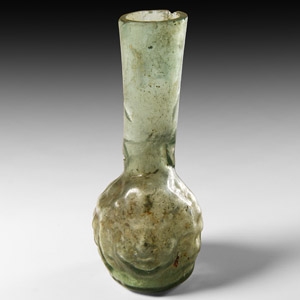
Roman Glass Janus Head Flask
Circa 3rd century A.D.Estimate: £150 - 200 (+bp*)
Opening Bid: £75
Formed as two addorsed heads with a flaring cylindrical neck and mouth; both heads with very similar detailing to the hair and face; restored. 41 grams, 99 mm high
Acquired 1969-1999. London collection of the late Mr S.M., thence by descent. -
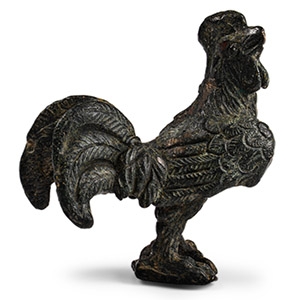
Roman Bronze Cockerel
Circa 2nd century A.D.Sold for (Inc. bp): £845
Free-standing with semi-naturalistic detailing to the head, wing and tail feathers, comb and wattle. 78 grams, 47 mm
‘The Ancient Menagerie Collection’ formerly the property of a Cambridgeshire lady, collected since the 1990s and acquired from auctions and dealers throughout Europe and the USA, now ex London collection.
