
Loading, please wait...
_900x900.jpg "Roman Bronze Horse Brooch")
_200x200.jpg "Roman Bronze Horse Brooch")
.jpg "Roman Bronze Horse Brooch")
LOT 0913
Roman Bronze Horse Brooch
CIRCA 2ND CENTURY A.D.
1 3/8 in. (11.8 grams, 35 mm).
Formed as a standing horse, the hindlegs forming crossbar, tail forming hinged pin, forelegs forming catchplate; ring-and-dot motifs to shoulders, linear detailing to the mane. [No Reserve]
ProvenanceFrom a collection acquired on the UK art market from various auction houses and collections mostly before 2000.
From an important Cambridgeshire estate; thence by descent.
Cf. Hattatt, R., Ancient Brooches and Other Artefacts, Oxford, 1989, item 1644.
CONDITIONTimeLine Auctions follows a vetting process to ensure the authenticity and legality of all items, reinforcing our commitment to integrity and responsible trading. Each antiquity, antique, and coin lot undergoes thorough examination by a vetting committee of at least ten external specialists, professional trade association members, scientists, and archaeologists: Our Vetting Process
AUCTIONS:
TimeLine is a leading auction house specialising in antiquities, ancient art, collectables, natural history, coins, medals, and books. Our auctions offer museums, collectors, historians, and enthusiasts the opportunity to acquire unique and historically significant pieces.
-
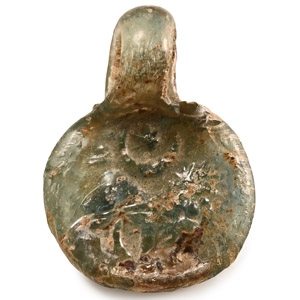
Late Roman Glass Lion Pendant with Star and Crescent
Mid 4th-mid 5th century A.D.Sold for (Inc. bp): £117
Discoid with integral loop, impressed image of an advancing lion below a crescent with star above. 1.81 grams, 24 mm
Collected from 1970-1999. From the collection of the late Mr S.M., London, UK. -
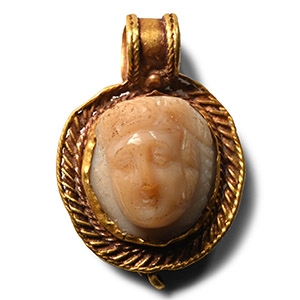
Roman Gold Pendant with Medusa Cameo
1st-2nd century A.D.Sold for (Inc. bp): £1,300
Discoid plaque with applied ropework wreath detailing, suspension loop with filigree borders and granule below, inset cameo gorgoneion; ring at bottom for attachment of a securing chain. 5.06 grams, 29 mm
From the collection of a gentleman, acquired on the London art market in the 1990s. -
.jpg)
Roman Marble Torso
1st-3rd century A.D.Sold for (Inc. bp): £2,600
Carved in the round, nude male torso resting against a tree (or jamb of an arch), with skilfully delineated musculature, in contrapposto pose; abraded. 3.27 kg, 23 cm.
Acquired in the mid 1980s-1990s. Private collection, Switzerland, thence by descent. Private collection, since the late 1990s. This lot has been checked against the Interpol Database of stolen works of art and is accompanied by search certificate number no.12230-222368
