
Loading, please wait...
LOT 0731
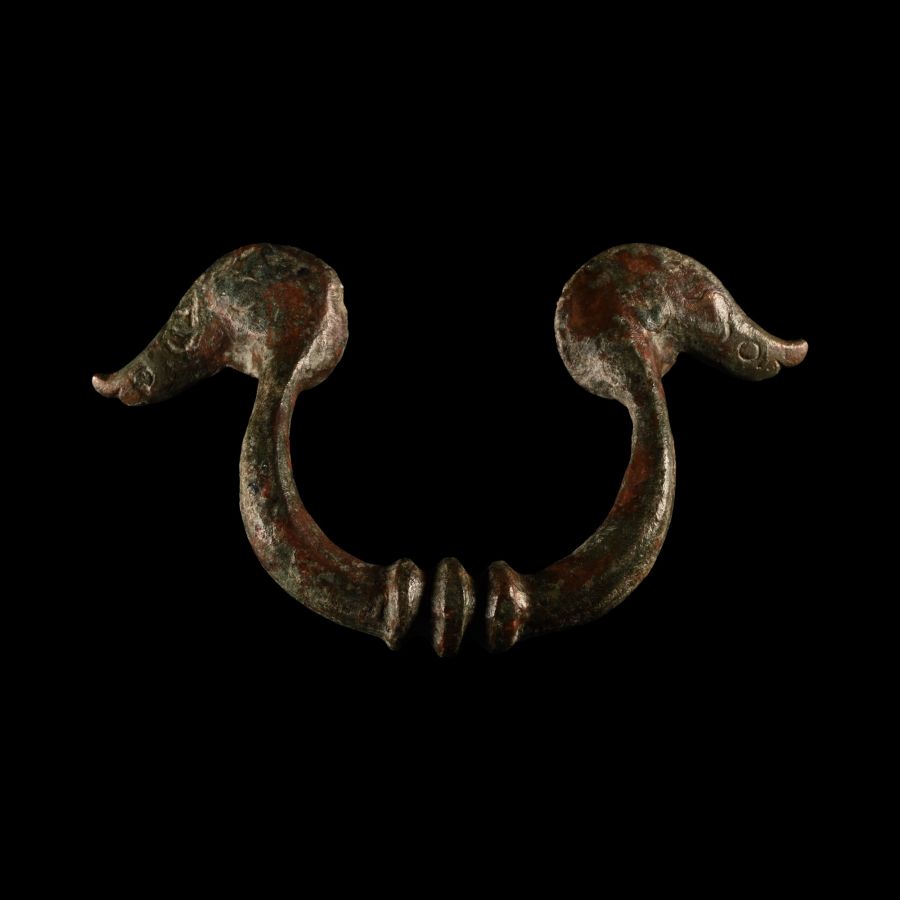
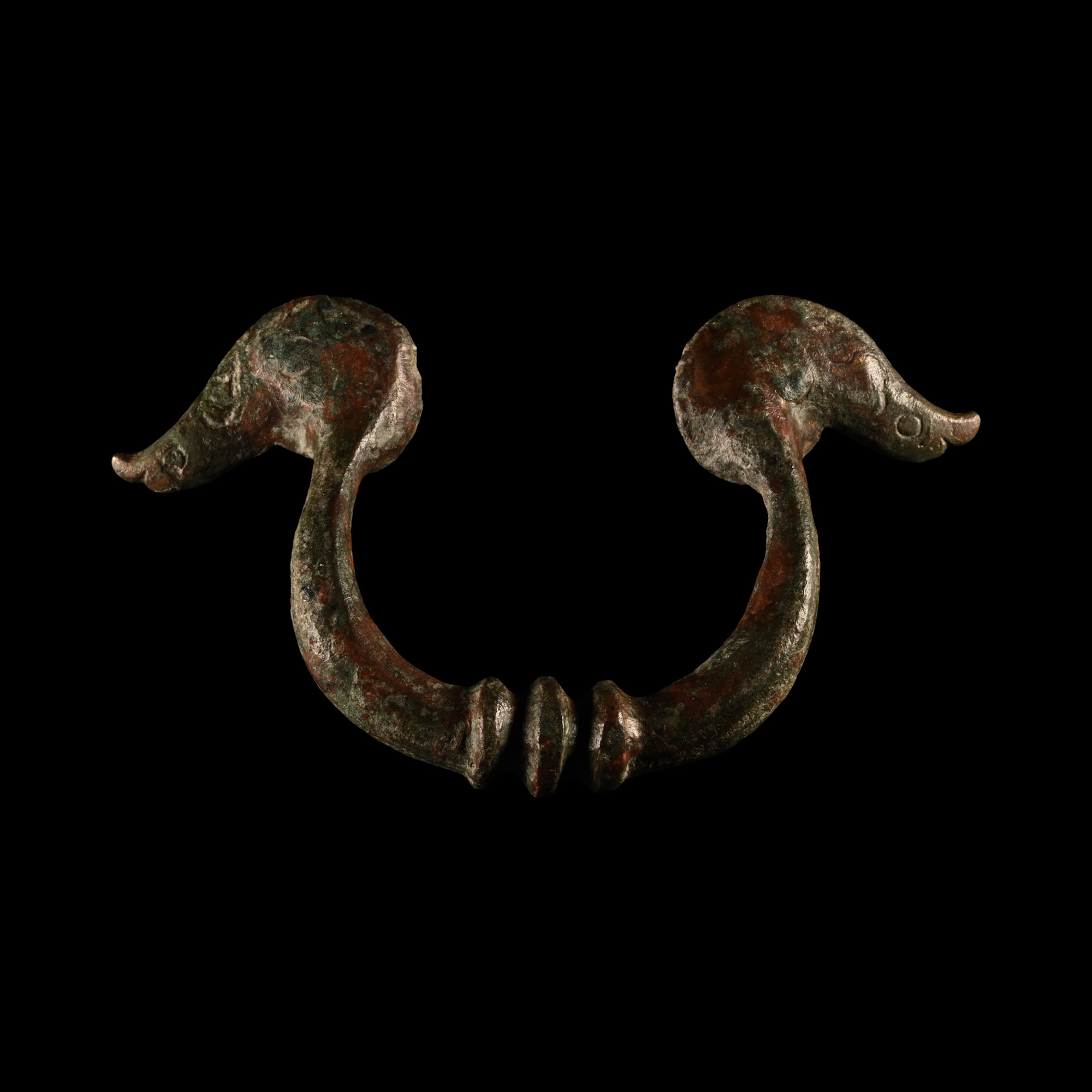
Roman Bronze Helmet Handle
1ST-2ND CENTURY A.D.
3 5/8 in. (65 grams, 92 mm).
Comprising a crescentic tapering shank with ribbed baluster to the centre; attachment points formed as wings with punched detailing. [No Reserve]
ProvenanceFrom a collection acquired on the UK art market from various auction houses and collections mostly before 2000.
From an important Cambridgeshire estate; thence by descent.
Cf. Appels, A. & Laycock, S., Roman Buckles and Military Fittings, Witham, 2007, item AA.4.8, for type.
FootnotesMany such handles are formed as a pair of opposed dolphins, whence the conventional name 'dolphin mounts'. They were attached to infantry helmets so that they could be carried when not in use, or slung from a strap.
CONDITIONTimeLine Auctions follows a vetting process to ensure the authenticity and legality of all items, reinforcing our commitment to integrity and responsible trading. Each antiquity, antique, and coin lot undergoes thorough examination by a vetting committee of at least ten external specialists, professional trade association members, scientists, and archaeologists: Our Vetting Process
AUCTIONS:
TimeLine is a leading auction house specialising in antiquities, ancient art, collectables, natural history, coins, medals, and books. Our auctions offer museums, collectors, historians, and enthusiasts the opportunity to acquire unique and historically significant pieces.
-
.jpg)
Bronze Age to Roman Bronze Artefact Collection
11th century B.C.-3rd century A.D.Sold for (Inc. bp): £26
Comprising two arrowheads with foliate head and square-sectioned tang and three awls. 45 grams total, 3.6-10.8 cm
Acquired prior to 2000. Ex private collection, Cambridgeshire, UK.
The two arrowheads are similar to specimens found in Luristan. They belong to the type V of the Khorasani classification. The bow was widely used by the Luristan people. The shape of the blade is often flat or ovate in the cross section with lanceolate profile and two cutting edges. -
.jpg)
Roman Bronze Jupiter Dolichenus Statuette
Circa 2nd century A.D.Sold for (Inc. bp): £598
Modelled in the round standing wearing a crested helmet, muscle-cuirass with tunic beneath, short pteruges and greaves; left hand raised to hold a spear, right hand with gladius resting on the forearm. 36 grams, 62 mm
From a collection acquired on the UK art market from various auction houses and collections mostly before 2000. From an important Cambridgeshire estate; thence by descent.
The cult of Jupiter Dolichenus was a variant of worship of Zeus from Asia Minor whose mystery cult was widespread in the Roman Empire from the early 2nd to mid-3rd centuries A.D., especially in the military. The god is usually represented mounting a bull, with the double axe (labrys or bipennis) in his right raised hand, and dressed in the military attire of a Roman general. -
.jpg)
Roman Marble Torso
1st-3rd century A.D.Sold for (Inc. bp): £2,600
Carved in the round, nude male torso resting against a tree (or jamb of an arch), with skilfully delineated musculature, in contrapposto pose; abraded. 3.27 kg, 23 cm.
Acquired in the mid 1980s-1990s. Private collection, Switzerland, thence by descent. Private collection, since the late 1990s. This lot has been checked against the Interpol Database of stolen works of art and is accompanied by search certificate number no.12230-222368
