
Loading, please wait...
LOT 0169
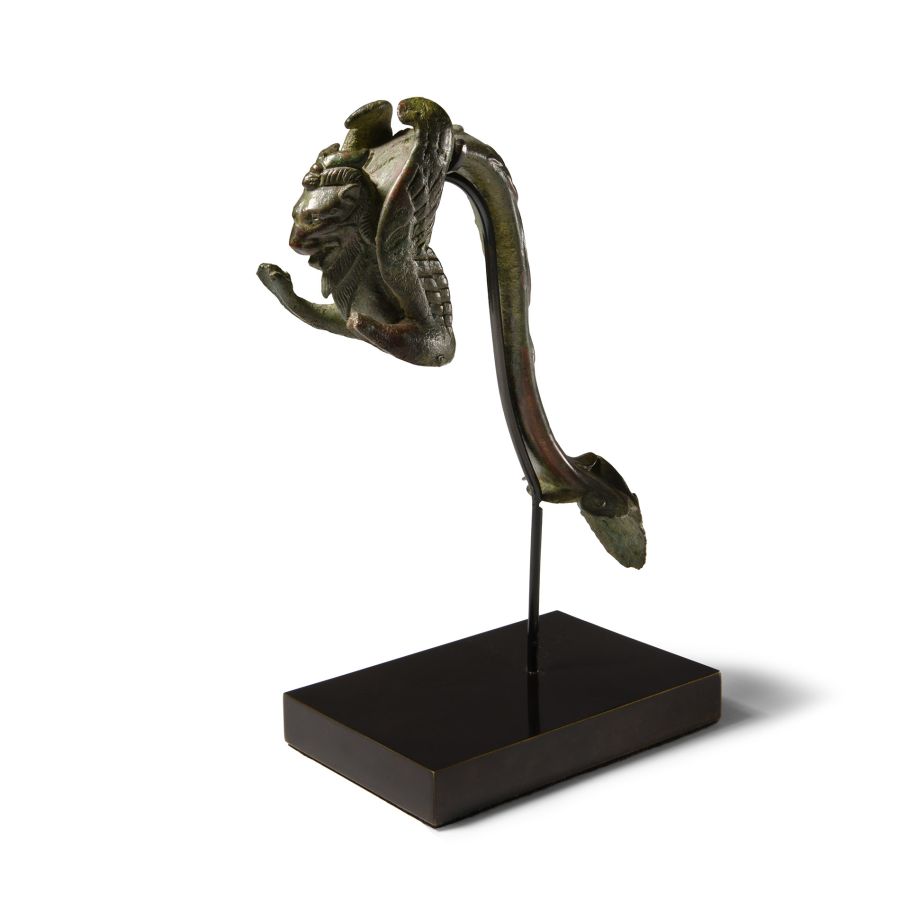
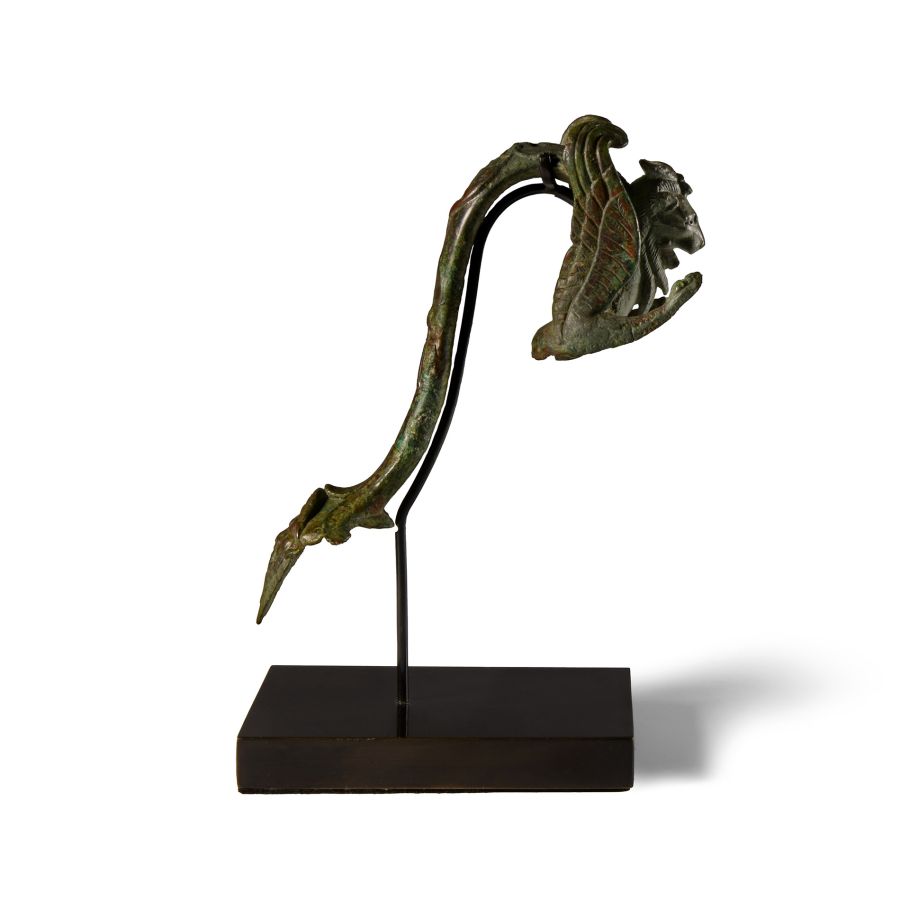
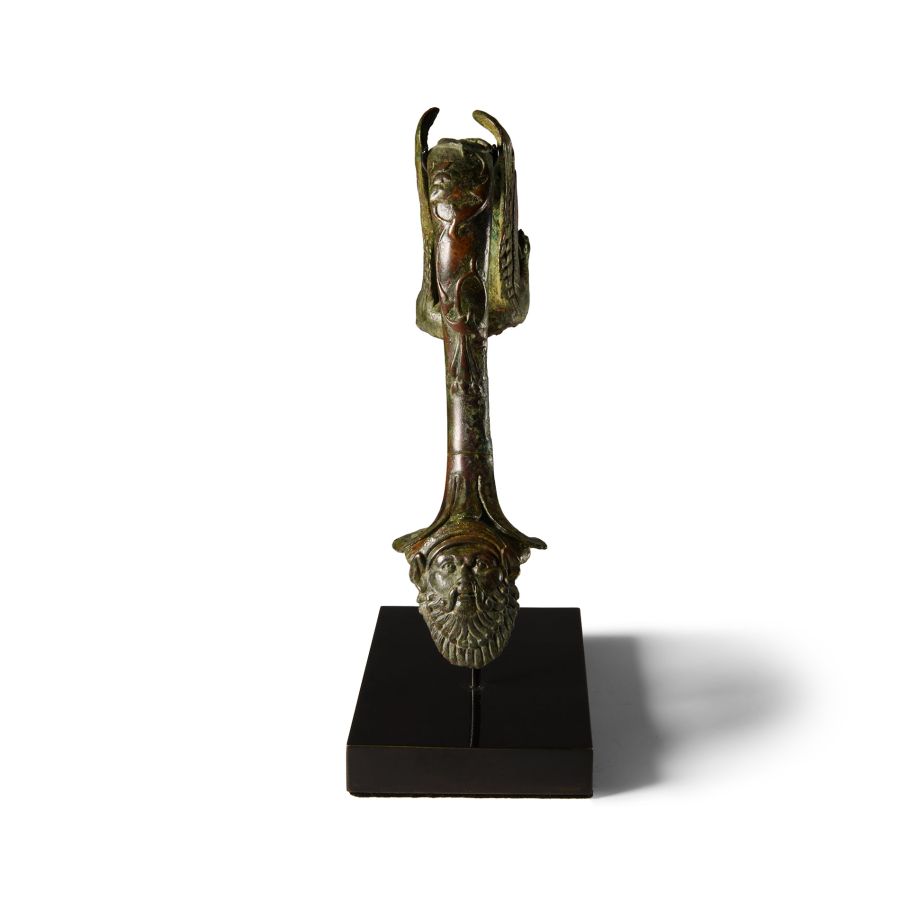
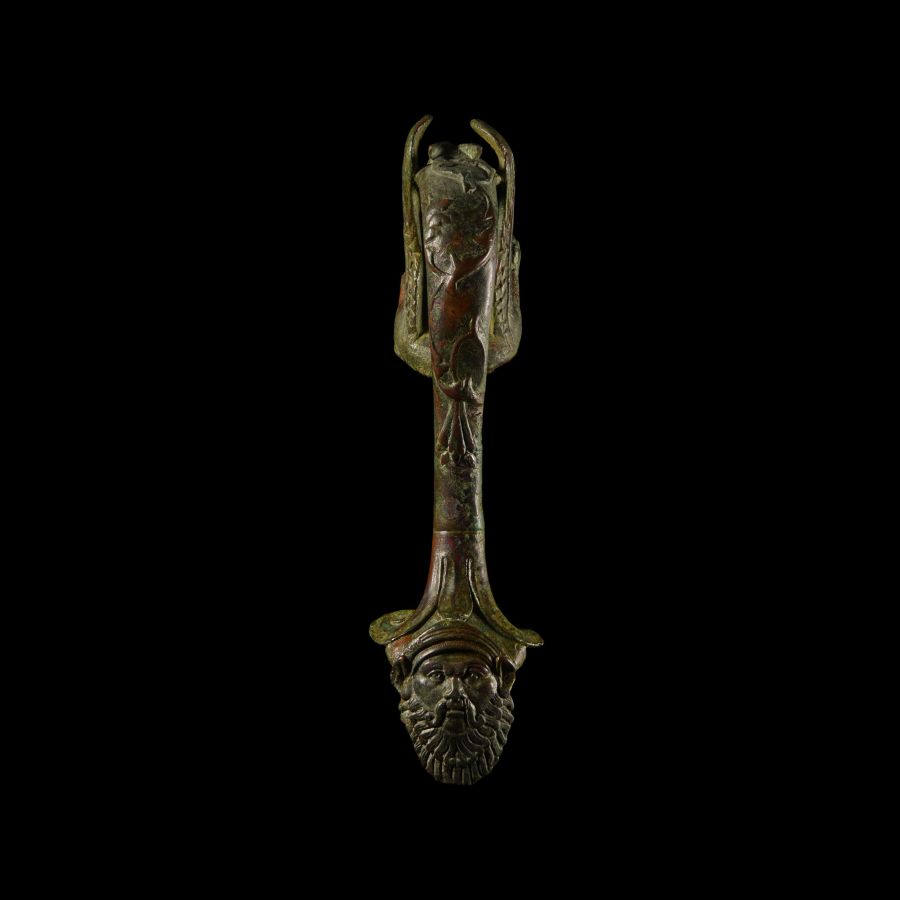
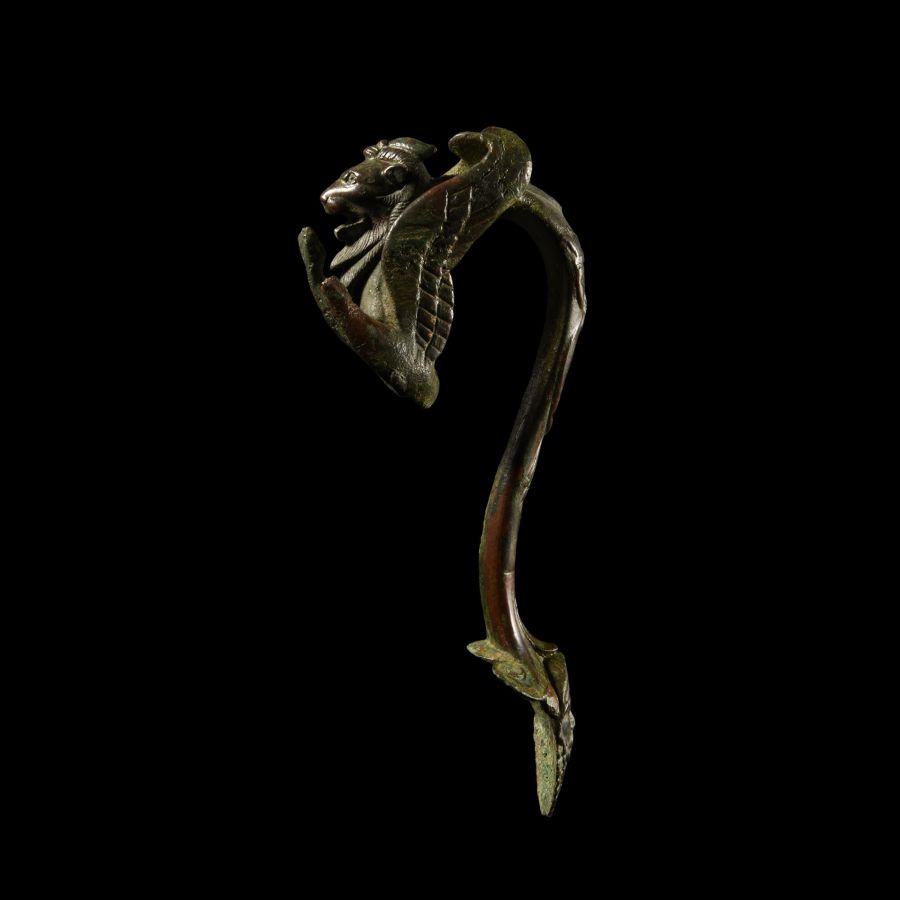
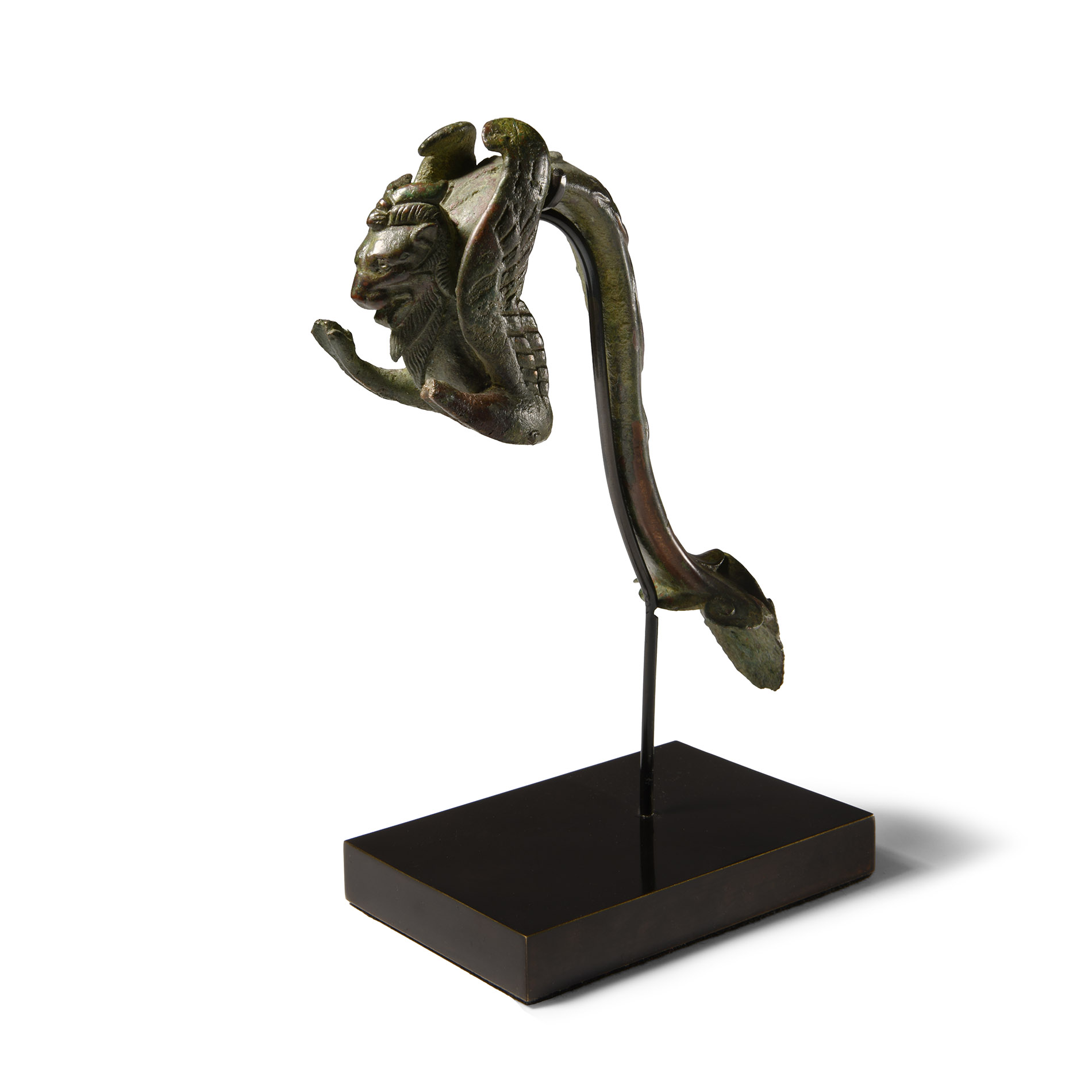
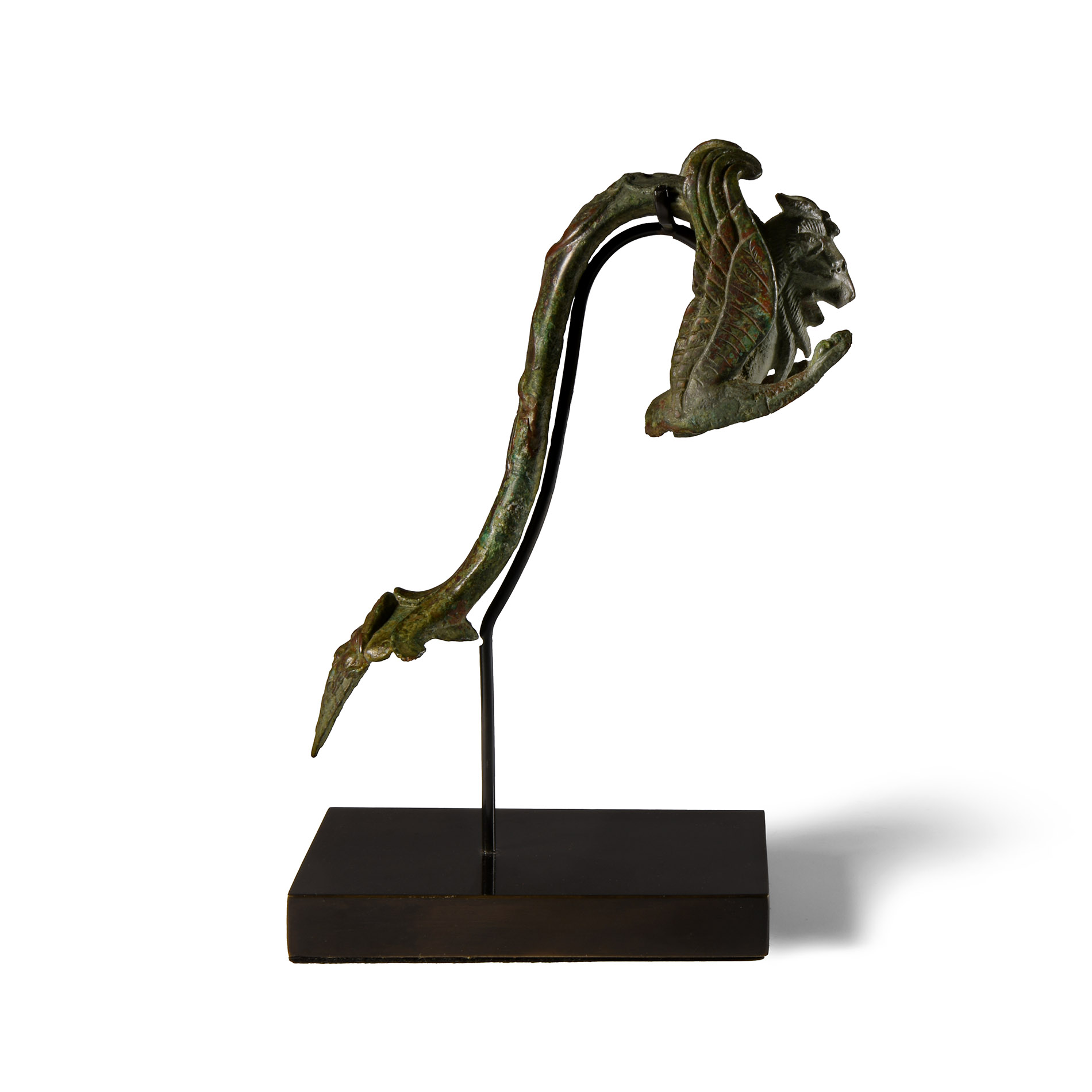
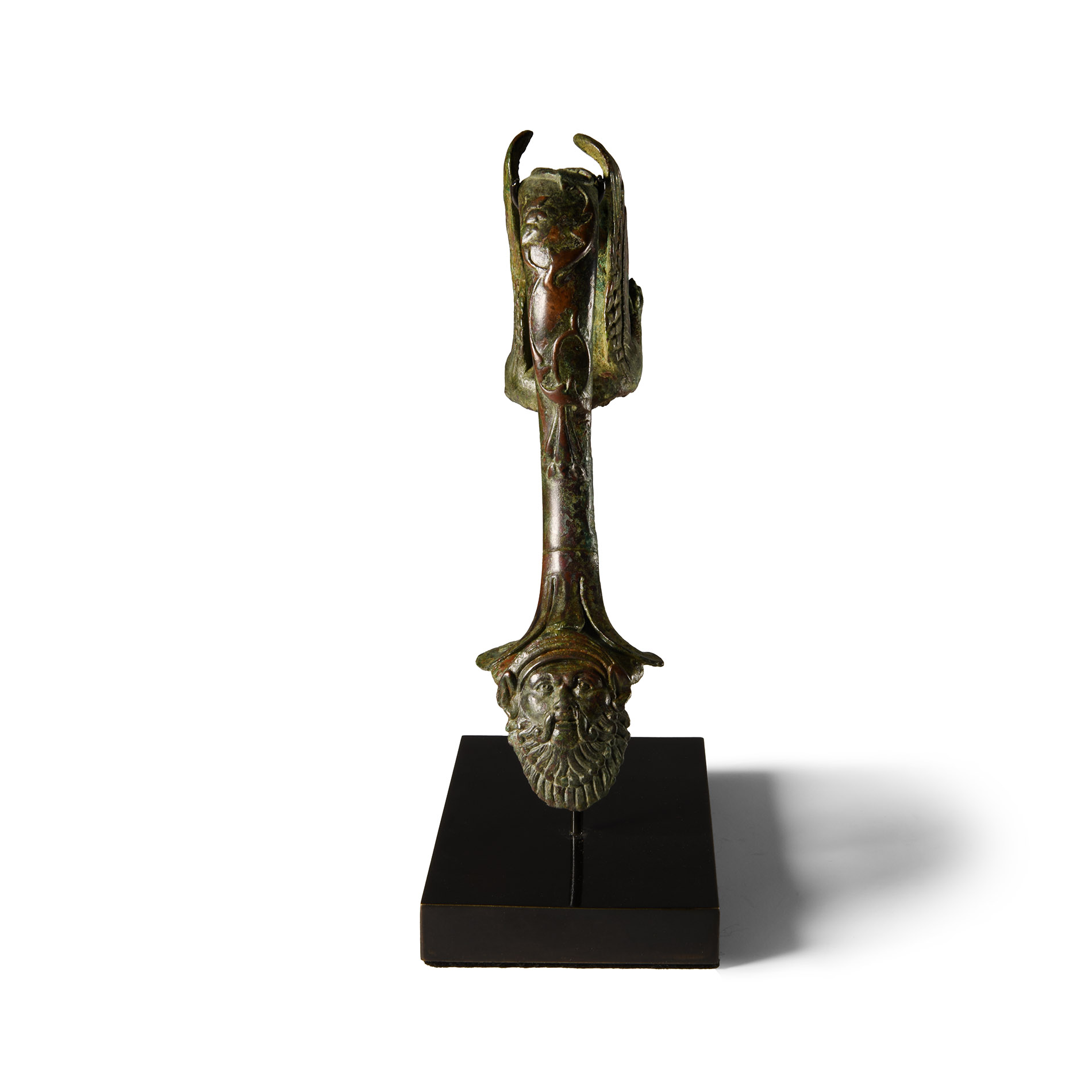
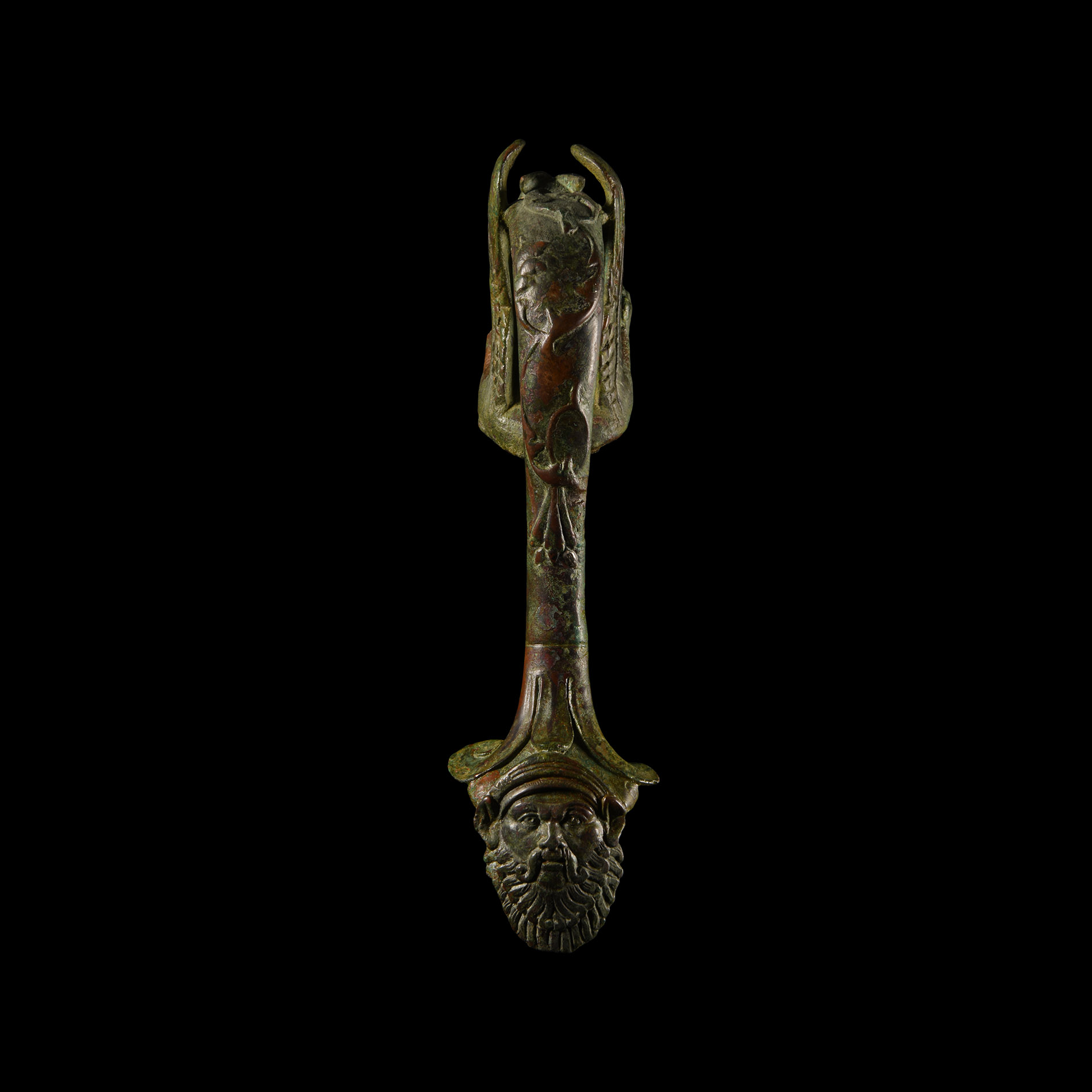
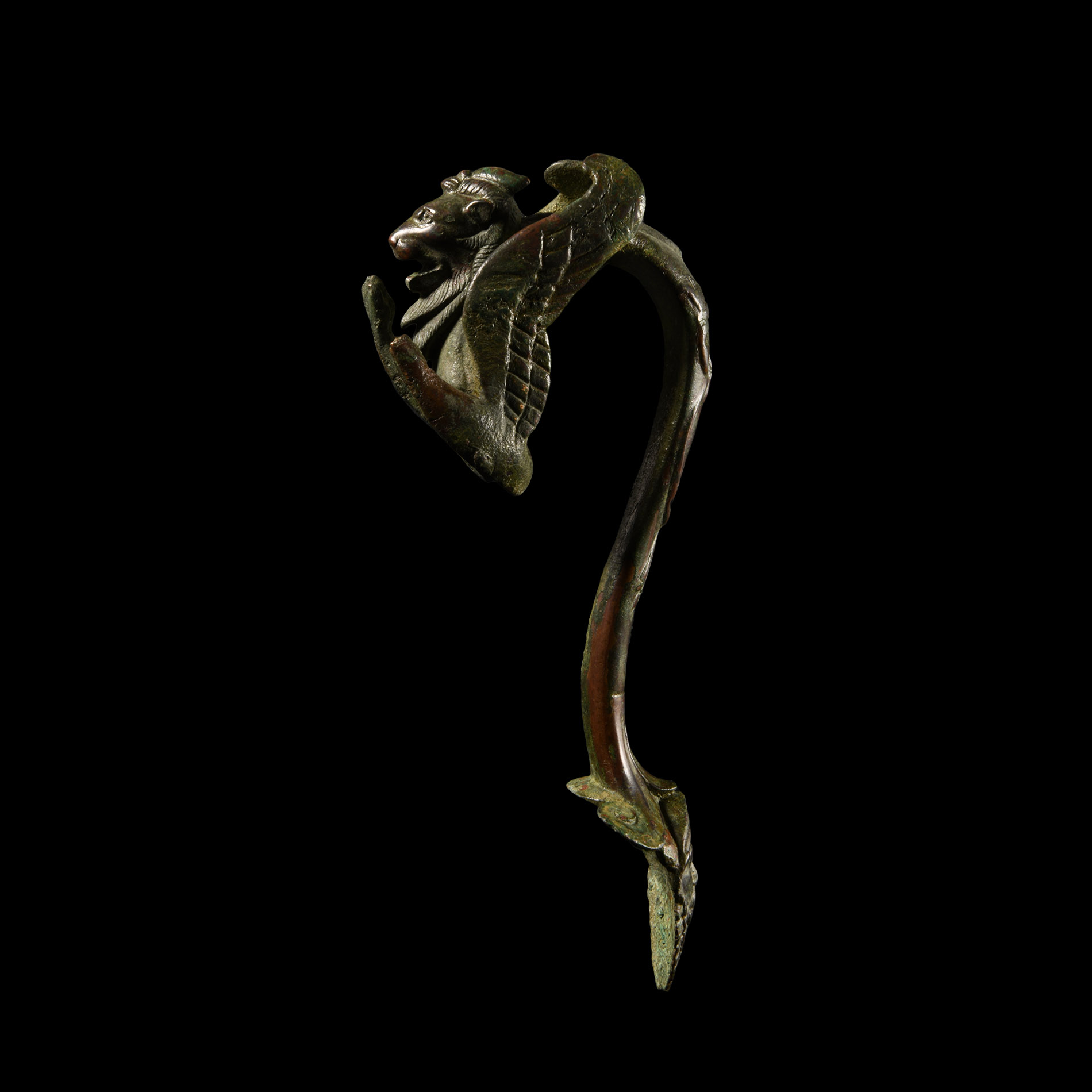
Roman Bronze Handle with Winged Lion and Mask
1ST-2ND CENTURY A.D.
5 1/8 in. (6 3/4 in.) (452 grams total, 13 cm high (17 cm high including stand)).
D-section swept-curve handle, the upper end developing to the foreparts of a winged lion with forelegs bent and paws resting on the vessel's rim, wings folded to the flanks; high-relief foliage detailing to the outer face of the handle; acanthus leaf to the lower end developing to a facing bearded mask of a satyr; mounted on a custom-made stand. [No Reserve]
ProvenanceAcquired between 1980-1983.
From the 'Empire' collection, an important UK private collection of seals.
Cf. Tassinari, S., La Vaisselle de Bronze, Romaine et Provinciale, au Musée des Antiquités Nationales, XXIXe supplément de Gallia, Paris, 1975, items 152, 178, for type.
FootnotesUsually this type of handles decorated ovoid-shaped oinochoai, a type of vase widespread in Southern Italy. Numerous specimens in the National Museum of Archaeology, Naples present panther or horse protomes, as do some provincial specimens from Gaul. Particular and unusual here is the lion-griffin, which refers to Greek-Egyptian motifs, perhaps connected to the cult of Isis-Serapis.
CONDITIONTimeLine Auctions follows a vetting process to ensure the authenticity and legality of all items, reinforcing our commitment to integrity and responsible trading. Each antiquity, antique, and coin lot undergoes thorough examination by a vetting committee of at least ten external specialists, professional trade association members, scientists, and archaeologists: Our Vetting Process
AUCTIONS:
TimeLine is a leading auction house specialising in antiquities, ancient art, collectables, natural history, coins, medals, and books. Our auctions offer museums, collectors, historians, and enthusiasts the opportunity to acquire unique and historically significant pieces.
-
Roman Terracotta Lion Rhyton
Late 2nd-early 3rd century A.D.Estimate: £5,000 - 7,000 (‡+bp*)
Opening Bid: £2,222
Modelled naturalistically in the round in an advancing pose with face, muzzle and tooth detailing within the open mouth, the tufts of the animal's mature mane individually rendered; filling hole on the back; the mouth open acting as a spout; North African workmanship; mounted on a custom-made display stand. 1.5 kg total, 20.5 cm high including stand
with Sotheby’s London, 9 December 1994, no.221. Accompanied by an academic report by Dr Raffaele D’Amato. Accompanied by copies of relevant Sotheby's catalogue pages. This lot has been checked against the Interpol Database of stolen works of art and is accompanied by search certificate number no.11797-206532.
The lion was famously featured in many ancient myths, perhaps the most famous being that of Hercules (Herakles) slaying the Nemean lion for his first labour, but it was also linked with the cult of the goddess Cybele, where it is usually represented sculptured in relief on either side of her throne. -
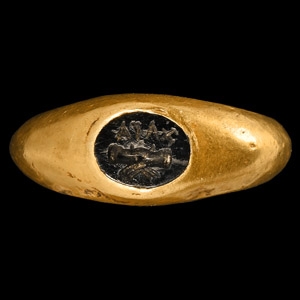
Roman Gold Ring with Mani in Fede Gemstone for Aiax
2nd century A.D.Sold for (Inc. bp): £1,950
Comprising a hollow-formed hoop with rounded shoulders, inset garnet intaglio with clasped hands and 'AIAX' inscription. 2.79 grams, 21.00 mm overall, 14.90 mm internal diameter (approximate size British E, USA 2 1/4, Europe 2.41, Japan 2)
Acquired in Europe in 1992. with Million Cornette de Saint Cyr, Hotel Regina, 12 December 2009. European private collection.
The Romanised name 'Aiax' is given to the hero Αἴας of the Trojan war, who carried off the body of Achilles and fought Hector. The subject of two clasped hands (dextrarum junctio) symbolising the fides (loyalty, trust), was very popular on Roman rings and gems. It was mainly used on marriage rings, sometimes with the equivalent Greek inscription 'OMONOIA'. Sometimes it was used in terms of military loyalty between commander and army. In this case it is most probable the name of the groom (AIAX). -
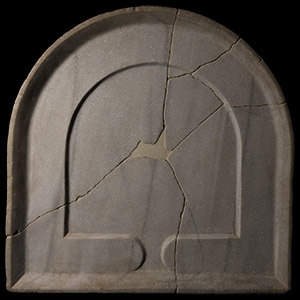
Large Late Roman Sigma-Shaped Marble Offering Table Top
Eastern Mediterranean, 4th-6th century A.D.Estimate: £10,000 - 14,000 (+bp*)
Opening Bid: £2,778
Semi-circular with raised and slightly everted edge, the top with a recessed area with a funnel-shaped outlet; for votive offerings within a church; restored. 84.5 kg including backplate, 91 cm wide
In general good condition, re-assembled.
Acquired in the late 1960s or early 1970s. Ex David Read collection. Accompanied by an academic report by Dr Raffaele D’Amato. This lot has been checked against the Interpol Database of stolen works of art and is accompanied by search certificate number no.12080-214035.
Marble tables such as the present example are called in archaeological terms sigma tables, in consideration of their resemblance to the Greek letter sigma. Sigma-shaped tables appeared in the banquet halls at the end of the 4th century and within Christian buildings from the following century. Most of the undecorated slabs were used as liturgical table tops for feasts to honour the deceased. This commemorative practice was known throughout the late Roman world in west and east, where it continued in the daily life of the citizens of the Eastern Roman Empire. In ecclesiastical settings, circular and sigma-shaped tables were used to collect offerings or for celebrating the agape, more generally as secondary furniture, while the rectangular form was preferred for use as an altar.
