
Loading, please wait...
_900x900.jpg "Roman Bronze Hand-Shaped Military Standard Finial")
_200x200.jpg "Roman Bronze Hand-Shaped Military Standard Finial")
.jpg "Roman Bronze Hand-Shaped Military Standard Finial")
LOT 0130
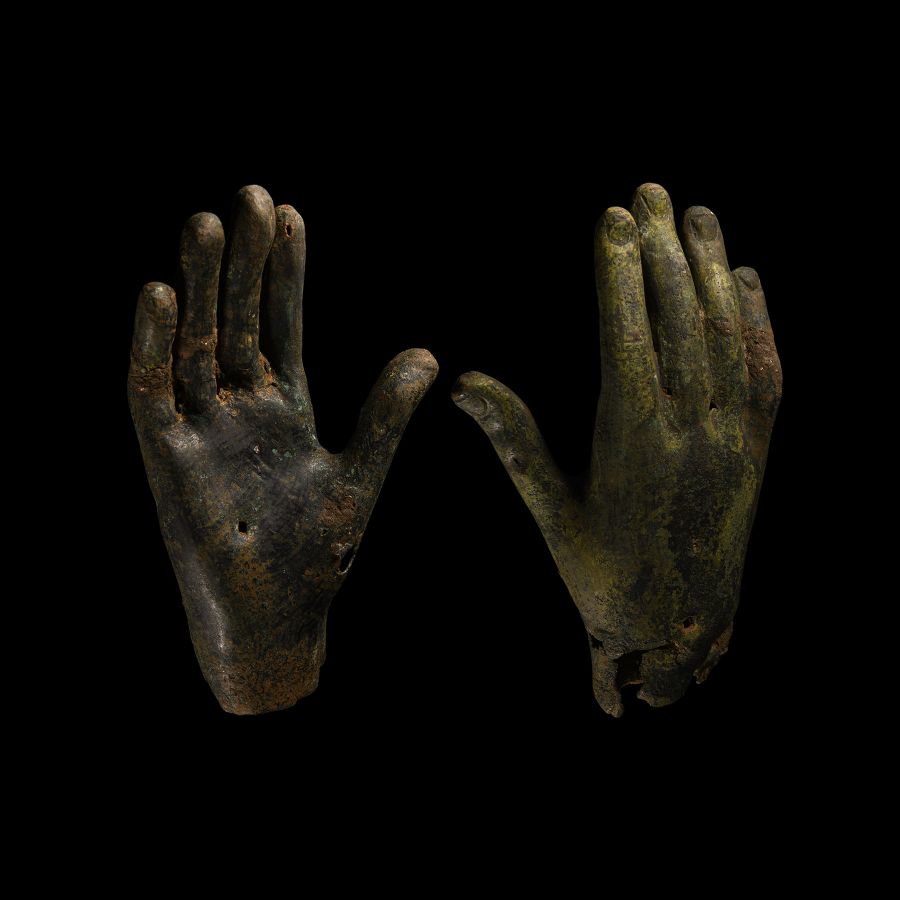
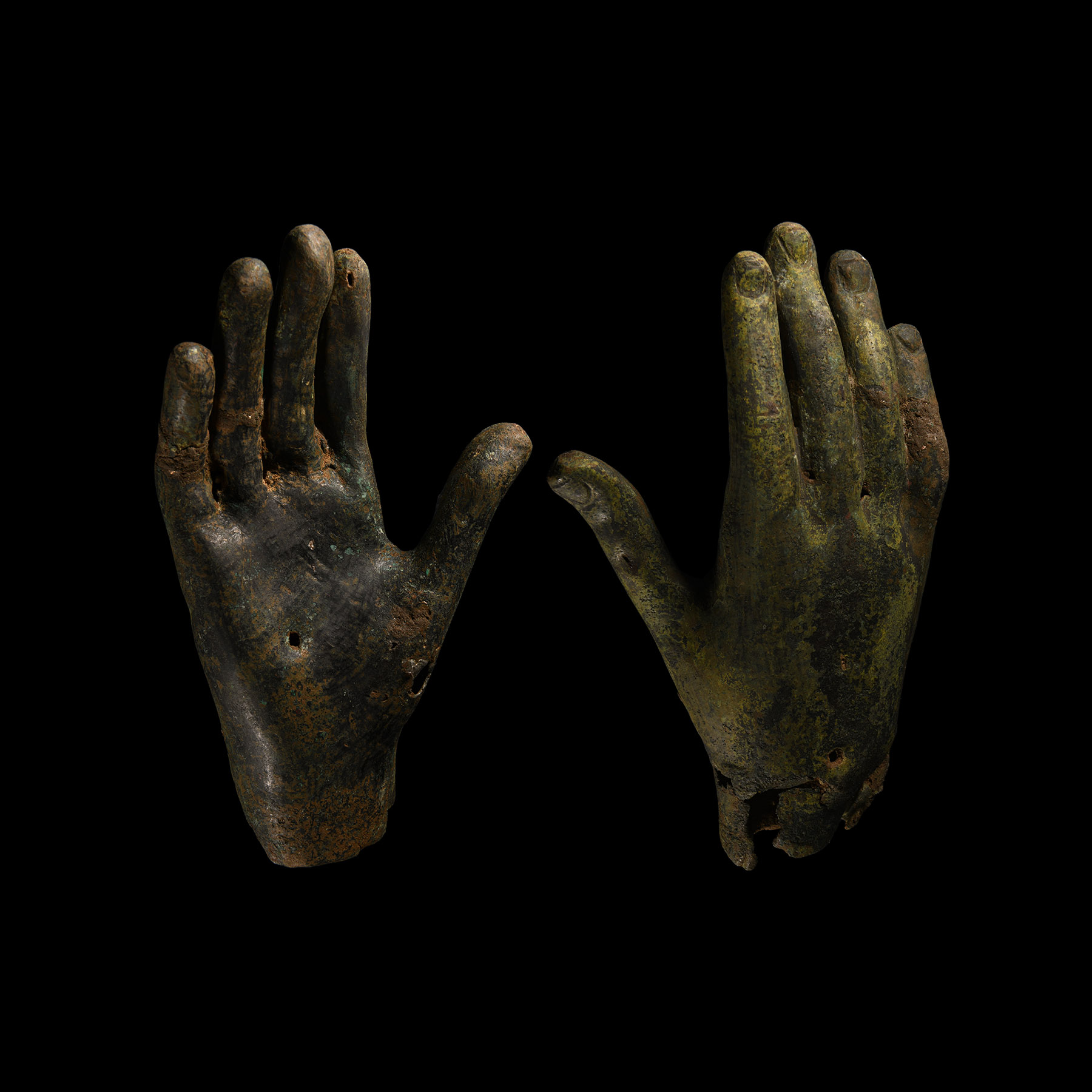
Roman Bronze Hand-Shaped Military Standard Finial
1ST-3RD CENTURY A.D.
8 1/8 in. (718 grams, 21 cm).
Hollow-formed with fine detailing to the fingers and nails; with fixing points for a military standard (signum) used by each unit under a centurion, originally fixed with the palm facing forwards inside a wreath.
ProvenanceAcquired in Europe before 2000.
European private collection.
Accompanied by an academic report by Dr Raffaele D'Amato.
This lot has been checked against the Interpol Database of stolen works of art and is accompanied by a search certificate number no.12003-211851.
Cf. a similar item from Martigny, in Zürich, Schweizerisches Landesmuseum, inventory nr. 41434, see Von Gonzenbach, V., 'Fides Exercituum, eine Hand von Vindonissa', in Jahrbuch der Gesellschaft Pro Vindonissa, 1951-1952, pp.5ff.; D’Amato, R., Arms and armour of the Roman Imperial Soldier, 112 BC - AD 192, London, 2009, p. 170, fig.239; Toepfer K.M., Die römischen Feldzeichen in der Republik und im Prinzipat, Mainz, 2011, NZ52; D’Amato, R., Roman standards and standard-bearers, (1), 112 BC - AD 192, Oxford, 2018, p.31.
FootnotesRoman military signa decorated by phalerae and surmounted by a right hand are visible since the Late Consular Age. The hand (manus) symbolised the fides, i.e. the allegiance between the soldiers and the Res Publica. It is also possible that the hand belonged to a statue in which it was extended as a sign of silence, to allow the speaker to speak. However, the iconography of military hands, and also the resemblance with a bronze hand (military signum) preserved in the Vindonissa museum (Windisch), support the possibility that the object was part of a military standard.
CONDITIONTimeLine Auctions follows a vetting process to ensure the authenticity and legality of all items, reinforcing our commitment to integrity and responsible trading. Each antiquity, antique, and coin lot undergoes thorough examination by a vetting committee of at least ten external specialists, professional trade association members, scientists, and archaeologists: Our Vetting Process
AUCTIONS:
TimeLine is a leading auction house specialising in antiquities, ancient art, collectables, natural history, coins, medals, and books. Our auctions offer museums, collectors, historians, and enthusiasts the opportunity to acquire unique and historically significant pieces.
LOT 0130
Roman Bronze Hand-Shaped Military Standard Finial
Estimate £5,000 - 7,000€5,800 - 8,120 (for guidance only)$6,750 - 9,450 (for guidance only)
-
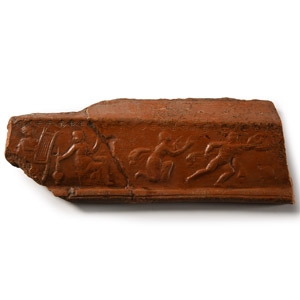
Roman Redware Pottery Sherd with Achilles and Thetis
4th-5th century A.D.Sold for (Inc. bp): £169
From the upper part of a vessel, displaying a frieze of profile images and figural scenes from Graeco-Roman mythology: a musician in late Roman garments playing a harp (Orpheus?), a seated woman weaving with a distaff in her hand (Penelope?), a kneeling naked woman imploring a naked warrior fighting with shield and spear (Achilles and Thetis?). 202 grams, 18 cm
Acquired 1960s-1990s. From the late Alison Barker collection, a retired London barrister.
This terra sigillata fragment appears to have been part of a large tray. Elements of dying paganism were still used to celebrate the deeds of the new imperial heroes. Note the detailed late Roman clothing of the harpist, with a chlamys-paludamentum on the right shoulder and the tunic decorated with clavi and orbiculi. -
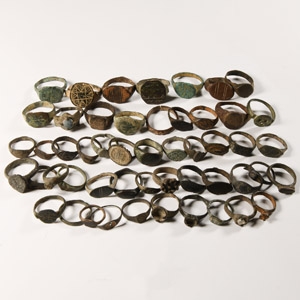
Roman and Later Bronze Ring Collection
1st century A.D. and laterSold for (Inc. bp): £338
Comprising fifty-one rings including discoid, scaphoid, square, ellipsoid and other bezels, with hatching, profile animals, tiered panels and other designs. 139 grams total, 15-25 mm
Part formerly in a European collection, acquired before 1980. From a Dutch private collection. Part from the collection of a Surrey gentleman; acquired 1970-1980. -
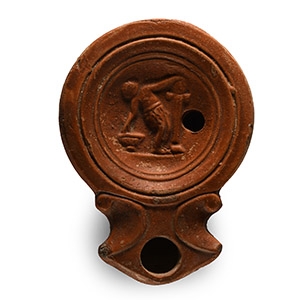
Roman Terracotta Oil Lamp with Figure
1st-2nd century A.D.Sold for (Inc. bp): £286
Comprising a shallow discus framed by concentric lines, low-relief image of a standing male reaching for a bowl with his right hand whilst supporting himself by grasping a low pillar with his left hand, filling hole flanking the pillar; volute to each side of the nozzle; maker's mark 'SVRIEPII'. 80 grams, 10.5 cm
Acquired on the European art market, 1980s. English private collection.
The period of activity of several well-known workshops—L M A D I E C , L M V N S V C , E R O T I S , G A B M E R C , and L M S V —is late Flavian to Trajanic, possibly Hadrianic.Based on this, we will not refer to the broader and too approximate dating given by Bailey to his group IV: Claudian to Trajanic.
