
Loading, please wait...
_900x900.jpg "Roman Bronze Goddess Applique")
_200x200.jpg "Roman Bronze Goddess Applique")
.jpg "Roman Bronze Goddess Applique")
LOT 0123
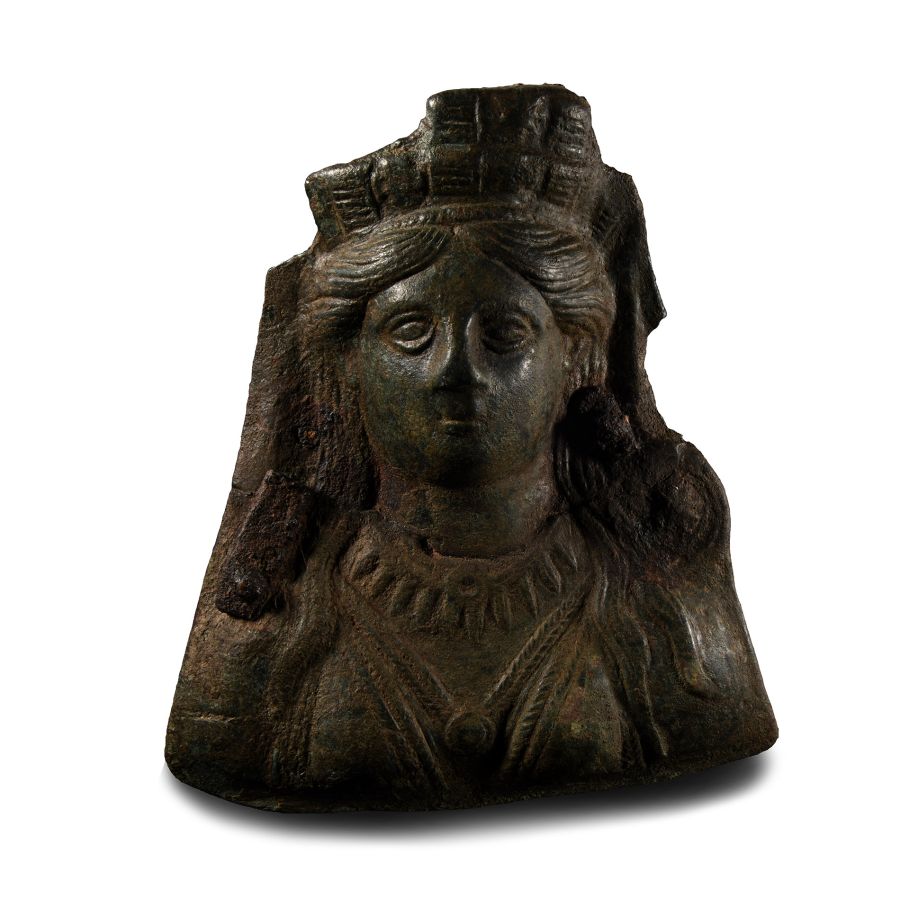
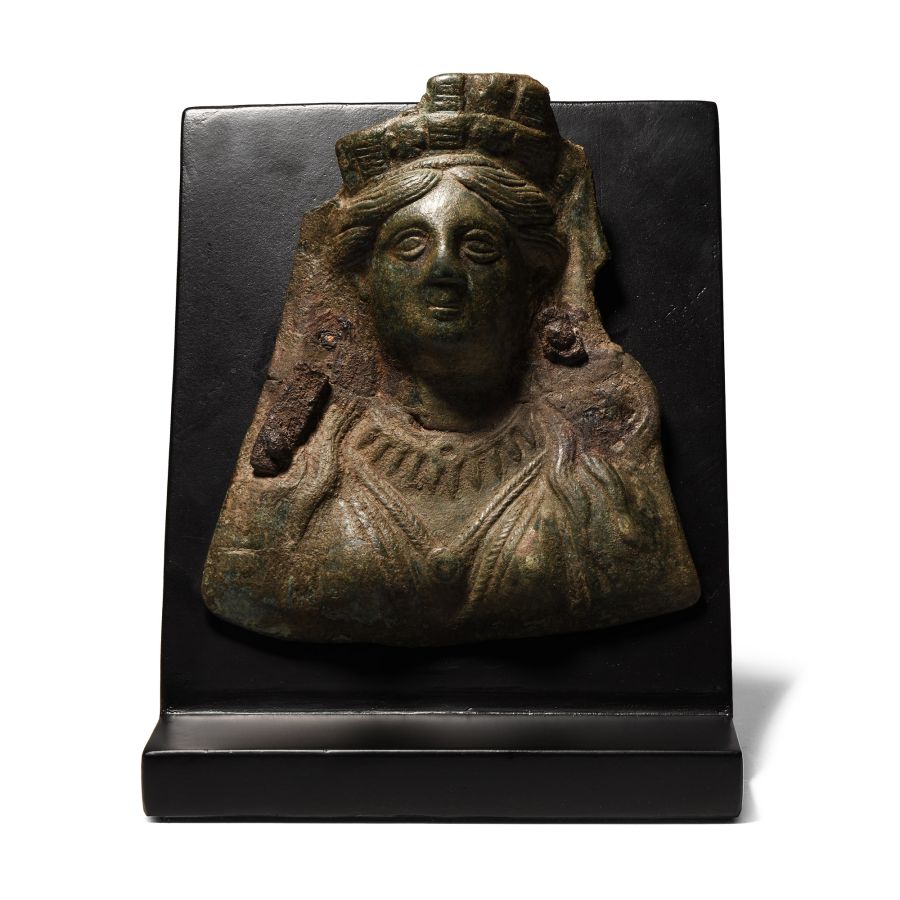
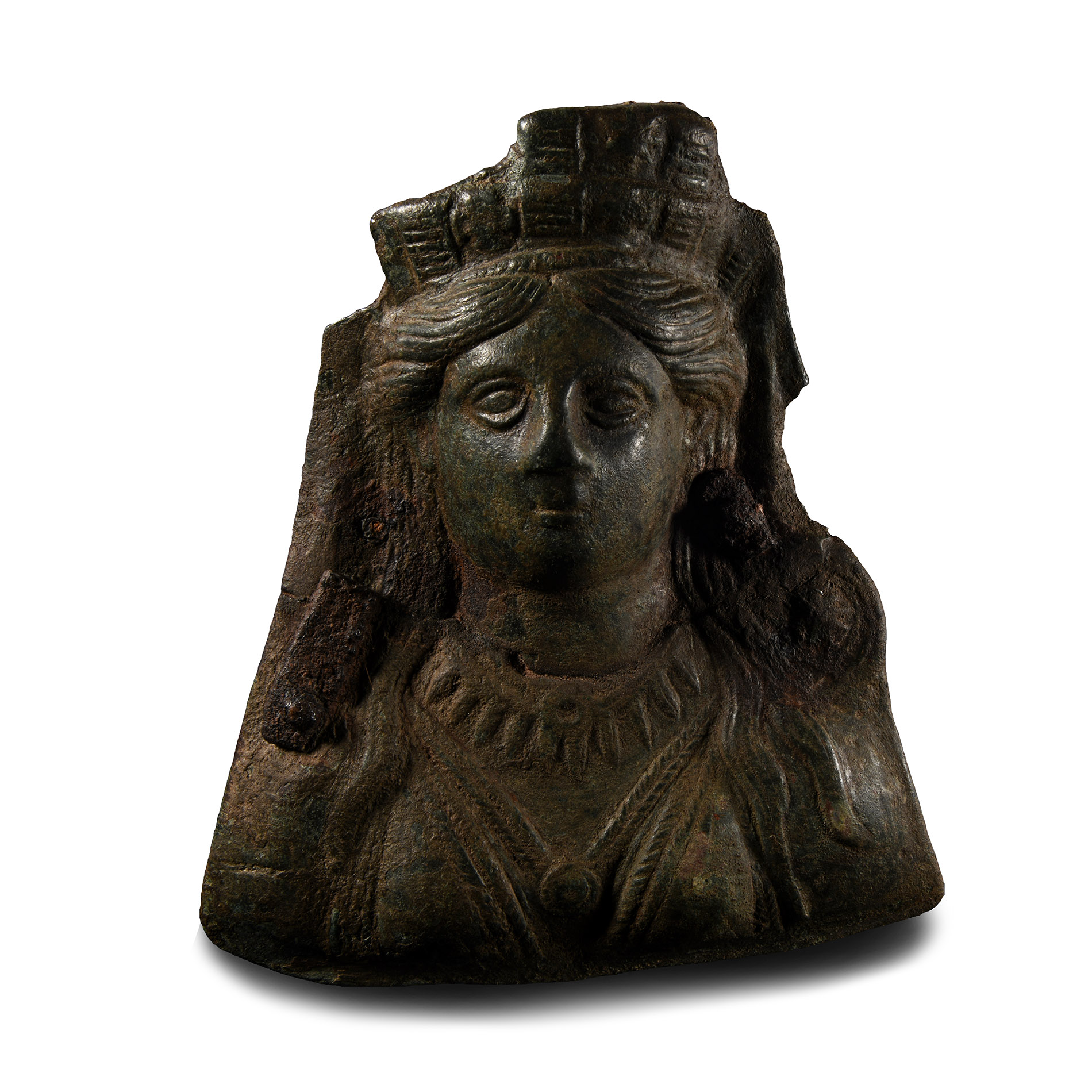
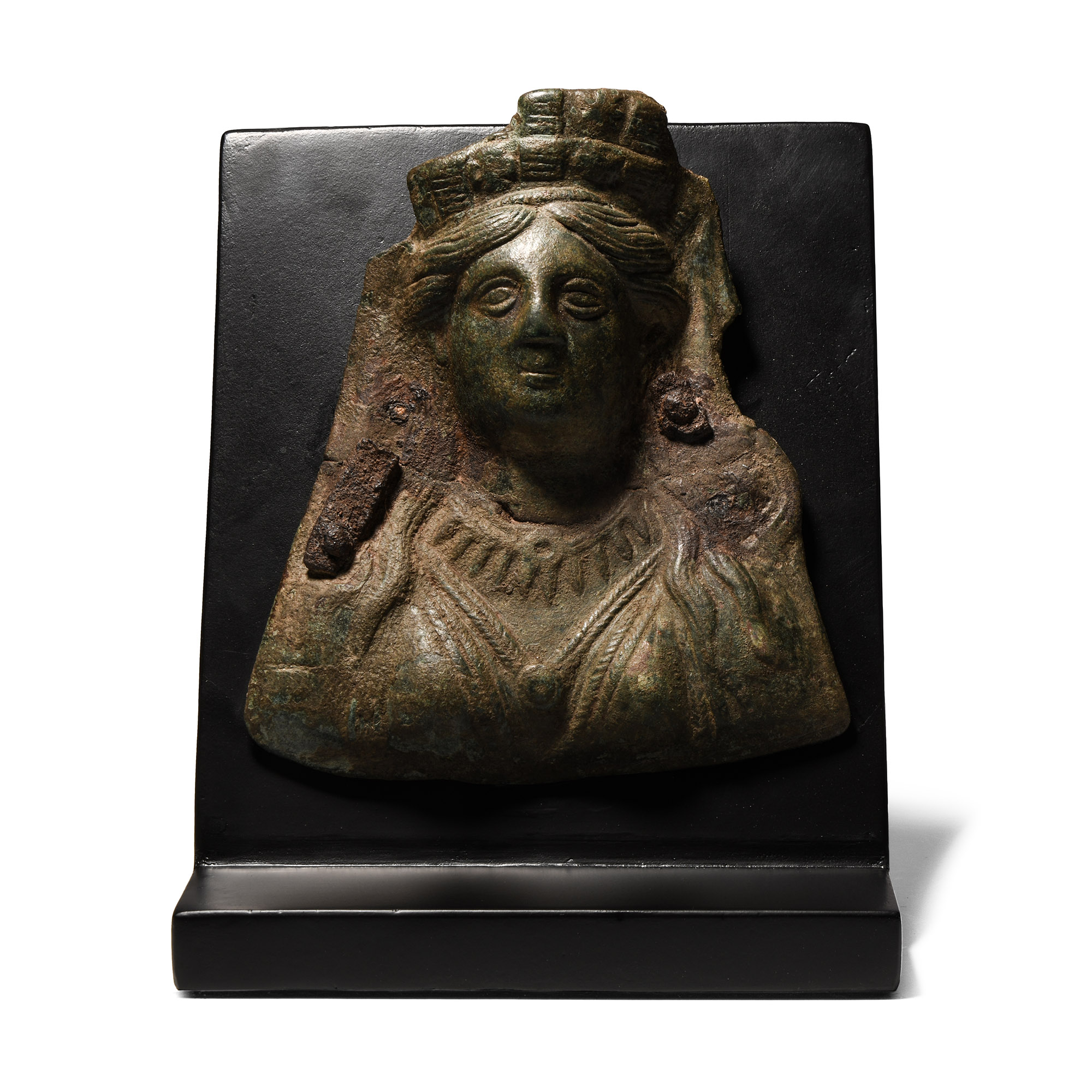
Roman Bronze Goddess Applique
2ND-3RD CENTURY A.D.
8 1/4 in. (3.66 kg total, 20.5 cm including stand).
The goddess Tyche or Cybele with a facing female bust wearing a mural crown, braided hair cascading to the sides, high-relief lenticular eyes, and small slit mouth, two iron fixing rivets; the lower part with detailed necklace of pendants, catena decorative chain, lateral braids, ferrous fixture; old collector's label 'BR.APP.064' to verso; repaired and mounted on a custom-made display stand.
ProvenancePrivate collection of Mr S.A., Switzerland, 1990s, thence by descent.
LiteratureCf. Beutler, F. et al., Der Adler Roms. Carnuntum und der Armee der Cäsaren, Bad-Deutsch Altenberg, 2017, item 69, for type, referred to as Isis-Venus; for Cybele with a mural crown see Reinach, S., Repertoire de la statuarie Grecque et Romaine, Paris, 1930, p.369; see also Metropolitan Museum of Art inventory no.47.100.40, for a bronze statuette of Tyche with mural crown.
FootnotesThe crown that characterises the bronze applique (corona muralis = wall crown) was a military decoration using symbolism from the Hellenistic age. Often associated with Tyche (Fortuna), the crown was also an attribute of the goddess Cybele, particularly when made of wood. However, the presence of a necklace similar to a late Roman statuette of Tyche at the Metropolitan Museum of Art seems to point more to the first identification. This bronze applique was probably used as decoration for a chariot used in a procession for the goddess, or as a furniture decoration.
CONDITIONTimeLine Auctions follows a vetting process to ensure the authenticity and legality of all items, reinforcing our commitment to integrity and responsible trading. Each antiquity, antique, and coin lot undergoes thorough examination by a vetting committee of at least ten external specialists, professional trade association members, scientists, and archaeologists: Our Vetting Process
AUCTIONS:
TimeLine is a leading auction house specialising in antiquities, ancient art, collectables, natural history, coins, medals, and books. Our auctions offer museums, collectors, historians, and enthusiasts the opportunity to acquire unique and historically significant pieces.
-
Roman Bronze Bear-Head Dagger Pommel
1st-2nd century A.D.Sold for (Inc. bp): £59
Hollow-formed with acute lower jaw, triangular muzzle, gusset and rounded rim to the socket-mouth. 29.5 grams, 44 mm
Property of a Gloucestershire, UK, collector. Property of an East Sussex, UK, gentleman. -
Silver Roman Coin and Limited Edition Framed Print
1st century B.C. and laterSold for (Inc. bp): £20
The Roman Republican silver denarius mounted on 22 carat gold foil, framed with an art print signed by the artist David McAllister, depicting scenes of Roman military activity; limited edition number 25/1150. 1.3 kg total, 48.5 x 36.5 cm
UK gallery, early 2000s. Accompanied by a previous certificate of authenticity.
David McAllister's exciting design is a 'one of a kind' work that portrays the might and riches of the Roman civilisation. This limited edition print is a celebration of the award winning artist's lifetime dedication to historical paintings of the ancient world. To enhance appreciation of this rare and historic work, each individual print is signed and numbered by the artist. -
.jpg)
Roman Bronze Horse Head Whorl Brooch
3rd-4th century A.D.Sold for (Inc. bp): £85
Swastika-shaped fibula with horse-head decoration, each head with punched ring-and-dot eye, a similar motif to the centre. 16.7 grams, 45 mm
Acquired before 2000. From the collection of a European gentleman living in the UK.
In the 3rd century A.D., several examples of fibulae in the shape of four horses’ heads forming a swastika (type Almgren 232) seem to be related to the creation of the Illyrian cavalry corps in Roman army. Many examples of these military fibulae were found in ancient Roman Dacia (Romania), in Roman Illyricum and Moesia.
