
Loading, please wait...
_900x900.jpg "Roman Bronze Figure of Apollo")
_200x200.jpg "Roman Bronze Figure of Apollo")
.jpg "Roman Bronze Figure of Apollo")
LOT 0191
Roman Bronze Figure of Apollo
CIRCA 1ST CENTURY A.D.
7 1/2 in. (700 grams, 19 cm).
Standing nude with a chlamys draped over his left shoulder and fastened on the right shoulder, bearing the weight on his right foot with the left leg bent at the knee with the heel raised; the right arm extended and holding the remains of an attribute, the left arm bent at the elbow; his head turned slightly to the right with long luxurious hair swept back and gathered at the nape of the neck; set on a circular socle base; stripped and repatinated.
ProvenanceAcquired at Mythes ét Légendes, 18 Place des Vosges, Paris, 14 May 1980.
Private collection, France.
Ex Jean Roudillon, Hôtel des Ventes de Belfort SARL, 22 October 2011, no.9.
with Christie's, London, 2 April 2014, no.91.
Accompanied by copies of the relevant Christie's catalogue pages.
Accompanied by a copy of an Art Loss Register certificate no.S0007570.
Accompanied by a copy of French passport no.132675 dated 7 December 2011.
Accompanied by an academic report by Dr Raffaele D’Amato.
This lot has been checked against the Interpol Database of stolen works of art and is accompanied by a search certificate number no.12360-226681.
This lot has been cleared against the Art Loss Register database, and is accompanied by an illustrated lot declaration signed by the Head of the Antiquities Department, Dr Raffaele D'Amato.
Cf. Rolland, H., Bronzes Antiques de Haute Provence, XVIII supplément à ‘Gallia’, Paris, 1965, no.17, same type without cloak; see also Reinach, S., Répertoire de la statuaire grecque et romaine, Paris, 1897, p.83, nos.3-4, 84, no.8, for the archaic prototypes; for discussion on statuettes of Apollo with patera inside cult places, see Fogolari, G. & Gambacurta, G., Materiali preromani e romani del santuario di Lagole di Calalzo al Museo di Pieve di Cadore (Collezioni e Musei Archeologici del Veneto, 44), Roma, 2001; Bolla, M., ‘Bronzi figurati romani da luoghi di culto dell’Italia settentrionale’ in LANX 20 (2015), pp. 49‐143.
FootnotesThe figurine is of archaic style; it is probably a provincial work of a Gallo-Roman workshop. The prototype can be seen in the Apollo of Naxos in the Berlin Museum. The style of posture and movement can also be seen in the archaic bronzes of Falterona, the Louvre and Athens.
CONDITIONTimeLine Auctions follows a vetting process to ensure the authenticity and legality of all items, reinforcing our commitment to integrity and responsible trading. Each antiquity, antique, and coin lot undergoes thorough examination by a vetting committee of at least ten external specialists, professional trade association members, scientists, and archaeologists: Our Vetting Process
AUCTIONS:
TimeLine is a leading auction house specialising in antiquities, ancient art, collectables, natural history, coins, medals, and books. Our auctions offer museums, collectors, historians, and enthusiasts the opportunity to acquire unique and historically significant pieces.
-
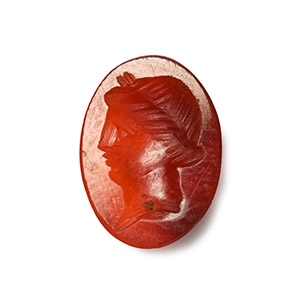
Roman Carnelian Gemstone with Female Portrait
1st-2nd century A.D.Estimate: £200 - 300 (+bp*)
Opening Bid: £100
Ellipsoid in plan with intaglio profile portrait bust of a female with hair in a chignon. 0.22 grams, 9 mm
Acquired on the German art market, 1989-1995. with The Museum Gallery, 19 Bury Place, London, WC1, UK, 1998-2003. Property of a London based academic, 2003 to present. This lot is accompanied by an illustrated lot declaration signed by the Head of the Antiquities Department, Dr Raffaele D'Amato. -
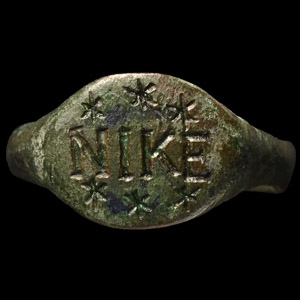
Roman Bronze Ring with NIKE
2nd-4th century A.D.Sold for (Inc. bp): £143
Comprising a D-section hoop and oval bezel bearing a possibly later 'NIKE' inscription with starburst motifs on the field. 2.91 grams, 21.24 mm overall, 18.25 mm internal diameter (approximate size British P, USA 7 1/2, Europe 16.23, Japan 15)
Ex German art market, 2000s. Acquired from an EU collector living in London. From the collection of a Surrey, UK, gentleman. This lot is accompanied by an illustrated lot declaration signed by the Head of the Antiquities Department, Dr Raffaele D'Amato. -
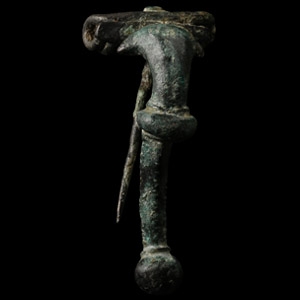
Roman Bronze Bow Brooch
2nd century A.D.Estimate: £100 - 140 (+bp*)
Opening Bid: £50
With chord and pin (now detached) at the head, D-section bow with lateral spurs, collar and swept foot with notched detailing, bulb finial, catch to the reverse. 26.6 grams, 54 mm
Ex important German collection, 1990s. This lot is accompanied by an illustrated lot declaration signed by the Head of the Antiquities Department, Dr Raffaele D’Amato. This lot is accompanied by an illustrated lot declaration signed by the Head of the Antiquities Department, Dr Raffaele D'Amato.
