
Loading, please wait...
LOT 0071
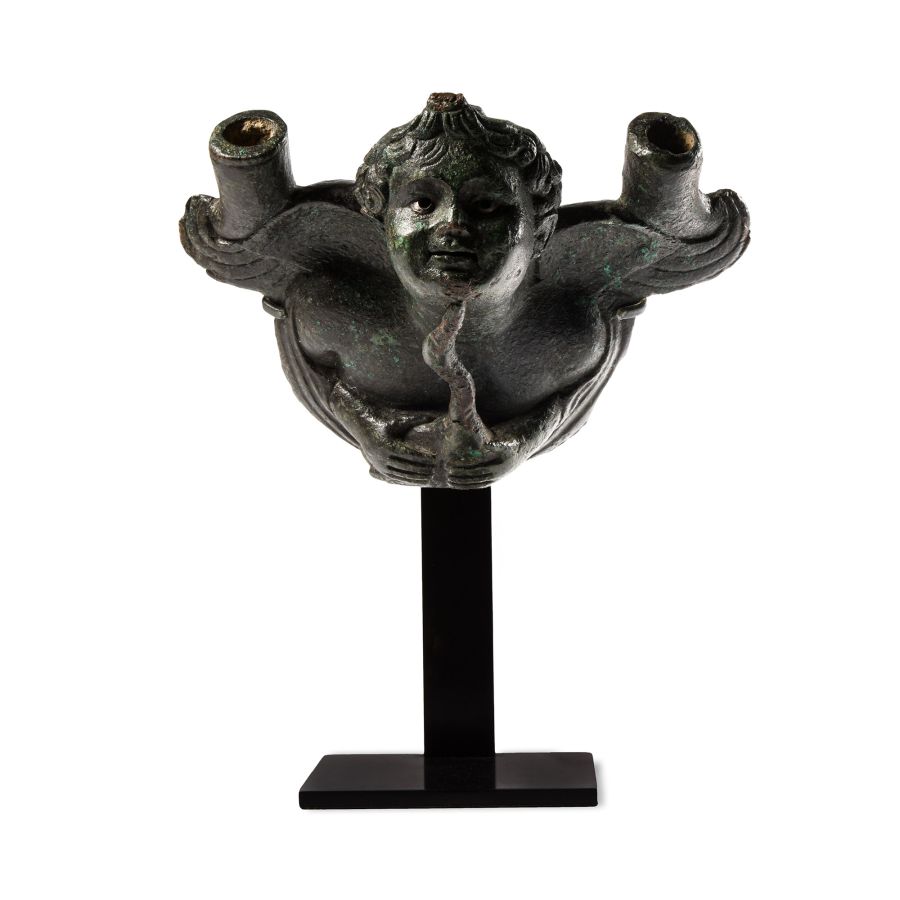
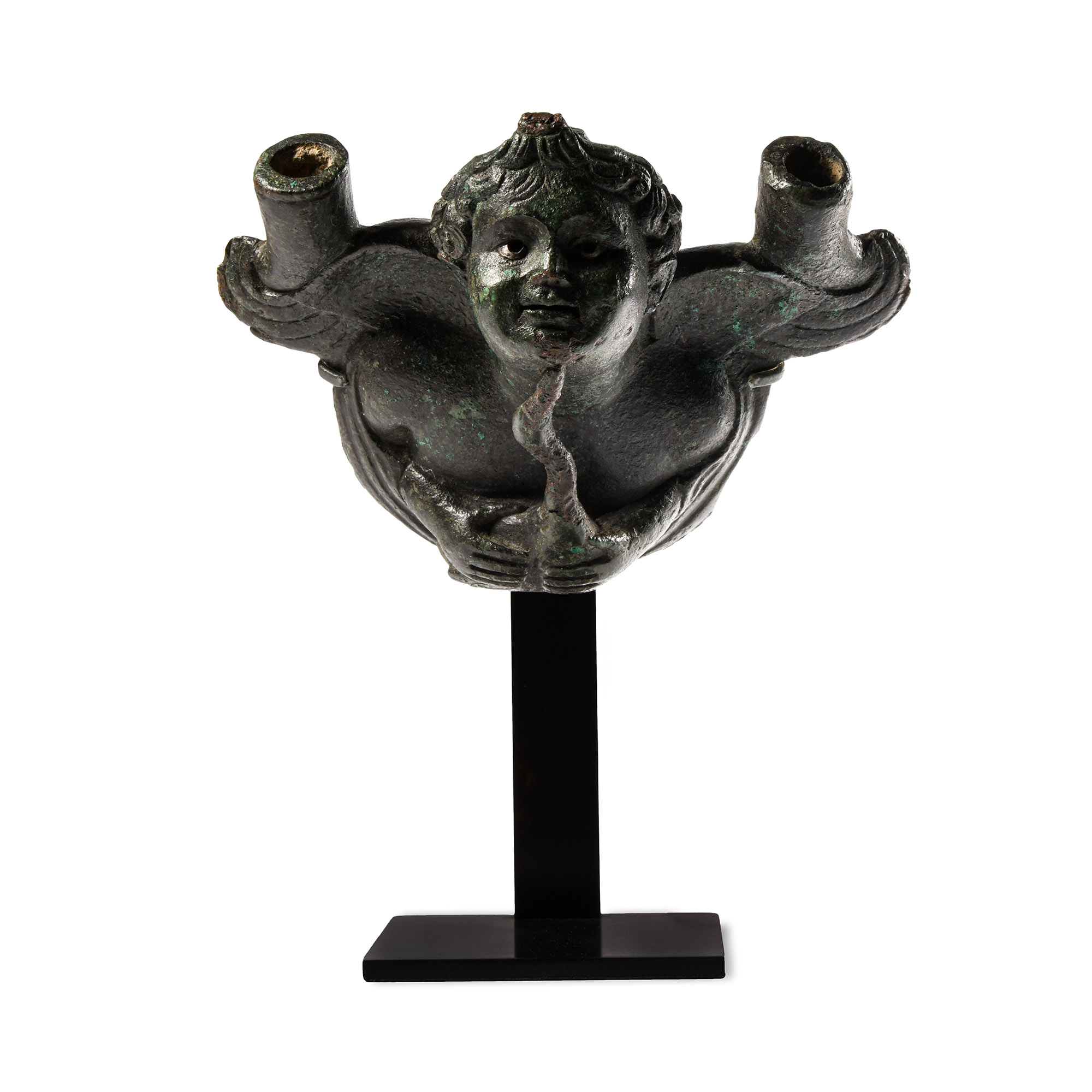
Roman Bronze Eros Cradling Goose Applique
LATE 1ST-EARLY 2ND CENTURY A.D.
4 3/4 in. (5 1/2 in.) (517 grams total, 11.9 cm wide (744 grams total, 14 cm high including stand)).
Formed as the bust of Eros looking upwards, stub wings to his shoulders, holding a goose to his chest; conical socket above each wing; eyes with silver inserts; old collector's label '1994 51.75' to the reverse; mounted on a custom-made stand; likely a socket base.
Provenancewith Sotheby's, London, May 1988, lot 234.
Ex Malter galleries, XLV, 28 May 1991, lot 902.
Ex Bruce A. Kamerling collection.
Acquired from Royal Athena Galleries, New York, 26 June 1994.
The Haggin Museum, Stockton, California.
with Bonhams, Antiquities, 23 May 2012, lot 121.
Cf. Barr-Sharrar, B., The Hellenistic and Early Imperial Decorative Bust, Mainz am Rhein, 1987, items C117, C127, for type.
CONDITIONTimeLine Auctions follows a vetting process to ensure the authenticity and legality of all items, reinforcing our commitment to integrity and responsible trading. Each antiquity, antique, and coin lot undergoes thorough examination by a vetting committee of at least ten external specialists, professional trade association members, scientists, and archaeologists: Our Vetting Process
AUCTIONS:
TimeLine is a leading auction house specialising in antiquities, ancient art, collectables, natural history, coins, medals, and books. Our auctions offer museums, collectors, historians, and enthusiasts the opportunity to acquire unique and historically significant pieces.
-
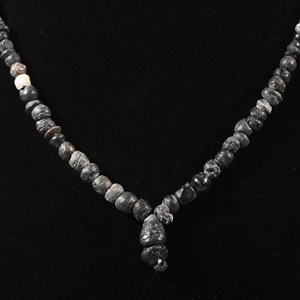
Roman Glass Bead Necklace
2nd-5th century A.D. or laterSold for (Inc. bp): £46
Composed of graduated monochrome opaque black glass beads of various types, including amorphous, facetted, spherical, carinated and other types; restrung. 16.8 grams, 80 cm long
Ex W.J. collection, 1990s. -

Roman Bronze Military Monkey
4th century A.D.Estimate: £800 - 1,000 (+bp*)
Opening Bid: £444
Modelled seated on a polygonal base wearing a paenula, the right hand placed on the left shoulder, head tilted to one side, right hand placed on a stela or lantern. 23.9 grams, 34 mm
‘The Ancient Menagerie Collection’ formerly the property of a Cambridgeshire lady, collected since the 1990s and acquired from auctions and dealers throughout Europe and the USA, now ex London collection.
The monkey is bearing a military sagum with cucullus and is holding beside him a squared lucerna. This representation can be a Roman military mascot or simply a grotesque. In 2001 in Spain, at Llivia, remains of Barbary apes with military belt buckles typically related to the late Roman period were discovered. The discovery of this type of belt buckle in a human grave would suggest that they were once a part of this army, so the fact that some were given to a Barbary ape means that the apes played a military role, for example, acted as targets to distract the enemy, or were used in type of a combat or for defence. Apes were also a very common form of pet in the Graeco-Roman world. -
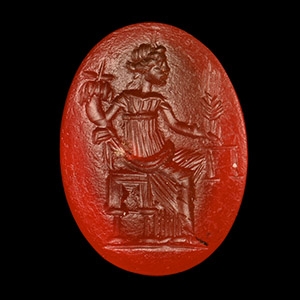
Roman Gemstone with Ceres
2nd-3rd century A.D.Sold for (Inc. bp): £260
Oval-shaped with scene depicting the goddess Ceres seated right, holding a cornucopia and ears of corn with scales below, wearing a modius. 0.93 grams, 14 mm
Altstetten collection since 1969.
Ceres was a goddess of agriculture, maternal relationships and fertility, and represents transition, motherhood and nurture. She was also the only one of ancient Rome's agricultural deities to be listed amongst the Dii Consentes, the Roman equivalent to the Twelve Olympians of Greek mythology.
