
Loading, please wait...
LOT 0914
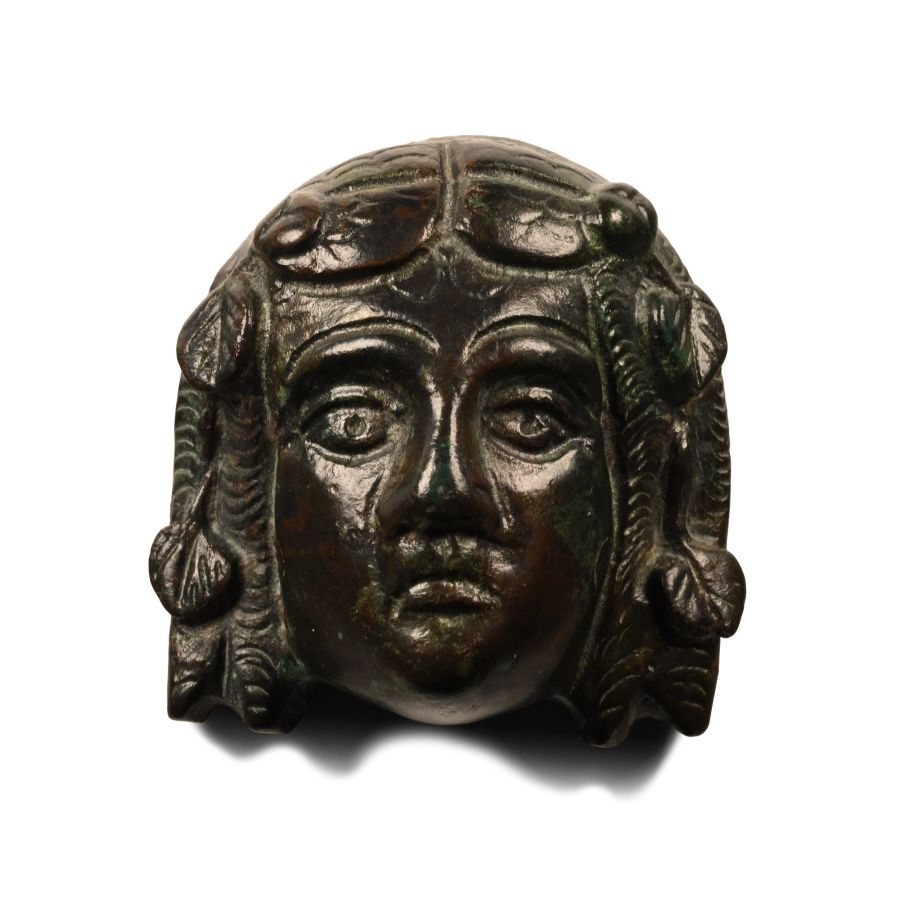
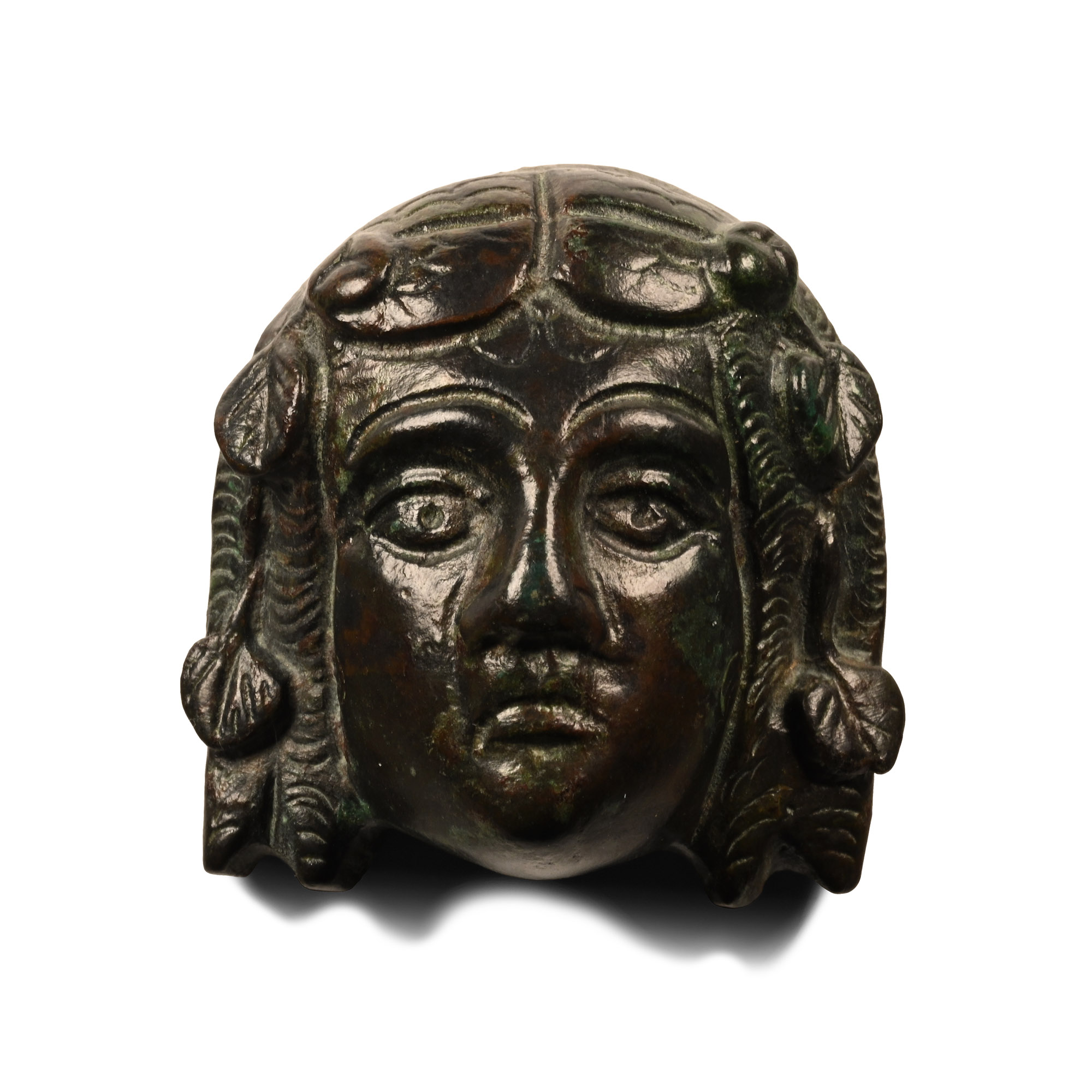
Roman Bronze Dionysus Attachment
1ST-2ND CENTURY A.D.
1 1/2 in. (90.7 grams, 40 mm).
Mask of Dionysus with vine leaves in the hair; hollow reverse filled with lead.
ProvenanceEx German art market, 2000s.
Acquired from an EU collector living in London.
From the collection of Surrey, UK, gentleman.
Cf. Boucher, S., Inventaire des Collections Publiques Françaises - 17 Vienne: Bronzes Antiques, Paris, 1971, item 298, for similar.
CONDITIONTimeLine Auctions follows a vetting process to ensure the authenticity and legality of all items, reinforcing our commitment to integrity and responsible trading. Each antiquity, antique, and coin lot undergoes thorough examination by a vetting committee of at least ten external specialists, professional trade association members, scientists, and archaeologists: Our Vetting Process
AUCTIONS:
TimeLine is a leading auction house specialising in antiquities, ancient art, collectables, natural history, coins, medals, and books. Our auctions offer museums, collectors, historians, and enthusiasts the opportunity to acquire unique and historically significant pieces.
LOT 0914
Roman Bronze Dionysus Attachment
Estimate £400 - 600€460 - 700 (for guidance only)$540 - 810 (for guidance only)
-
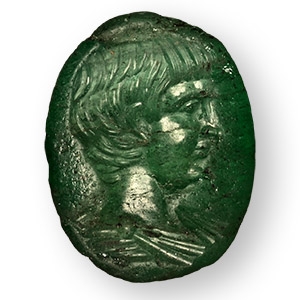
Roman Emerald Gemstone with Portrait of Young Nero
51-55 A.D.Sold for (Inc. bp): £6,500
Depicting Nero as a young boy, either as crown prince or within the first year of his reign in his first known portrait type, unequivocal with his long hair fringe. 2.17 grams, 17 mm
Ex Paul Munro Walker collection, Bournemouth, UK, 1970s. Private collection of Alexander Cotton, Hampshire, UK, sold October 1986. From a London gentleman's, UK, collection, in the 1990s. This lot has been checked against the Interpol Database of stolen works of art and is accompanied by a search certificate number no.12104-216215.
Dr Ittai Gradel writes: 'Date is AD 51-55. On most glyptic portraits from shortly after he became emperor, so 54-55, he is shown laurelled ... However, on the coins he is shown also bare-headed even as emperor in 54-55 (second coin, denarius). Again, on coins his bust is shown draped only before he became emperor in 54 (first coin, aureus), but cameos show him draped also as emperor (as e. g. the Marlborough one: but there are several known). It is therefore not possible to say if the emerald shows him as crown prince or as emperor, and I cannot date it more precisely than 51-55.' -

Roman Bronze Statuette of Athena
2nd-3rd century A.D.Sold for (Inc. bp): £3,640
Standing erect in contrapposto pose, wearing a floor-length himation and with the gorgoneion medallion on her chest; Corinthian helmet on her head tilted backwards to reveal her face; right arm raised and bent with open hand to accept a spear-shaft; mounted on a custom-made display stand. 279 grams total, 13 cm including stand
From a collection acquired on the UK art market from various auction houses and collections mostly before 2000. From an important Cambridgeshire estate; thence by descent.
The figure is a hybrid based on representation of Roman Minerva, closely associated with Greek Athena. The missing attributes are the spear and the shield, according to the type of Minerva of Firenze (Reinach, 1930, p.278). -
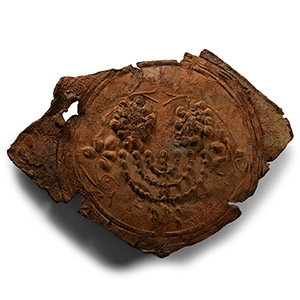
Roman Lead Sarcophagus Fragment with Menorah
2nd-3rd century A.D.Sold for (Inc. bp): £2,340
Irregular fragment with raised concentric rings, low-relief wreath and raised bulbs forming a stem with seven arms. 1.36 kg, 32.5 cm
Acquired on the German art market, 1989-1995. with The Museum Gallery, 19 Bury Place, London, WC1, UK, 1998-2003. Property of a London based academic, 2003-present. This lot has been checked against the Interpol Database of stolen works of art and is accompanied by a search certificate number no.12097-214786.
This fragment of a sarcophagus front is probably a remnant of a Jewish sarcophagus from the Roman period. It belongs to a style of sarcophagi made in the Levant, often decorated with dolphins, sphinxes and other symbols of the hereafter.
