
Loading, please wait...
LOT 0086
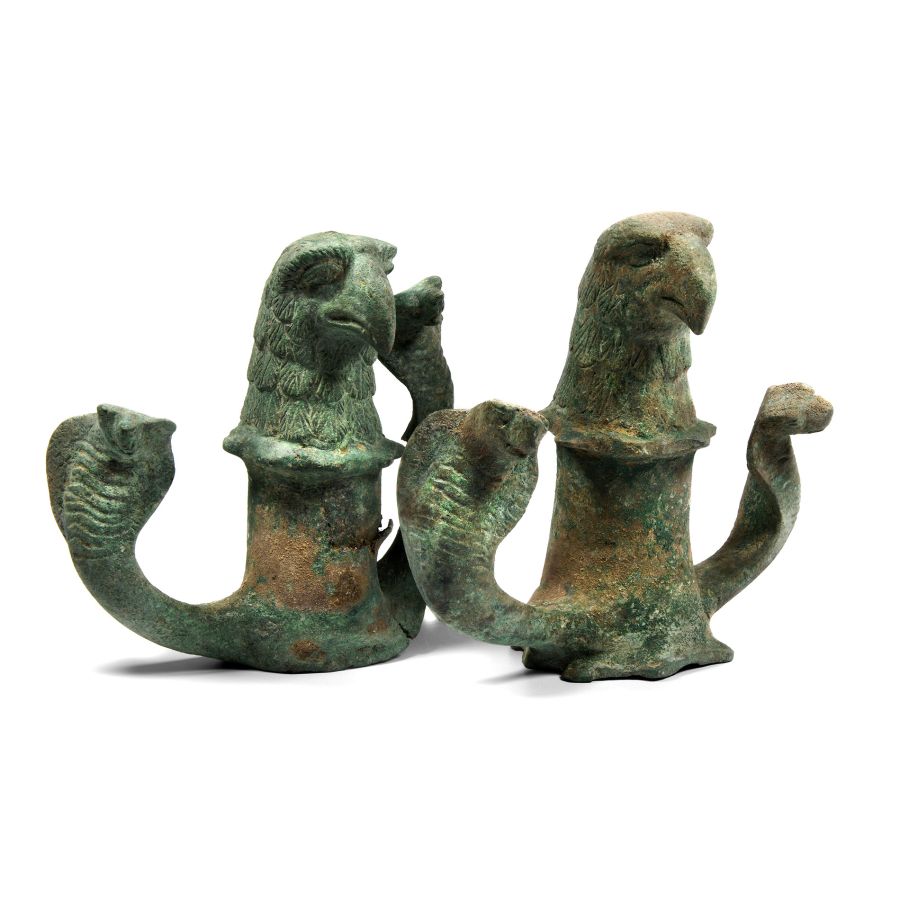
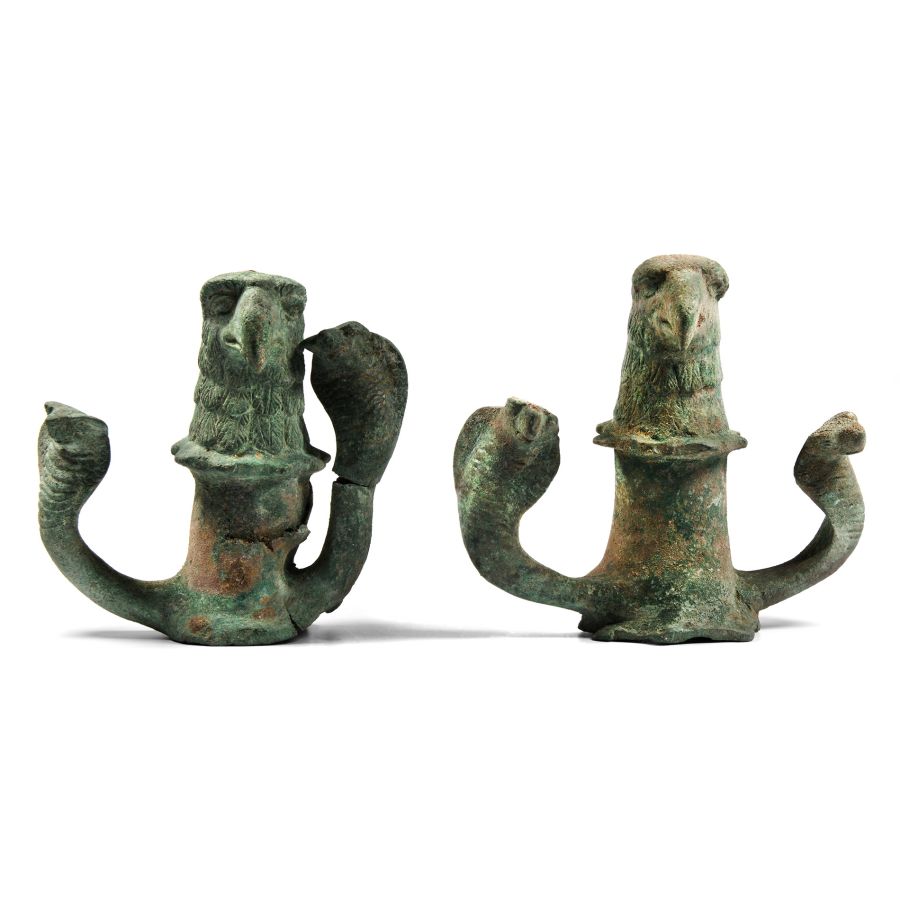
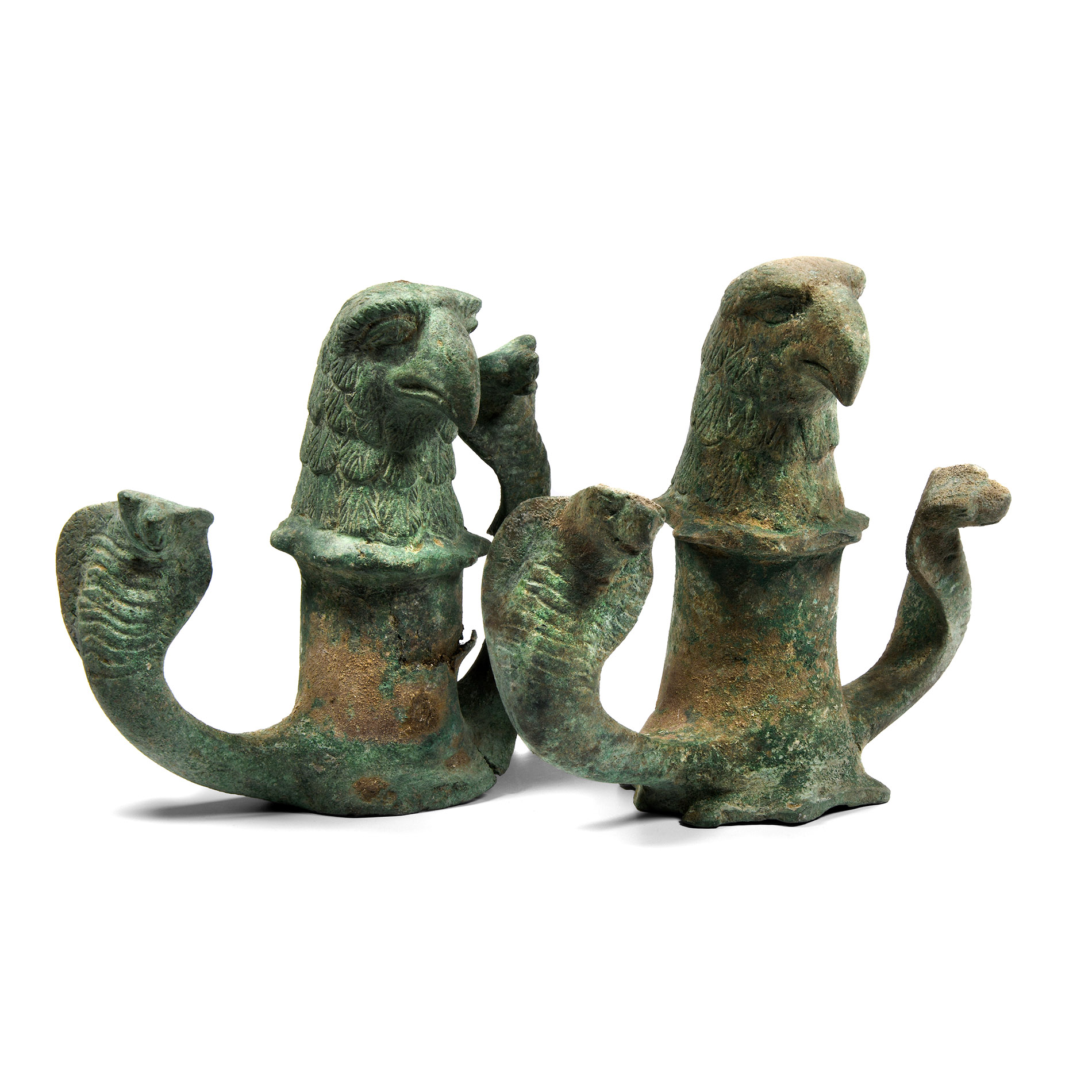
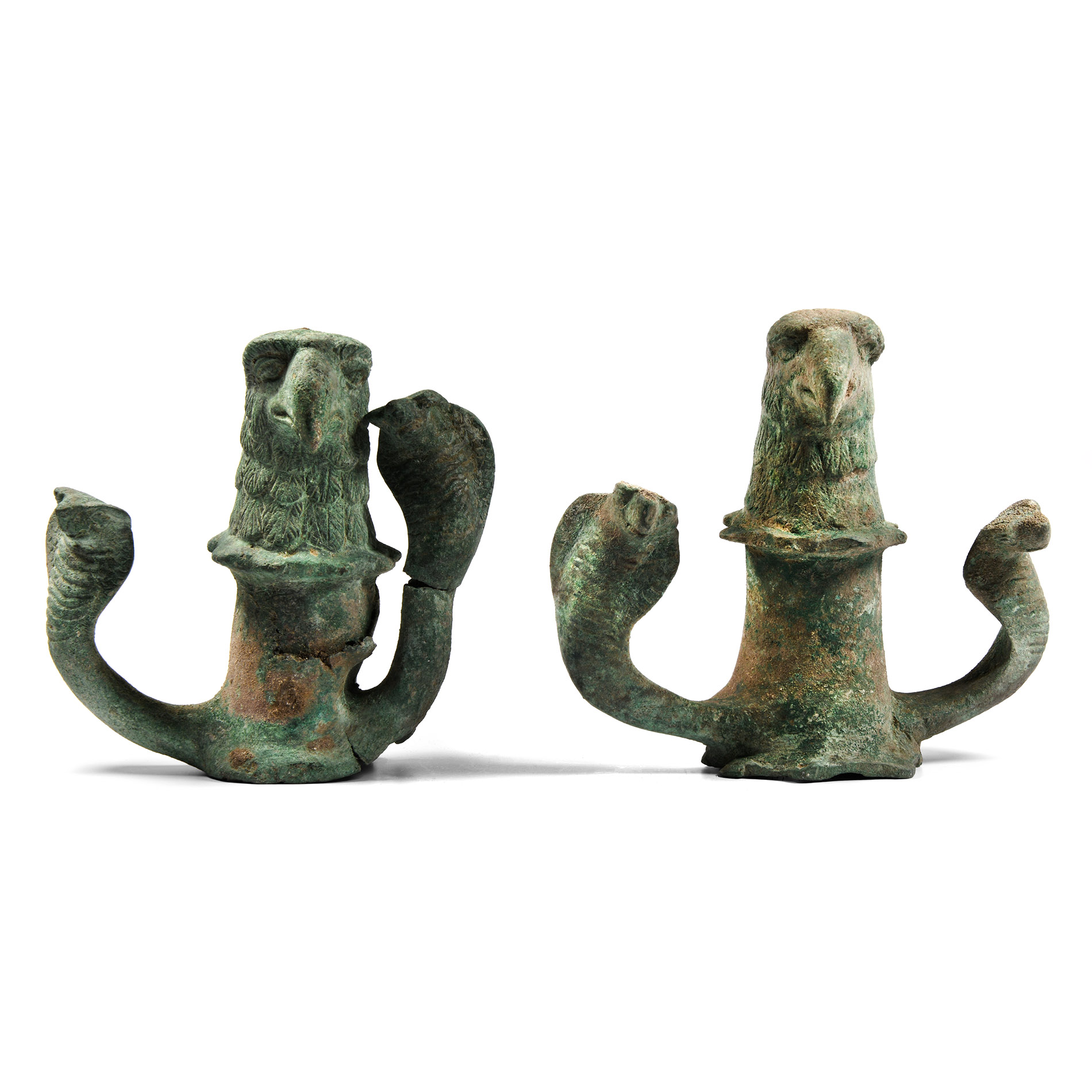
Roman Bronze Chariot Mount Pair with Eagle and Cobras
CIRCA 2ND-3RD CENTURY A.D.
5 1/8 - 5 3/8 in. (2.1 kg total, 13-13.7 cm).
Each protome composed of a gently tapering shallow octagonal body, the upper part formed as an eagle's head with semi-naturalistic hooked beak, eye and feather detailing, collar at the base of the neck decorated with crenelated borders; two upward curving arms terminating with stylised cobra heads; one with impact damage from a crash(?). [2]
ProvenancePrivate collection, Rosenheim, Germany, 1960s.
Accompanied by an academic report by Dr Raffaele D'Amato.
This lot has been checked against the Interpol Database of stolen works of art and is accompanied by search certificate number no.11732-201194.
Cf. Boube-Piccot, C., Les bronzes antiques de Maroc, III, Les chars et l’attelage, Rabata, 1980, p.199, no.333, from Banasa; cf. Wenedikov, I., Le char thrace, Sofia, 1960, pp.153-201, pl.97, and Gudea, N., Porolissum. Un complex arheologic daco-roman la marginea de nord a Imperiului roman. II. Vama romana (monografie arheologica). Contributii la cunoasterea sistemului vamal din provinciile dacice, Cluj-Napoca, 1996, fig.31 (also Boube-Piccot, 1980, fig.10bis); a similar sheath had been found with the chariot of Nicomedia, and a similar, with open lateral rings showing serpents have been found in Thrace: three with a chariot from the tumulus of Doukhowa-Moghila, four with a cart from Ljubimec (Wenedikov, 1960, pl.55A, fig.190-192; p.40, no.150, pl.30, fig.107), four with the cart from Svilengrad, and a single isolated find has been discovered in the Burgos region.
FootnotesThese chariot fittings were usually elements surmounting the axle, a sort of sheath allowing the suspension from the body of the cart to the wagon box using belts. The chariot (currus) which these fittings adorned may have been used for transporting wealthy and aristocratic individuals, although most probably it was a tensa, i.e. a triumphal chariot or a ceremonial vehicle upon which images and symbols of divinities were placed.
CONDITIONTimeLine Auctions follows a vetting process to ensure the authenticity and legality of all items, reinforcing our commitment to integrity and responsible trading. Each antiquity, antique, and coin lot undergoes thorough examination by a vetting committee of at least ten external specialists, professional trade association members, scientists, and archaeologists: Our Vetting Process
AUCTIONS:
TimeLine is a leading auction house specialising in antiquities, ancient art, collectables, natural history, coins, medals, and books. Our auctions offer museums, collectors, historians, and enthusiasts the opportunity to acquire unique and historically significant pieces.
LOT 0086
Roman Bronze Chariot Mount Pair with Eagle and Cobras
Sold for (Inc. bp): £6,110
-
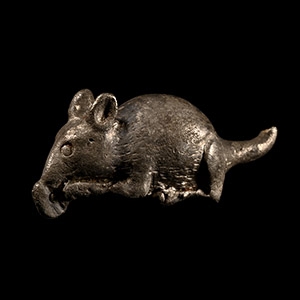
Roman Silver Mouse Figure
2nd-3rd century A.D.Sold for (Inc. bp): £624
Shown with semi-naturalistic detailing in a crouching posture, eating a nut held in its front paws. 7.74 grams, 27 mm
‘The Ancient Menagerie Collection’ formerly the property of a Cambridgeshire lady, collected since the 1990s and acquired from auctions and dealers throughout Europe and the USA, now ex London collection. -
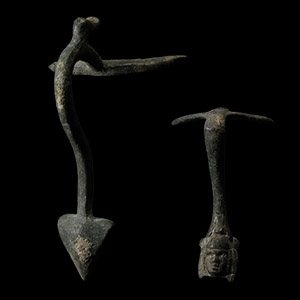
Roman Bronze Tankard Handle Group
Circa 1st-4th century A.D.Estimate: £100 - 140 (+bp*)
Opening Bid: £40
Comprising two differently sized handles, one featuring a female mask, the other with a leaf-shaped terminal and stylised duck's head to the apex of the bow. 411 grams total, 11.4-18 cm
Acquired 1990s-early 2000s. East Anglian private collection. -
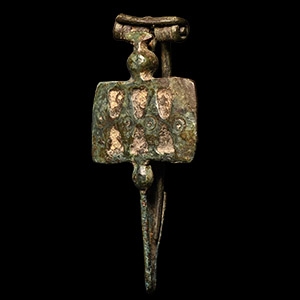
Roman Bronze Hod Hill Type Brooch
1st century A.D.Sold for (Inc. bp): £78
Of unusual style, similar to the Hod Hill type with a rectangular plate, two bulbs above and below, integral spring and pin to the reverse; below the plate a fine extension returned beneath to form the catchplate. 6.56 grams, 50 mm
Acquired 1970s-1980s. From a London brooch collector.
