
Loading, please wait...

LOT 0691
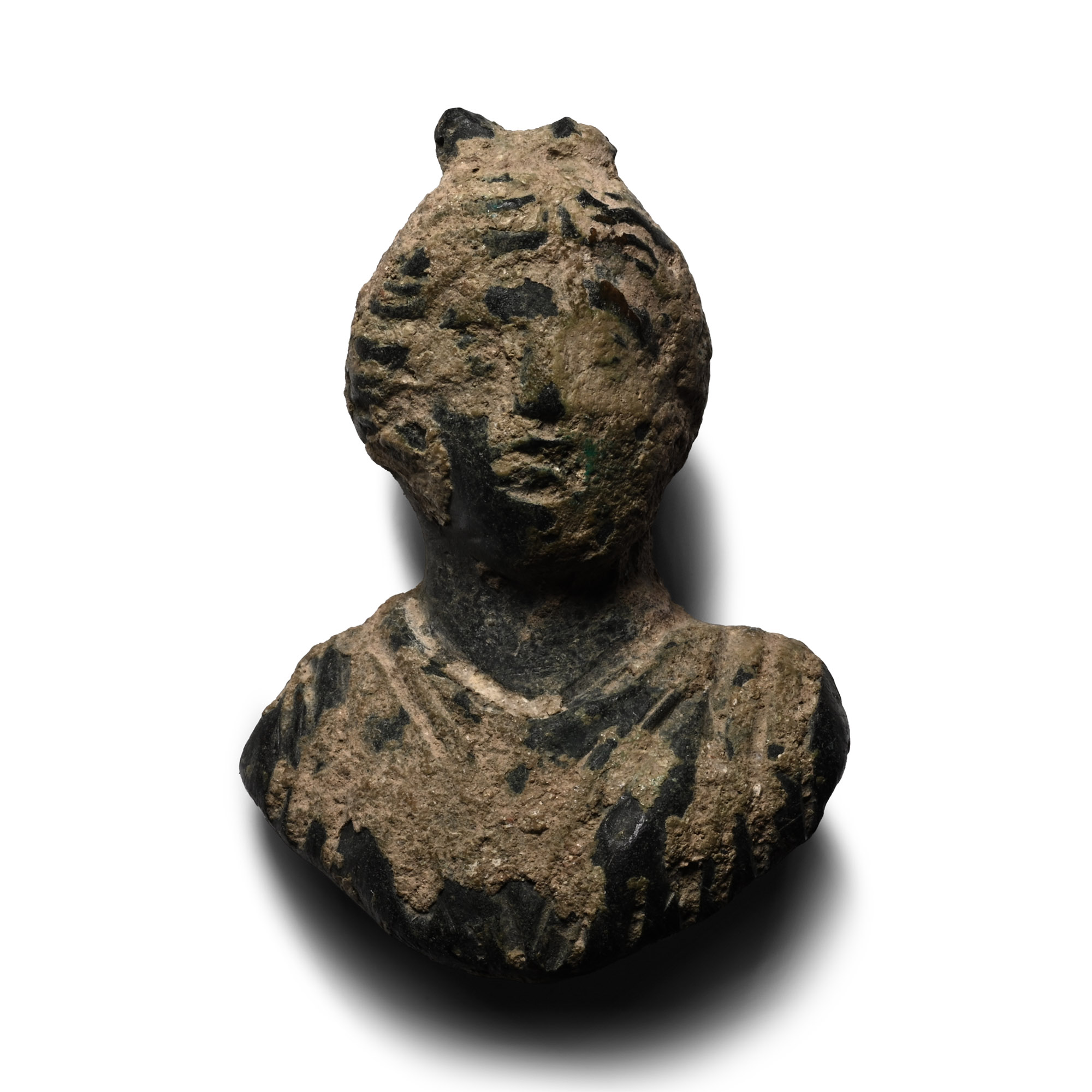
Roman Bronze Bust of a Woman
2ND-3RD CENTURY A.D.
2 3/8 in. (140 grams, 60 mm).
Modelled in the round with stephane to the hair, crescent above, wearing a peplos dress with undertunic; mounting lug to reverse.
ProvenanceAcquired in the mid 1980s-1990s.
Private collection, Switzerland, thence by descent.
Private collection, since the late 1990s.
This lot is accompanied by an illustrated lot declaration signed by the Head of the Antiquities Department, Dr Raffaele D'Amato.
Cf. Rolland, H., Bronzes Antiques de Haute Provence, XVIII supplément à ‘Gallia’, Paris, 1965, no.473, for similar.
FootnotesThe small bronze sculpture could represent the 'Night' (divinity), with the crescent moon on her head. It could have been an appliqué from a ceremonial chariot, or an appliqué for furniture or triclinium bed.
CONDITIONTimeLine Auctions follows a vetting process to ensure the authenticity and legality of all items, reinforcing our commitment to integrity and responsible trading. Each antiquity, antique, and coin lot undergoes thorough examination by a vetting committee of at least ten external specialists, professional trade association members, scientists, and archaeologists: Our Vetting Process
AUCTIONS:
TimeLine is a leading auction house specialising in antiquities, ancient art, collectables, natural history, coins, medals, and books. Our auctions offer museums, collectors, historians, and enthusiasts the opportunity to acquire unique and historically significant pieces.
-
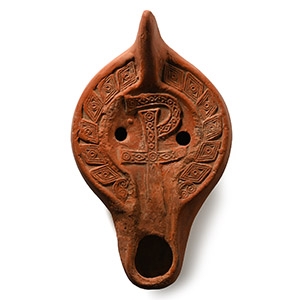
Late Roman Terracotta Oil Lamp with Christogram
5th-6th century A.D.Estimate: £400 - 600 (+bp*)
Opening Bid: £222
With a decorated Christogram and filled circles and quatrefoil ornaments on the shoulder. 199 grams, 14 cm
From the private collection of H. L., Rheinland, Germany, before 2000. This lot is accompanied by an illustrated lot declaration signed by the Head of the Antiquities Department, Dr Raffaele D'Amato. -
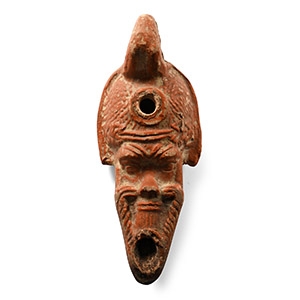
Roman Terracotta Oil Lamp of Head of Silenus
Late 1st century B.C.-early 1st century A.D.Sold for (Inc. bp): £312
Mould-made with the upper half of the body in the form of a male head with well-defined features, long moustache and beard, possibly a representation of the god Silenus; ring handle at the rear. 82 grams, 12.1 cm
Previously Cambridge, UK, private collection, circa 2010. Ex London, UK, gallery. This lot is accompanied by an illustrated lot declaration signed by the Head of the Antiquities Department, Dr Raffaele D'Amato.
Plastic lamps with figurines first appear in the Hellenistic period, possibly originating in Athens. Found in all parts of the Mediterranean basin, they were particularly popular during the first and second centuries AD. -
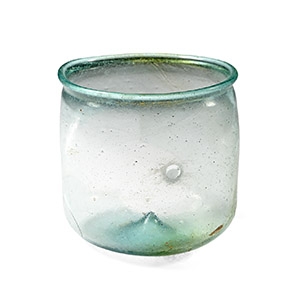
Roman Glass Cup with Piece Missing
1st-2nd century A.D.Sold for (Inc. bp): £72
Aqua glass drum-shaped jar with waisted rim and pontil base; cracked and one piece absent. 34 grams, 68 mm high
Audrey Davies, Astarte Gallery, London, UK, 1986. Ex private UK collection. This lot is accompanied by an illustrated lot declaration signed by the Head of the Antiquities Department, Dr Raffaele D'Amato.
