
Loading, please wait...
_900x900.jpg "Roman Bronze Bowl with Concentric Circles")
_200x200.jpg "Roman Bronze Bowl with Concentric Circles")
.jpg "Roman Bronze Bowl with Concentric Circles")
LOT 0666
Roman Bronze Bowl with Concentric Circles
1ST CENTURY A.D.
3 1/4 in. (142 grams, 83 mm).
With flat base and central boss, flared rim, incised rings to the inner face.
ProvenanceAcquired 1980-2015.
Ex Abelita family collection.
Cf. Tassinari, S., La Vaisselle de Bronze, Romaine et Provinciale, au Musée des Antiquités Nationales, XXIXe supplément de Gallia, Paris, 1975, items 88,90, for similar types.
FootnotesThe function of Roman vessels is not always precise, as well as the separation between culinary forms and forms for domestic use, those of the kitchen and those of the table. Many bronzes belonged to table service (like perhaps this splendidly preserved example), others to objects of usual worship (patera) or washing, while basins, plates and crockery found their place above all in the kitchen.
CONDITIONTimeLine Auctions follows a vetting process to ensure the authenticity and legality of all items, reinforcing our commitment to integrity and responsible trading. Each antiquity, antique, and coin lot undergoes thorough examination by a vetting committee of at least ten external specialists, professional trade association members, scientists, and archaeologists: Our Vetting Process
AUCTIONS:
TimeLine is a leading auction house specialising in antiquities, ancient art, collectables, natural history, coins, medals, and books. Our auctions offer museums, collectors, historians, and enthusiasts the opportunity to acquire unique and historically significant pieces.
-
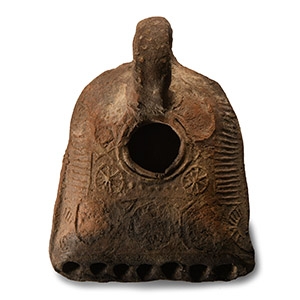
Romano-Jewish Terracotta Oil Lamp with Seven Spouts
4th-5th century A.D.Sold for (Inc. bp): £416
Hollow-formed tongue-shaped lamp with chamfered sides, loop handle, large filler hole; low-relief rosette and other ornament to the discus, chamfered forward edge with seven nozzles. 238 grams, 13 cm
Acquired on the German art market, 1989-1995. with The Museum Gallery, 19 Bury Place, London, WC1, UK, 1998-2003. Property of a London based academic, 2003-present.
The lamp was probably a variant on the menorah with seven separate lights from a single source. -
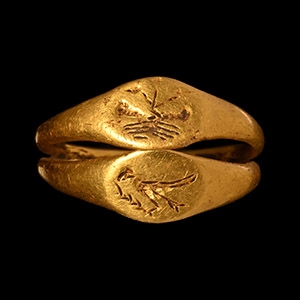
Roman Gold Marriage Ring with Clasped Hands and Eagle
1st-2nd century A.D.Sold for (Inc. bp): £2,080
Bifid form with parallel bands and lentoid bezels, one with low-relief clasped hands motif, the other with a bird holding a frond. 3.45 grams, 17.96 mm overall, 15.19 mm internal diameter (approximate size British G 1/2, USA 3 1/2, Europe 5.55, Japan 5)
Ex German art market, 2000s. Acquired from an EU collector living in London. From the collection of Surrey, UK, gentleman. -
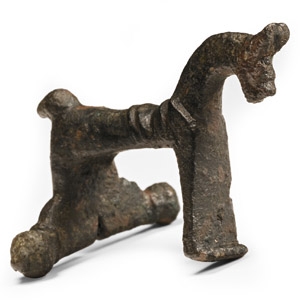
Roman Bronze Horse Bow Brooch
Circa 3rd century A.D.Sold for (Inc. bp): £39
With pricked ears, arched neck, D-shaped saddle and bobbed tail; the lower hindlegs developing into a headplate similar to a Roman crossbow brooch; the hinge-notch present on the headplate, the pin and catchplate absent. 29.8 grams, 47 mm
Acquired late 1980s-early 1990s. Ex private collection, Nottinghamshire, UK. Property of a Kent lady collector.
