
Loading, please wait...
_900x900.jpg "Roman Bronze Bow Brooch")
_200x200.jpg "Roman Bronze Bow Brooch")
.jpg "Roman Bronze Bow Brooch")
LOT 0707
Roman Bronze Bow Brooch
1ST-3RD CENTURY A.D.
1 3/4 in. (23 grams, 45 mm).
Of kräftig profilierte 'anchor' type, with a broad plaque in front of the spring and pin, trumpet-type bow; broad footplate with catch to the rear. [No Reserve]
ProvenanceProperty of a gentleman from Vienna; from his private collection formed since 1970.
LiteratureSee Hattatt, R., Brooches of Antiquity, Oxford, 1987, item 1396, for type.
CONDITIONTimeLine Auctions follows a vetting process to ensure the authenticity and legality of all items, reinforcing our commitment to integrity and responsible trading. Each antiquity, antique, and coin lot undergoes thorough examination by a vetting committee of at least ten external specialists, professional trade association members, scientists, and archaeologists: Our Vetting Process
AUCTIONS:
TimeLine is a leading auction house specialising in antiquities, ancient art, collectables, natural history, coins, medals, and books. Our auctions offer museums, collectors, historians, and enthusiasts the opportunity to acquire unique and historically significant pieces.
-
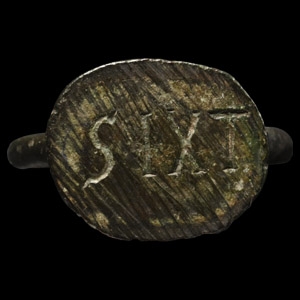
Roman Bronze Ring for 'Sixtus'
2nd-4th century A.D.Sold for (Inc. bp): £416
Ellipsoid bezel with 'SIXT' in seriffed capitals. 3.34 grams, 21.50 mm overall, 18.12 mm internal diameter (approximate size British O, USA 7, Europe 14.98, Japan 14)
Ex German art market, 2000s. Acquired from an EU collector living in London. From the collection of Surrey, UK, gentleman.
The Roman personal name 'Sixtus' is usually assumed to be an adaptation of Greek 'Ξυστος' meaning 'polished. However, in Latin, it originally indicated the sixth child born in the family. -
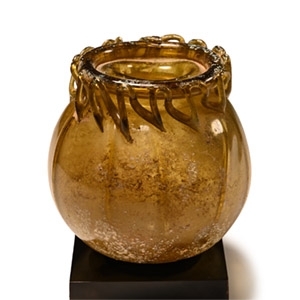
Roman Translucent Glass Jar with Gallery
3rd-4th century A.D.Sold for (Inc. bp): £546
Globular in profile with wide double-stepped rolled rim, applied wavy line trails forming a gallery from rim to body, pinched diagonal ribs to outer face and dimple to the underside; supplied with a custom-made stand. 46 grams, 74 mm wide (125 grams, 85 mm high including stand)
From the glass collection of a London gentleman, UK, 1990s. -
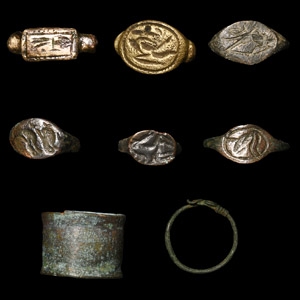
Roman to Medieval Bronze Ring Collection
1st-16th century A.D.Sold for (Inc. bp): £143
Including a broad hoop type with flared rims, a wire type with coils, an ellipsoid bezel type with low-relief horse and others. 30.9 grams total, 20-26 mm
UK private collection before 2000. Acquired on the UK art market. Property of a London gentleman.
