Loading, please wait...

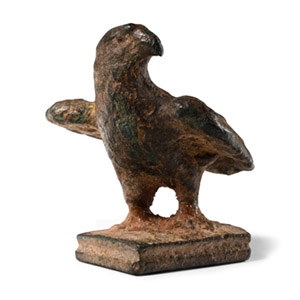
Roman Bronze Bear-Head Dagger Pommel Roman Bronze Bear-Head Dagger Pommel Roman Bronze Bear-Head Dagger Pommel
Use mousewheel to zoom in and out, click to enlarge
Details

LOT 0796

Roman Bronze Bear-Head Dagger Pommel

1ST-2ND CENTURY A.D.

1 3/4 in. (29.5 grams, 44 mm).

Hollow-formed with acute lower jaw, triangular muzzle, gusset and rounded rim to the socket-mouth. [No Reserve]

Provenance

Property of a Gloucestershire, UK, collector.
Property of an East Sussex, UK, gentleman.

Literature

See similar mounts in shape of eagle from Cerne Abbas, in Worrell, S., Worrell, 'Roman Britain in 2005. II. Finds reported under the Portable Antiquities Scheme', in Britannia, 37 (2006), pp.429-466, p.457, fig.27

Footnotes

The function of the animal head terminal in the form of a stylised eagle or griffin head found in the canabae at Caerleon was interpreted as
a possible pommel for a sword or other weapon due to the rectangular hole at the top of the head for a tang or other attachment.

CONDITION
VETTING:

TimeLine Auctions follows a vetting process to ensure the authenticity and legality of all items, reinforcing our commitment to integrity and responsible trading. Each antiquity, antique, and coin lot undergoes thorough examination by a vetting committee of at least ten external specialists, professional trade association members, scientists, and archaeologists: Our Vetting Process


AUCTIONS:

TimeLine is a leading auction house specialising in antiquities, ancient art, collectables, natural history, coins, medals, and books. Our auctions offer museums, collectors, historians, and enthusiasts the opportunity to acquire unique and historically significant pieces.

LOT 0796

Roman Bronze Bear-Head Dagger Pommel

Sold for (Inc. bp): £65

Print page

RELATED LOTS
  • Large Late Roman Sigma-Shaped Marble Offering Table Top
    Large Late Roman Sigma-Shaped Marble Offering Table Top
    Eastern Mediterranean, 4th-6th century A.D.

    Sold for (Inc. bp): £3,900

    Semi-circular with raised and slightly everted edge, the top with a recessed area with a funnel-shaped outlet; for votive offerings within a church; restored. 84.5 kg including backplate, 91 cm wide

    In general good condition, re-assembled.

    Acquired in the late 1960s or early 1970s. Ex David Read collection. Accompanied by an academic report by Dr Raffaele D’Amato. This lot has been checked against the Interpol Database of stolen works of art and is accompanied by search certificate number no.12080-214035.

    Marble tables such as the present example are called in archaeological terms sigma tables, in consideration of their resemblance to the Greek letter sigma. Sigma-shaped tables appeared in the banquet halls at the end of the 4th century and within Christian buildings from the following century. Most of the undecorated slabs were used as liturgical table tops for feasts to honour the deceased. This commemorative practice was known throughout the late Roman world in west and east, where it continued in the daily life of the citizens of the Eastern Roman Empire. In ecclesiastical settings, circular and sigma-shaped tables were used to collect offerings or for celebrating the agape, more generally as secondary furniture, while the rectangular form was preferred for use as an altar.

    Lot Details

  • Roman Enamelled Bronze Vessel Lid
    Roman Enamelled Bronze Vessel Lid
    2nd-4th century A.D.

    Sold for (Inc. bp): £9,100

    With carinated body and gently inverted lower rim, circumferential frieze displaying 'yellow' and red champlevé enamelled flower heads within foliate roundels, alternating with stylised amphoras and volute scrolls creating heart shapes set against a rich blue field; central projecting stem with hexagonal plate, ornamented with a central domed flower head, amphora and foliate motifs surrounding; two suspension lugs with loops to the perimeter of the lower rim; repaired. 435 grams, 15 cm wide


    Acquired from Ariadne Galleries Inc, New York, 30 October 2003. This lot has been checked against the Interpol Database of stolen works of art and is accompanied by search certificate no.11622-198955.

    Champlevé is a decorative technique which involves cutting cells into a metal surface and filling the void with enamel, using the raised metal borders between the cells to create the design outline.

    Lot Details

  • Roman Marble Janiform Herm Head of Ariadne and a Maenad
    Roman Marble Janiform Herm Head of Ariadne and a Maenad
    1st-2nd century A.D.

    Sold for (Inc. bp): £11,050

    Carved architectural element depicting a double herm comprising: a diademed female bust with long wavy hair framing the face, slender features with small mouth and raised lids; the other side with a diademed female with hair arranged in neat curls on the forehead, large eyes and small mouth, taenia shown on each side of the neck; base reworked with drilled sockets for mounting. 12.6 kg, 29 cm high


    Old collection, acquired in the 1970s. Acquired by inheritance from Mr N.S. Accompanied by an academic report by Dr Marina Mattei and Dr Laura Maria Vigna. This lot has been checked against the Interpol Database of stolen works of art and is accompanied by search certificate no.12084-211893.

    The head with elaborately curled hair and diadem could represent Ariadne, as shown by comparisons with a fragment of a two-faced herm with bearded Dionysus and Ariadne preserved in the Antiquarium Ostiense, dated to the lmperial Roman age. The heads could be interpreted either as Ariadne and a Maenad, or as two Maenads being characterised by the diadem and long taeniae. The association of these figures with Dionysus is congruent with the typology of the herm, which refers to rural places and theatres. Numerous herms in fact attest that this type of sculpture was used in contexts linked to Dionysus and his sacred procession as well as, obviously, the representation of Ariadne, his female partner and double. The example fits into the class of domestic sculpture with a decorative function, mostly used to adorn peristyles and viridaria; the type placed at the crown of columns and pillars is quite documented, in particular in the version with the head of Dionysus contrasted with that of Ariadne or a Maenad.

    Lot Details

Stay up-to-date with the latest from TimeLine Auctions by joining our mailing list