
Loading, please wait...
_900x900.jpg "Roman Bronze Armour Double Fastening Hooks")
_200x200.jpg "Roman Bronze Armour Double Fastening Hooks")
.jpg "Roman Bronze Armour Double Fastening Hooks")
LOT 1030
Roman Bronze Armour Double Fastening Hooks
CIRCA 1ST CENTURY A.D.
2 1/2 in. (19.6 grams total, 64-66 mm).
Each a scrolled bar formed as a serpent or other animal with stylised geometric detailing; attachment perforations to both terminals. [2]
ProvenanceAcquired on the London art market, 1980s-1990s.
LiteratureCf. Bishop, M.C. & Coulston, J.C.N., Roman military equipment, from the Punic wars to the fall of Rome, London, 2006, p.96, fig.51,3 for similar.
FootnotesIn the 1st century B.C.-1st century A.D., the Celtic fastening system of the ring mail armour (gallica, lorica ferro aspera) became the standard in the Imperial Roman army, with a pivot attached to the breast and hinged to the edges of the humeralia (shoulder guards). The chest fastener had various different designs. The double hooks, S-shaped and usually with snake-head terminals, were secured by a central rivet on the chest. The system allowed excellent freedom of movement, giving greater protection to the shoulders and the arms. Similar fasteners for infantry mail have been found on the Kalkriese battlefield, some of them also decorated with niello and inscribed with the name of the soldier.
CONDITIONTimeLine Auctions follows a vetting process to ensure the authenticity and legality of all items, reinforcing our commitment to integrity and responsible trading. Each antiquity, antique, and coin lot undergoes thorough examination by a vetting committee of at least ten external specialists, professional trade association members, scientists, and archaeologists: Our Vetting Process
AUCTIONS:
TimeLine is a leading auction house specialising in antiquities, ancient art, collectables, natural history, coins, medals, and books. Our auctions offer museums, collectors, historians, and enthusiasts the opportunity to acquire unique and historically significant pieces.
LOT 1030
Roman Bronze Armour Double Fastening Hooks
Estimate £150 - 200€170 - 230 (for guidance only)$200 - 270 (for guidance only)
-
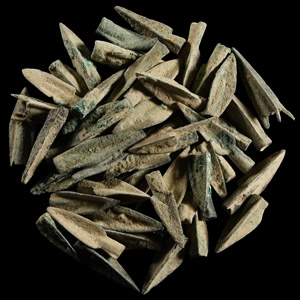
Greek Bronze Arrowhead Group
5th-3rd century B.C.Sold for (Inc. bp): £111
Primarily composed of socketted types with triangular cross-sections. 198 grams total, 26-43 mm
Ex private collection, 1980s. Acquired on the UK art market in the 1990s. -
.jpg)
Large Byzantine Silver Archer's Ring
14th-15th century A.D.Estimate: £600 - 800 (+bp*)
Opening Bid: £240
Comprising a hoop with reserved triangular ornament on the edges and triangular plaque with foliage motifs, raised central panel with frond motif. 22.61 grams, 34.77 mm overall, 25.16 mm internal diameter
Acquired in the 1990s. Ex Cambridgeshire, UK, collection.
Archer rings in Late Byzantium and the medieval Balkans were connected with the employment of the powerful composite bow, but very often, in the 14th century they served as insignia of rank for aristocratic noblemen. Archaeological findings of archers’ rings originate mainly from fortified towns, including mining centres. Many were made in bone, simple in design and undecorated. In contrast, the ones made in bronze and silver were usually decorated in rather uniform style, consisting of floral motifs on the head, mostly tulip and foliage, and linear motifs around the edges. This decoration combined Turkish, Central European and Eastern Roman traditional patterns. -
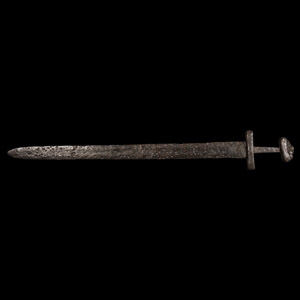
Viking Age Iron Sword with Five-Lobed Pommel
10th-11th century A.D.Sold for (Inc. bp): £4,550
Of Petersen Type S variant with a double-edged blade, shallow fullers and a rounded point; boat-shaped upper and lower guard with some remains of silver inlay, the pommel also showing traces of silver decoration. 1.3 kg, 87.5 cm
The structure of the blade is still homogenous but presents delamination on various part, corrosion damage along the edge and deep corrosion and pitting due to permanence in the water.
Acquired 1971-1972. From the collection of the vendor's father. Property of a London, UK, collector. Accompanied by an academic report by Dr Raffaele D’Amato. This lot has been checked against the Interpol Database of stolen works of art and is accompanied by search certificate number no.11756 - 202774.
Viking swords of Type S are commonly found in Nordic countries and in Eastern Europe, with only a small number found in Western Europe. The type was often characterised by splendid decoration achieved with silver and copper inlays, of which here some traces are still visible.
