
Loading, please wait...
_900x900.jpg "Roman Bronze Animal Collection")
_200x200.jpg "Roman Bronze Animal Collection")
.jpg "Roman Bronze Animal Collection")
LOT 0115
Roman Bronze Animal Collection
1ST-4TH CENTURY A.D.
1 - 2 in. (119 grams total, 28-50 mm).
Comprising: a squirrel nibbling a nut; a rabbit; a monkey with its hands covering its eyes; a mounting lug formed as a beast with outstretched legs; with an earlier Eastern ladle finial terminating in a beast's head. [5]
Provenance‘The Ancient Menagerie Collection’ formerly the property of a Cambridgeshire lady, collected since the 1990s and acquired from auctions and dealers throughout Europe and the USA, now ex London collection.
CONDITIONTimeLine Auctions follows a vetting process to ensure the authenticity and legality of all items, reinforcing our commitment to integrity and responsible trading. Each antiquity, antique, and coin lot undergoes thorough examination by a vetting committee of at least ten external specialists, professional trade association members, scientists, and archaeologists: Our Vetting Process
AUCTIONS:
TimeLine is a leading auction house specialising in antiquities, ancient art, collectables, natural history, coins, medals, and books. Our auctions offer museums, collectors, historians, and enthusiasts the opportunity to acquire unique and historically significant pieces.
LOT 0115
Roman Bronze Animal Collection
Estimate £600 - 800€700 - 930 (for guidance only)$810 - 1,080 (for guidance only)
-
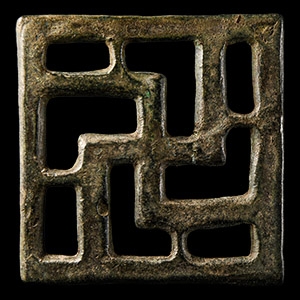
Roman Bronze Swastika Mount
3rd-4th century A.D.Sold for (Inc. bp): £72
The gammadion design created from an openwork square-shaped plate; semi-circular suspension loop to centre reverse. 32.4 grams, 49 mm
Acquired on the EU art market around 2000. From the collection of a North American gentleman. -
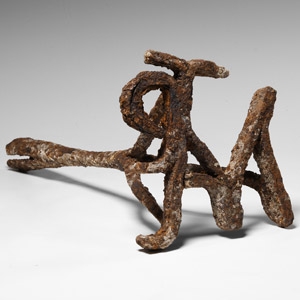
Late Roman Iron Branding Signaculum
5th-6th century A.D.Estimate: £100 - 140 (+bp*)
Opening Bid: £40
Featuring an elaborate monogram composed of Greek letters M, A, T and P on three supporting prongs; tapering cylindrical socket. 343 grams, 29.5 cm high
Acquired 1990s-early 2000s. East Anglian private collection.
Branding stamps or signacula, in particular those with large single letters, were used for marking livestock to identify the owner, the breed, the quality and other features of the animal. These signacula were usually made in bronze, but iron examples are also preserved. -
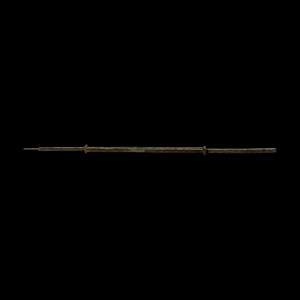
Roman Bronze Extendable Table Leg
2nd-3rd century A.D.Sold for (Inc. bp): £130
Composed of two rectangular-section bars with square-sockets. 2 kg total, 1.07 m
Acquired 1990s-early 2000s. East Anglian private collection.
These bars were one of the four supports of a folding table with a height-adjustable frame, often surmounted by busts of divinities. These folding supports for tables, bracers and cauldrons are known finds from important excavations in the Roman world, like Pompeii. The purpose of such folding stands varied; during a meal they were placed between the triclinium beds with bowls and plates hung to the hooks at the back of the holders.
