
Loading, please wait...
LOT 0268
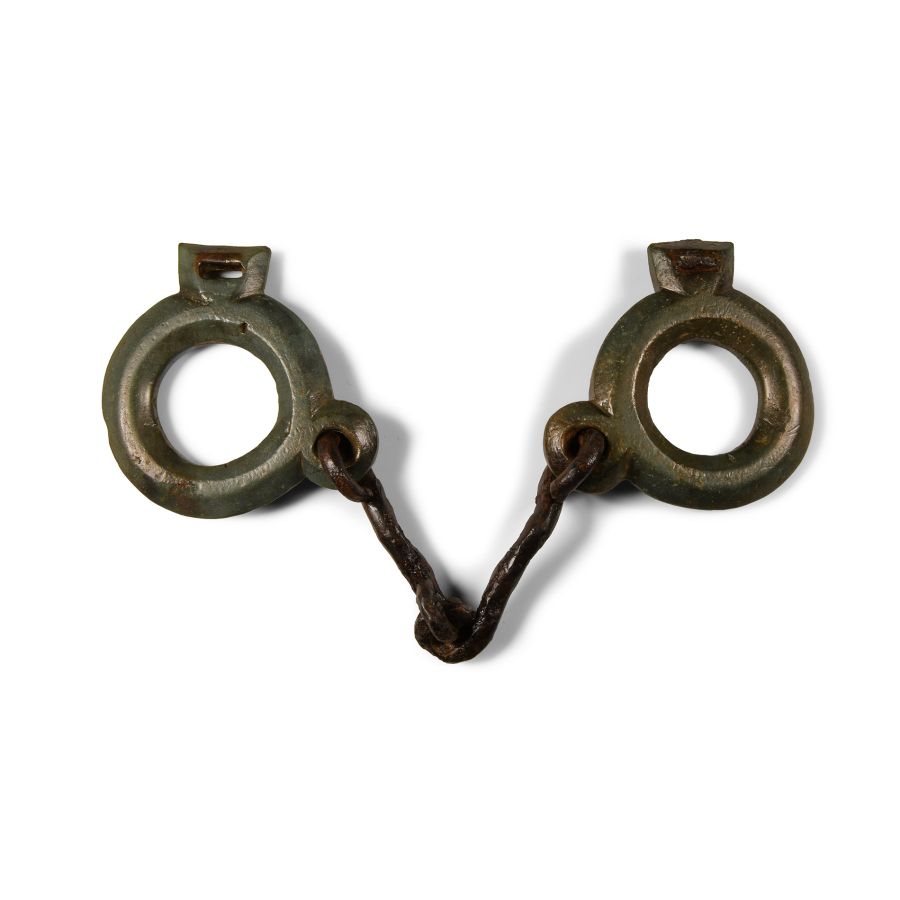
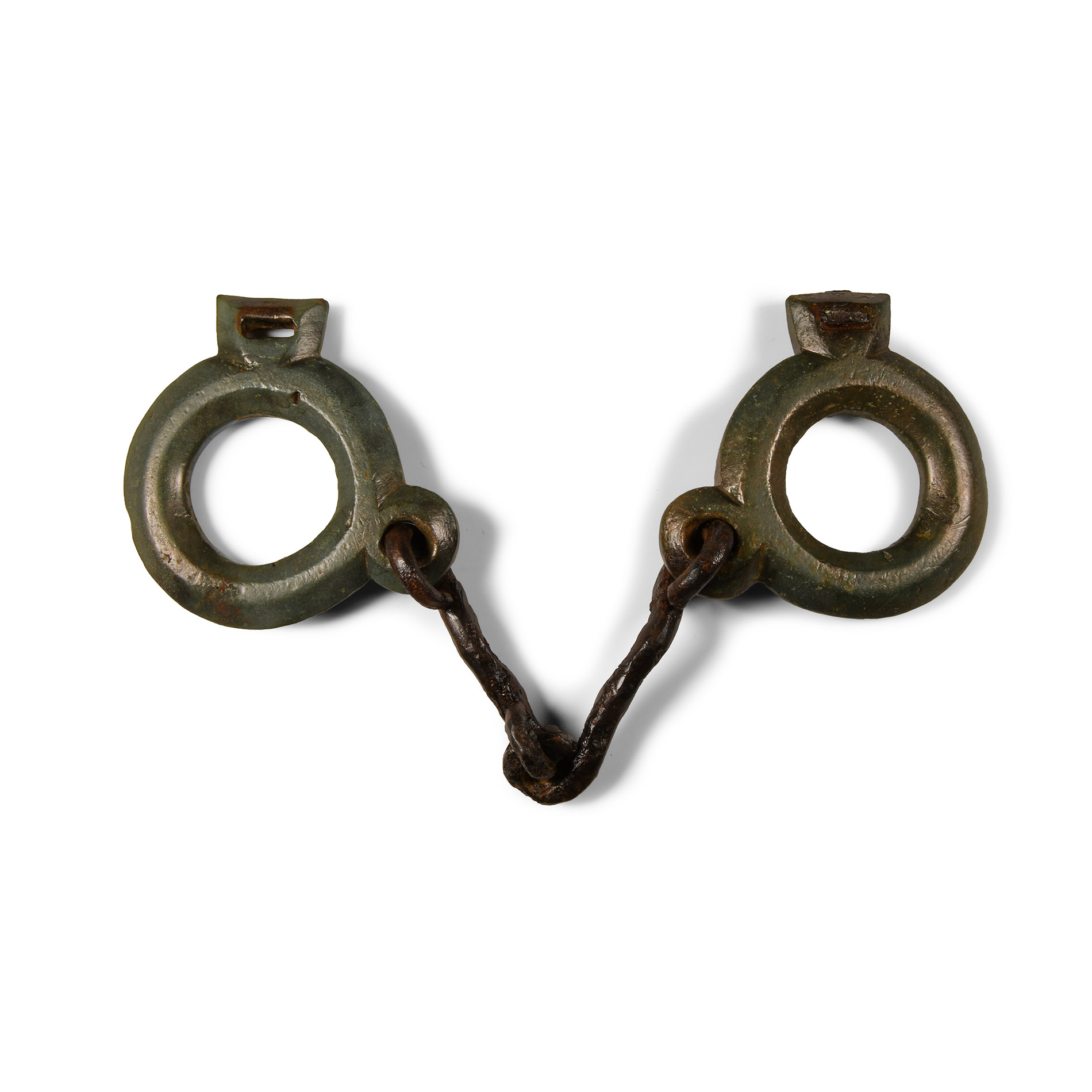
Roman Bronze and Iron Military Horse Bit
2ND-3RD CENTURY A.D.
10 1/4 in. (377 grams, 26 cm).
Comprising a pair of curved iron bars linked at the centre, loop at each outer end attached to a substantial flat-section ring with lateral lug pierced to accept a strap. [No Reserve]
ProvenanceFrom the private collection of a London gentleman, from his grandfather's collection formed before the early 1970s.
LiteratureCf. James, S., Excavations at Dura Europos 1928-1937. VII The Arms, Armour and Other Military Equipment, London, 2004, p.66-7.
CONDITIONTimeLine Auctions follows a vetting process to ensure the authenticity and legality of all items, reinforcing our commitment to integrity and responsible trading. Each antiquity, antique, and coin lot undergoes thorough examination by a vetting committee of at least ten external specialists, professional trade association members, scientists, and archaeologists: Our Vetting Process
AUCTIONS:
TimeLine is a leading auction house specialising in antiquities, ancient art, collectables, natural history, coins, medals, and books. Our auctions offer museums, collectors, historians, and enthusiasts the opportunity to acquire unique and historically significant pieces.
-
.jpg)
Smith and Wesson Old Model No 2 Revolver
1861-1874 A.D.Estimate: £600 - 800 (+bp*)
Opening Bid: £250
Also known as 'Model No 2 Army' with hinged frame, six shot .32 calibre rimfire cylinder with 'PATENTED APRIL 3 1855 JULY 5 1859 & DEC 18 1860' and 15cm (6") octagonal barrel marked 'SMITH & WESSON SPRINGFIELD MASS' to top with fixed extractor pin and spur trigger; serial number 47946 to butt strap with plain wood grip scales; action working. 690 grams, 27 cm
Acquired from Bolk Antique Arms, Netherlands, 2016. Ex Kusmirek Collection, UK. Accompanied by an original Bolk invoice.
Sold as an exempt item under Section 58 (2) of the Firearms Act, 1968, to be held as a curiosity or ornament. No license required but buyer must be over 18 years of age. Overseas bidders should note that, due to UK regulations governing export of all firearms, overseas buyers will need to make arrangements for shipping this lot out of the UK directly, by air freight, with a specialist company or agent. -
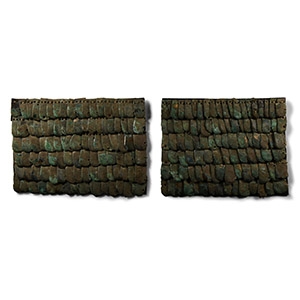
Scythian Scale Armour Sections
6th-5th century B.C.Sold for (Inc. bp): £2,340
Two panels from a scale armour coat composed of more than two hundred overlapping bronze scales, each mounted onto a custom-made leather panel for purposes of display; the scales formed in different series, some having holes only in the upper part, some with three holes in the upper part and two holes to the left, and others showing three upper holes and one side hole. 255 grams total, 15.2-16.5 cm
From the private collection of a London gentleman, from his grandfather's collection formed before the early 1970s. Accompanied by an academic report by Dr Raffaele D’Amato. This lot has been checked against the Interpol Database of stolen works of art and is accompanied by a search certificate number no.12044-216404.
The favourite armour of the Scythian noblemen was composed of scales, usually protecting the torso, sometimes the entire body (kataphraktoi). The Scythians found that the most efficient method was to arrange the overlapping ‘fish-scales’ as a corselet made of a number of bronze and iron plates, which then protected the wearer against sword and spear thrusts. Our scales correspond well to bronze scales found in May 1961 in an accidentally destroyed burial in a barrow, near the village of Nadezhda Sovetsky district. They were discovered together with iron scales, a Greek Corinthian helmet, fragments of an amphora, five arrowheads and fragments of an iron sword. Most of these bronze scales were oblong in shape, with a sub-rectangular upper end and a rounded lower end, but slightly bigger than our scales. -
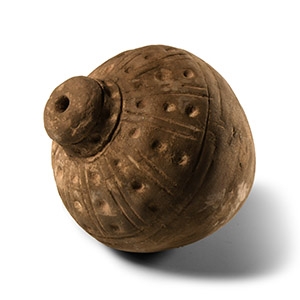
Byzantine 'Greek Fire' Ceramic Fire Bomb or Hand Grenade
9th-11th century A.D.Sold for (Inc. bp): £130
Piriform body with segmented shoulder and impressed roundels, domed filler-hole, intended to be filled with explosive liquid and wick, used as a hand grenade. 420 grams, 10.8 cm
From a specialist collection of militaria, London, UK, collected 1990s onwards. Accompanied by an academic paper by military specialist Dr Raffaele D'Amato, dated 15 July 2019 and titled 'Eastern Roman Empire - Greek Fire Bomb or Hand Grenade (μεσαίον kακάβιον) 9th-11th century AD'.
Apart from the use of siphons or manual flame-throwers called cheirosiphona, special corps of Roman soldiers employed terracotta grenades, in the form of small jars, abundantly evidenced in archaeological excavations. They were called μεσαία kακαβιά or κυτροκακάβια where the former had a bulbous shape and the latter a more cylindrical form.
