Loading, please wait...

Roman Brilliant Blue Dimpled Glass Jar Roman Brilliant Blue Dimpled Glass Jar Roman Brilliant Blue Dimpled Glass Jar
Use mousewheel to zoom in and out, click to enlarge
Details

LOT 0142

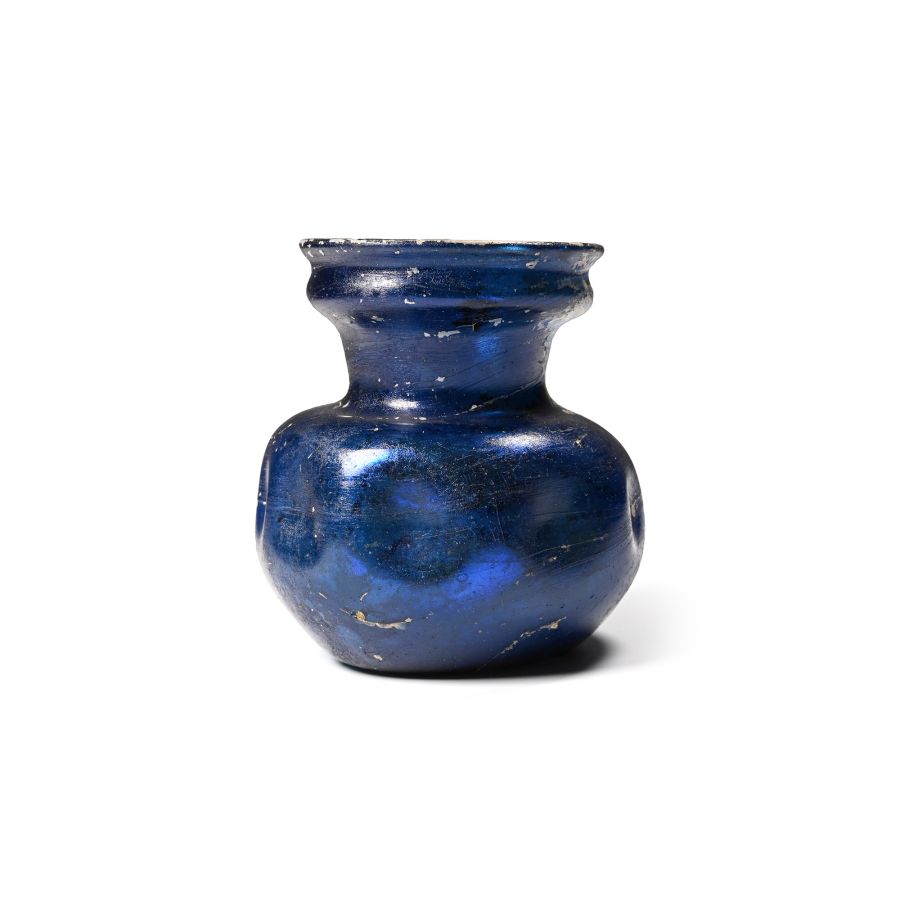
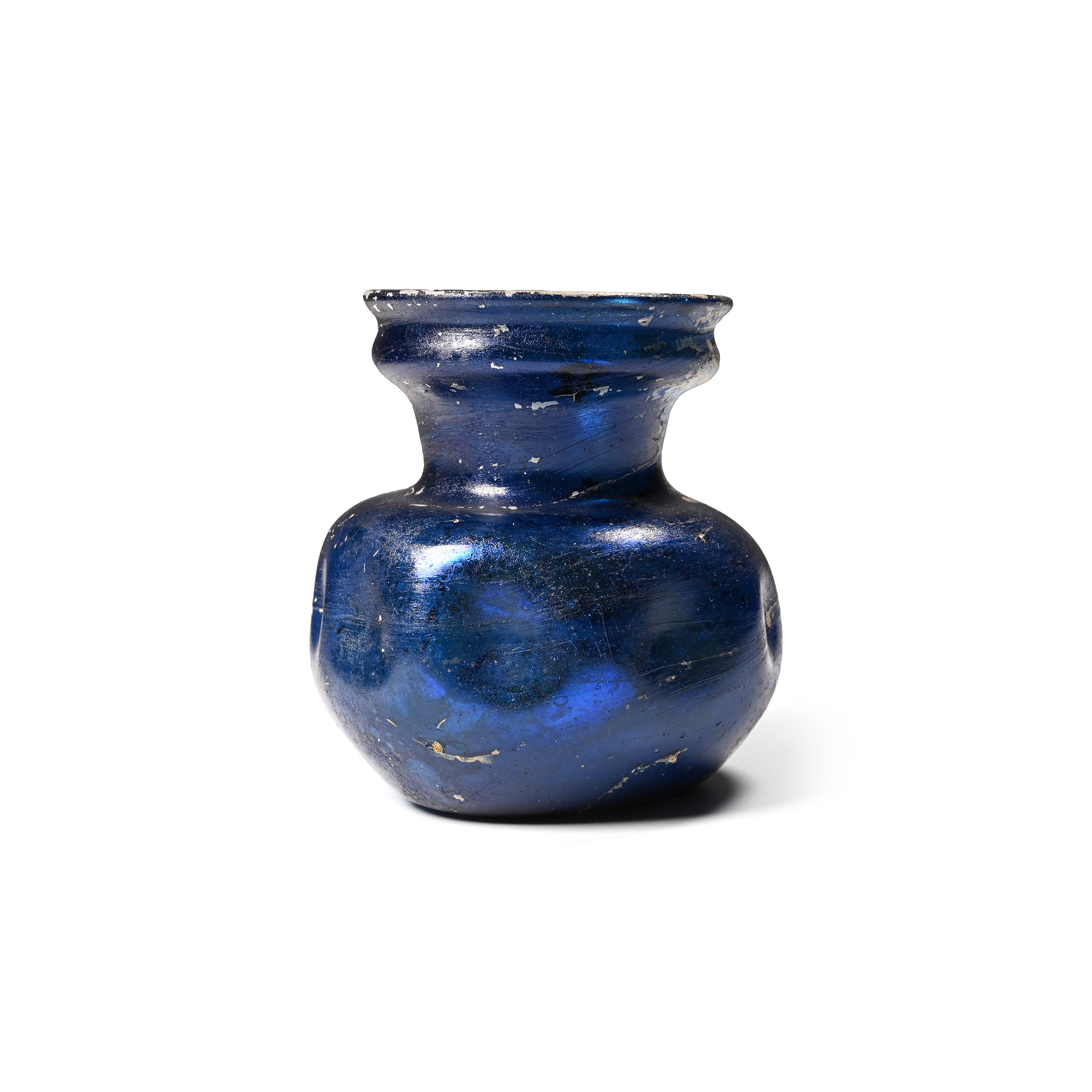
Roman Brilliant Blue Dimpled Glass Jar

3RD-4TH CENTURY A.D.

3 1/8 in. (73.2 grams, 80 mm high).

Of squat profile with dimples to the equator, gussetted neck, broad mouth with rolled and everted rim; dimple to the underside.

Provenance

From the estate of a late Sheffield, UK, lady, thence by descent 1960-1970; latterly a London, Mayfair, UK, collection.
This lot has been cleared against the Art Loss Register database, and is accompanied by an illustrated lot declaration signed by the Head of the Antiquities Department, Dr Raffaele D'Amato.

Literature

Cf. Lightfoot, C.S., Ancient Glass in National Museums Scotland, Edinburgh, 2007, item 374, for type.

CONDITION
VETTING:

TimeLine Auctions follows a vetting process to ensure the authenticity and legality of all items, reinforcing our commitment to integrity and responsible trading. Each antiquity, antique, and coin lot undergoes thorough examination by a vetting committee of at least ten external specialists, professional trade association members, scientists, and archaeologists: Our Vetting Process


AUCTIONS:

TimeLine is a leading auction house specialising in antiquities, ancient art, collectables, natural history, coins, medals, and books. Our auctions offer museums, collectors, historians, and enthusiasts the opportunity to acquire unique and historically significant pieces.

LOT 0142

Roman Brilliant Blue Dimpled Glass Jar

Estimate £1,500 - 2,000€1,740 - 2,320 (for guidance only)$2,030 - 2,700 (for guidance only)

Print page

RELATED LOTS
  • Roman Marble Statue Fragment with Dog
    Roman Marble Statue Fragment with Dog
    2nd-3rd century A.D.

    Sold for (Inc. bp): £12,350

    Trapezoidal in plan base fragment with figures carved in the round: tree with bands of horizontal ribbing; left foot, ankle and calf of a male wearing open-toed sandal and military-style boot, the upper part decorated with the skin of a lion cub; body of a dog sitting at heel beside the tree. 13.9 kg, base: 30 cm long


    Acquired in the mid 1980s-1990s. Private collection, Switzerland, thence by descent. Private collection, since the late 1990s. Accompanied by an academic report by Dr Raffaele D’Amato. This lot has been checked against the Interpol Database of stolen works of art and is accompanied by search certificate number no.12578-232182. This lot has been cleared against the Art Loss Register database, and is accompanied by an illustrated lot declaration signed by the Head of the Antiquities Department, Dr Raffaele D'Amato.

    The military boot cothurnus worn here by a hunter or a military commander, was widely used by commanders of the Roman army, and sometimes by actors playing military heroes. Officers wore splendid closed cothurni of various colours, like those realised in blue leather and worn by an officer represented on a fresco from Stabiae (D’Amato-Sumner, 2009, p.13).

    Lot Details

  • Roman Bronze Figure of Apollo
    Modelled After the Apollo of Naxos
    Roman Bronze Figure of Apollo
    Circa 1st century A.D.

    Sold for (Inc. bp): £13,000

    Standing nude with a chlamys draped over his left shoulder and fastened on the right shoulder, bearing the weight on his right foot with the left leg bent at the knee with the heel raised; the right arm extended and holding the remains of an attribute, the left arm bent at the elbow; his head turned slightly to the right with long luxurious hair swept back and gathered at the nape of the neck; set on a circular socle base; stripped and repatinated. 700 grams, 19 cm


    Acquired at Mythes ét Légendes, 18 Place des Vosges, Paris, 14 May 1980. Private collection, France. Ex Jean Roudillon, Hôtel des Ventes de Belfort SARL, 22 October 2011, no.9. with Christie's, London, 2 April 2014, no.91. Accompanied by copies of the relevant Christie's catalogue pages. Accompanied by a copy of an Art Loss Register certificate no.S0007570. Accompanied by a copy of French passport no.132675 dated 7 December 2011. Accompanied by an academic report by Dr Raffaele D’Amato. This lot has been checked against the Interpol Database of stolen works of art and is accompanied by a search certificate number no.12360-226681. This lot has been cleared against the Art Loss Register database, and is accompanied by an illustrated lot declaration signed by the Head of the Antiquities Department, Dr Raffaele D'Amato.

    The figurine is of archaic style; it is probably a provincial work of a Gallo-Roman workshop. The prototype can be seen in the Apollo of Naxos in the Berlin Museum. The style of posture and movement can also be seen in the archaic bronzes of Falterona, the Louvre and Athens.

    Lot Details

  • Roman Bronze Patera with Handle
    Roman Bronze Patera with Handle
    1st century B.C.-1st century A.D.

    Estimate: £600 - 800 (+bp*)

    Opening Bid: £300

    The bowl with a wide flat bottom and convex sides; the inside with incised concentric circles; flat handle with raised edges and hooked finial for suspension. 483 grams, 39.5 cm


    German private collection, Mr O., collecting in the 1950s-1960s; thence by descent. with Bonhams, London, 7 July 2016, lot 191 (£3,000-5,000). Accompanied by an academic report by Dr Raffaele D’Amato. Accompanied by copies of the relevant Bonhams printed catalogue pages (full page). This lot has been checked against the Interpol Database of stolen works of art and is accompanied by search certificate number no.11735-201189. This lot is accompanied by an illustrated lot declaration signed by the Head of the Antiquities Department, Dr Raffaele D’Amato. This lot is accompanied by an illustrated lot declaration signed by the Head of the Antiquities Department, Dr Raffaele D'Amato.

    This vessel was part of Roman and provincial bronze instrumentum domesticum, i.e. culinary or domestic utility ware. Such cooking vessels are rare: some are found in central and northern Italy, in Pannonia, Germany and in Britain. The Aylesford Pan, today in the British Museum (inventory no.1886.1112.1), is one of the most important finds. This specimen (Eggers type 130), probably pre-Caesarian or Caesarian, was found in a grave together with a Celtic bucket and a jug.

    Lot Details

Stay up-to-date with the latest from TimeLine Auctions by joining our mailing list