Loading, please wait...
Details
LOT 0806
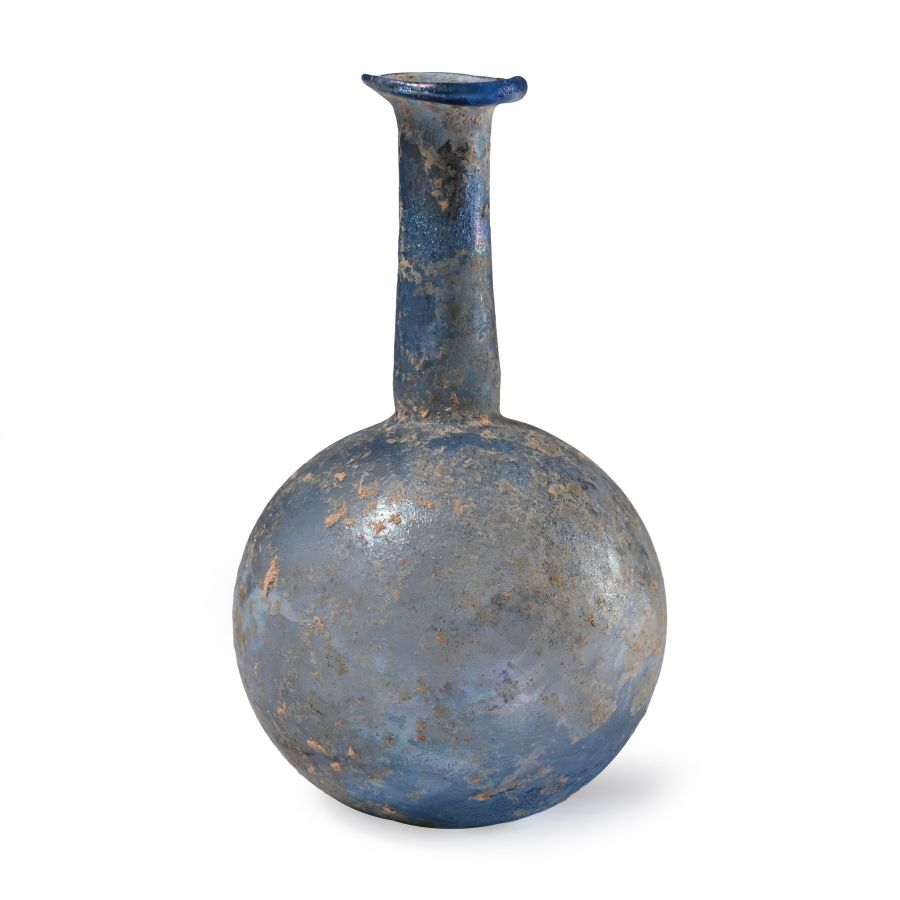
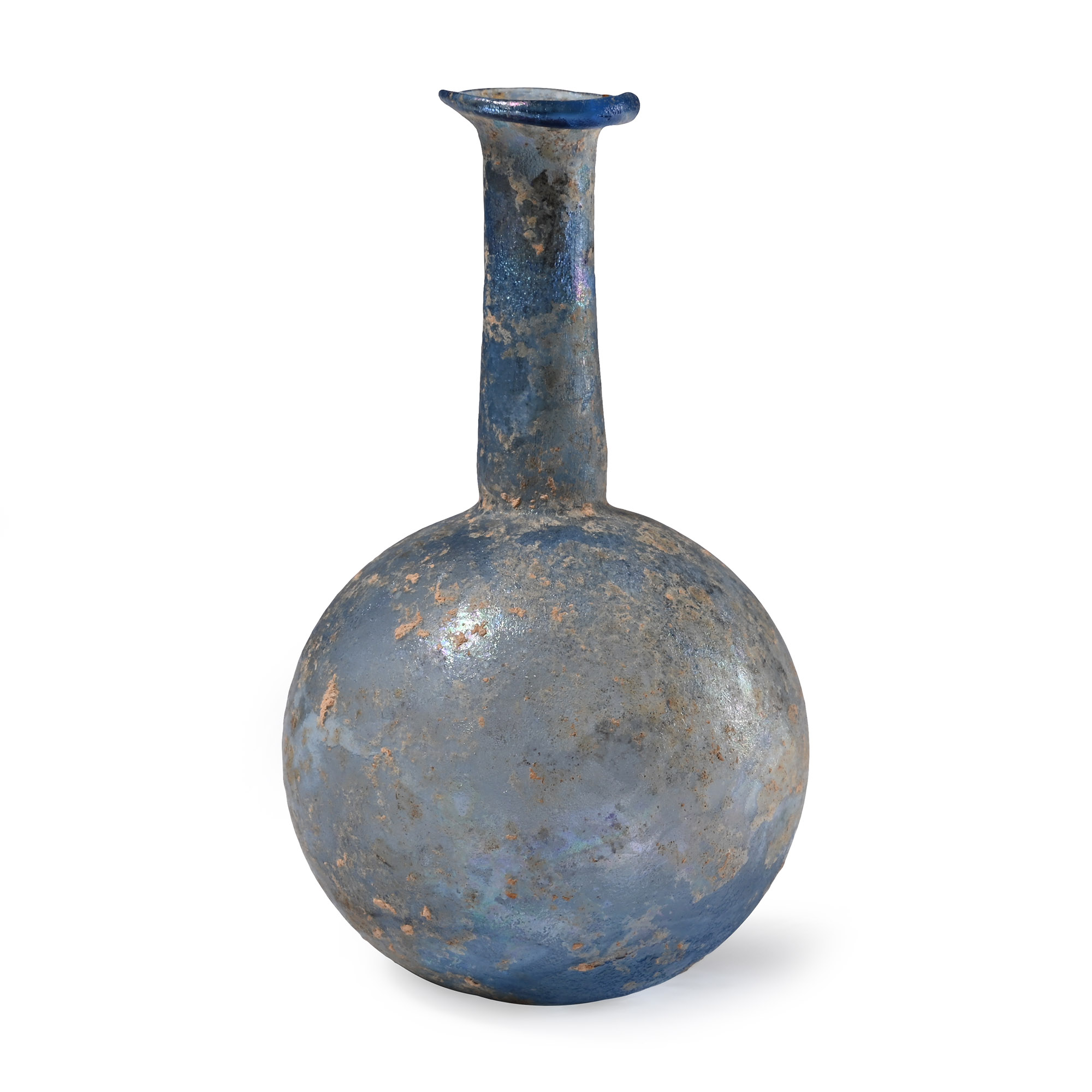
Roman Blue Glass Bottle
3RD CENTURY A.D.
3 1/8 in. (10.1 grams, 79 mm).
With slightly flattened base and spherical body, tubular neck with flared and rolled rim.
Provenance
From an important London collection of glass, 1990s.
This lot is accompanied by an illustrated lot declaration signed by the Head of the Antiquities Department, Dr Raffaele D'Amato.
Literature
Cf. Whitehouse, D., Roman Glass in the Corning Museum of Glass, vol.2, New York, 2001, item 621, for type.
CONDITIONVETTING:
TimeLine Auctions follows a vetting process to ensure the authenticity and legality of all items, reinforcing our commitment to integrity and responsible trading. Each antiquity, antique, and coin lot undergoes thorough examination by a vetting committee of at least ten external specialists, professional trade association members, scientists, and archaeologists: Our Vetting Process
AUCTIONS:
TimeLine is a leading auction house specialising in antiquities, ancient art, collectables, natural history, coins, medals, and books. Our auctions offer museums, collectors, historians, and enthusiasts the opportunity to acquire unique and historically significant pieces.
RELATED LOTS
-
Roman Mosaic Depicting Nereids and Tritons
Circa 270-350 A.D.Sold for (Inc. bp): £65,000
At the centre of the mosaic a company of three Nereid-nymphs riding across the sea on the back of two fish-tailed Tritons accompanied by a putto; the Nereids covered only by a red-mauve and cerulean cloak (chlamys) with yellow edges, draped around their legs; one of them waving a garment over her head; fourth Nereid dressed in a long green-blue chiton, with yellow collar and fastened at the waist by a red and yellow belt, offering a phiale to a centaur and waving a long cerulean cloak over her head, the centaur grasping the hem of her cloak and holding a snake in his right hand; the fish tails of the Tritons unfolding in elegant spirals on the seabed; Greek inscriptions with the names of the Nereids ΦΕΡΟΙϹΑ (= Ferousa, the ‘carrier’), ΚΥΜω (Kymo, goddess of the waves), (ΕΥΚ) ΡΑΝΤΗ (Eukrante, the Nereid of the successful voyages and fishing) and probably the name of one of the Triton, ΕΥΟΡΜΟΣ (Euormos, ‘safe harbour for mooring’) or a Roman Age contraction of the name of a fourth Nereid, Euarne, 'the well lambed'; some restoration. 53.1 kg, 162 x 151 cm
From the private collection of V. Colin, Belgium, 1960s. with Ariadne Galleries Inc, New York, 2008. Accompanied by a copy of an Art Loss Register certificate no.S00017755, dated 11 September 2008. Accompanied by an academic report by Dr Raffaele D'Amato. Accompanied by a copy of the Art & Antiques article. This lot has been checked against the Interpol Database of stolen works of art and is accompanied by a search certificate number no.12605-230246. This lot has been cleared against the Art Loss Register database, and is accompanied by an illustrated lot declaration signed by the Head of the Antiquities Department, Dr Raffaele D'Amato.
The thiasos theme with marine cycles was very popular in the Hellenistic and Roman times. In the late Roman period, especially in the Greek speaking Eastern provinces of the Empire, the mythological subjects of heroes and goddesses multiplied in the rich villas and public buildings, like basilicas and thermae (public baths). -
Roman Life-Size Marble Statue of an Important Magistrate
Late 3rd-early 4th century A.D.Estimate: £180,000 - 240,000 (+bp*)
Opening Bid: £100,000
Clad in a symmetrically incised late Roman toga, which was originally painted; the right hand covered by the robe and resting against his chest, the now lost left hand probably held a rank symbol or a scroll; short hair, cut according to the style of the Tetrarchy, wide eyes and pronounced lips; beard extended under the chin and on the throat; crepida sandal of Greek typology still visible on the right foot. 700+ kg, 206 cm including base
Fine condition. An impressive museum-quality display piece.
Acquired by L.H., Munich, Germany, prior to 1982. with H.v.C., Munich, Germany, in 1982, forming a central part of their family collection during the 1980s. Thence by descent to his son, C.M., Switzerland. Accompanied by a copy of a German cultural export licence. Accompanied by an academic report by Dr Raffaele D’Amato. Accompanied by a geological report No. TL3253 by geology consultant Dr R. L. Bonewitz. This lot has been checked against the Interpol Database of stolen works of art and is accompanied by search certificate no.12089-211955. This lot has been cleared against the Art Loss Register database, and is accompanied by an illustrated lot declaration signed by the Head of the Antiquities Department, Dr Raffaele D'Amato.
This statue of a Roman magistrate represents a high-ranking citizen with political and ritual responsibilities. The stylised facial features date it to the period of the Tetrachy under the Emperor Diocletian (284-305 A.D.), when representation of the human form began to show a concern for geometry and symmetry. A similar style can be seen in official portraits of Diocletian, Galerius, Constantinus Chlorus, and Maximianus Herculius. Despite the stylisation typical of the era, however, the sculptor of this lot has taken pains to add personal details, such as the dimpled chin and creased forehead. Its powerful resemblance to Imperial portraiture stems from the desire of magistrates to emulate emperors in the way they represented themselves. This is a piece of outstanding quality, and unlike other Late Roman sculptures, in which a portrait head is often attached to an earlier body, it appears to have been created as a whole. It shows exceptional attention to detail, including in the magistrate’s beautifully carved footwear. It is likely to represent an official of an Eastern Empire city, either in Greece or Illyria. -
Late Roman Decorated Iron Bow Brooch
Circa 6th century A.D.Sold for (Inc. bp): £39
Comprising a broad flat-section bow, narrow waist and flat-section foot, all with herringbone hatching; returned foot forming the catch, spring and pin at the head. 16.5 grams, 69 mm
From a private, UK, collection in the 1980s. Property of a London, UK, antiquarian. This lot is accompanied by an illustrated lot declaration signed by the Head of the Antiquities Department, Dr Raffaele D'Amato.