
Loading, please wait...
_900x900.jpg "Roman Bloodstone Intaglio with Horus, Osiris and Ouroboros")
_200x200.jpg "Roman Bloodstone Intaglio with Horus, Osiris and Ouroboros")
_900x900.jpg "Roman Bloodstone Intaglio with Horus, Osiris and Ouroboros")
_200x200.jpg "Roman Bloodstone Intaglio with Horus, Osiris and Ouroboros")
_900x900.jpg "Roman Bloodstone Intaglio with Horus, Osiris and Ouroboros")
_200x200.jpg "Roman Bloodstone Intaglio with Horus, Osiris and Ouroboros")
.jpg "Roman Bloodstone Intaglio with Horus, Osiris and Ouroboros")
.jpg "Roman Bloodstone Intaglio with Horus, Osiris and Ouroboros")
.jpg "Roman Bloodstone Intaglio with Horus, Osiris and Ouroboros")
LOT 0183
Roman Bloodstone Intaglio with Horus, Osiris and Ouroboros
2ND-3RD CENTURY A.D.
5/8 in. (1.31 grams, 17 mm).
Egyptizing intaglio representing the myth of Osiris, with the mummy of the god resting above the snake Ouroboros and surmounted by his son, the falcon god Horus, a star above.
ProvenanceGiorgio Sangiorgi (1886-1965), Rome, acquired and brought to Switzerland, late 1930s; thence by continuous descent to the current owner.
with Christie's Ancient Jewellery, New York, 6 December 2007, no.338.
This lot has been checked against the Interpol Database of stolen works of art and is accompanied by a search certificate number no.12582-232140.
This lot has been cleared against the Art Loss Register database, and is accompanied by an illustrated lot declaration signed by the Head of the Antiquities Department, Dr Raffaele D'Amato.
See the Walters Art Museum, no.42.870, for a similar style Roman intaglio with Ouroboros.
FootnotesThe image of Ouroboros (a snake eating its own tail) is usually associated with stars and Egyptian mythology as represented in Roman gnostic intaglios. Ouroboros is continuously re-birthing itself and depicted as a circle, representing eternity and the cyclical nature of things that start once they end. It is also the symbol of duality and dualising power.
CONDITIONTimeLine Auctions follows a vetting process to ensure the authenticity and legality of all items, reinforcing our commitment to integrity and responsible trading. Each antiquity, antique, and coin lot undergoes thorough examination by a vetting committee of at least ten external specialists, professional trade association members, scientists, and archaeologists: Our Vetting Process
AUCTIONS:
TimeLine is a leading auction house specialising in antiquities, ancient art, collectables, natural history, coins, medals, and books. Our auctions offer museums, collectors, historians, and enthusiasts the opportunity to acquire unique and historically significant pieces.
LOT 0183
Roman Bloodstone Intaglio with Horus, Osiris and Ouroboros
Sold for (Inc. bp): £4,160
-
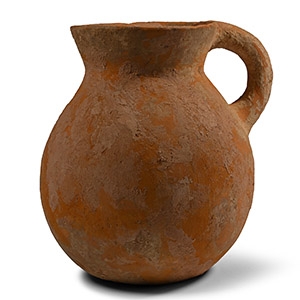
Roman Terracotta Jug with Flared Rim
1st-4th century A.D.Estimate: £100 - 140 (+bp*)
Opening Bid: £50
With a bulbous body and trumpet-shaped neck, handle to the rear. 736 grams, 17.5 cm
Ex London art market 1990s. From a London, UK, collection. This lot is accompanied by an illustrated lot declaration signed by the Head of the Antiquities Department, Dr Raffaele D’Amato. This lot is accompanied by an illustrated lot declaration signed by the Head of the Antiquities Department, Dr Raffaele D'Amato. -
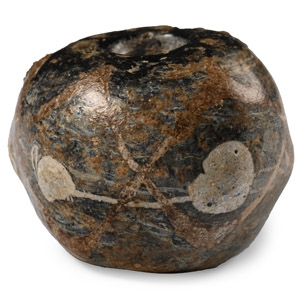
Large Roman Glass Bead
2nd-3rd century AD.Sold for (Inc. bp): £39
Oblate black bead with dragged trails and applied white bosses to the equator. 41 grams, 35 mm
Ex German art market, 2000s. Acquired from an EU collector living in London. From the collection of a Surrey, UK, gentleman. This lot is accompanied by an illustrated lot declaration signed by the Head of the Antiquities Department, Dr Raffaele D'Amato. -
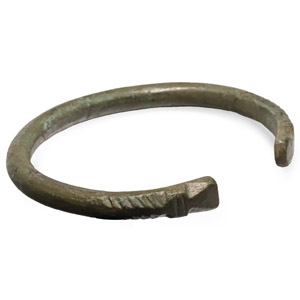
Late Roman Bronze Military Bracelet with Animal-Heads
4th-5th century A.D.Sold for (Inc. bp): £91
Round-section penannular body with stylised animal-head finials. 32.9 grams, 68 mm
Ex German art market, 2000s. Acquired from an EU collector living in London. From the collection of a Surrey, UK, gentleman. This lot is accompanied by an illustrated lot declaration signed by the Head of the Antiquities Department, Dr Raffaele D'Amato.
