
Loading, please wait...
_900x900.jpg "Roman Artefact Group")
_200x200.jpg "Roman Artefact Group")
.jpg "Roman Artefact Group")
LOT 0766
Roman Artefact Group
CIRCA 1ST-5TH CENTURY A.D.
1 1/4 - 3 5/8 in. (150 grams total, 33-92 mm).
A trio of artefacts comprising: a Roman copper-alloy coin, likely a sestertius, with worn designs to obverse and reverse, the reverse likely portraying the goddess Minerva leaning on a shield and wearing a helmet; a stone loom weight of conoid form, dated c.100 A.D. and discovered in Egypt; a Roman ceramic oil lamp dated c.500 A.D., piriform in plan with raised borders to the central opening and nozzle, decorative ribbing to the shoulder, conical handle and basal ring. [3, No Reserve]
ProvenanceFrom an old UK collection.
From the private collection of Alf Baxendale (1941-2016) part 2, keen Egyptologist, member of the Egyptology Society, trustee of the Amarna Trust; thence by descent.
Accompanied by a copy of his obituary published in Horizon, The Amarna Project and Amarna Trust newsletter, Issue 18, 2017, p.21, by Barry John Kemp, CBE, FBA, Professor Emeritus of Egyptology at the University of Cambridge and directing excavations at Amarna in Egypt.
TimeLine Auctions follows a vetting process to ensure the authenticity and legality of all items, reinforcing our commitment to integrity and responsible trading. Each antiquity, antique, and coin lot undergoes thorough examination by a vetting committee of at least ten external specialists, professional trade association members, scientists, and archaeologists: Our Vetting Process
AUCTIONS:
TimeLine is a leading auction house specialising in antiquities, ancient art, collectables, natural history, coins, medals, and books. Our auctions offer museums, collectors, historians, and enthusiasts the opportunity to acquire unique and historically significant pieces.
-
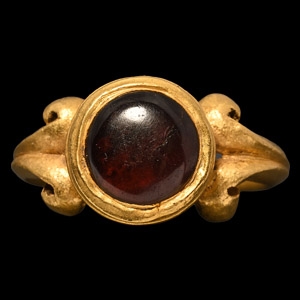
Roman Gold Ring with Garnet Cabochon
Circa 2nd-3rd century A.D.Estimate: £3,000 - 4,000 (+bp*)
Opening Bid: £1,600
Comprising a keeled hoop forked at the shoulders to form two elegant scrolls supporting the raised bezel, decorative grooves framing the garnet cabochon. 8.16 grams, 23.85 mm overall, 19.37 mm internal diameter (approximate size British N, USA 6 1/2, Europe 13.72, Japan 13)
Acquired from London galleries during the 1990s. From the jewellery collection of a London, UK, gentleman. This lot has been checked against the Interpol Database of stolen works of art and is accompanied by search certificate no.12114-214295.
The type of ring seems to date (with the volutes on the shoulders) to the late 2nd-early 3rd century A.D., although the model is certainly derived from the Hellenistic world. The use of carnelian and garnet was abundant in Hellenistic and Roman rings, and the style of the rings continued without change in the Roman Hellenised east. -
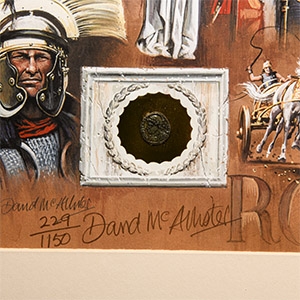
Bronze Roman Coin and Limited Edition Framed Print
3rd century A.D. and laterSold for (Inc. bp): £13
The coin of Constantine the Great (272-337 A.D.) mounted on 22 carat gold foil, framed with an art print signed by the artist David McAllister, depicting scenes of Roman military activity; limited edition number 229/1150. 1.26 kg, 49.5 x 37.5 cm
UK gallery, early 2000s. Accompanied by a previous certificate of authenticity.
David McAllister's exciting design is a 'one of a kind' work that portrays the might and riches of the Roman civilisation. This limited edition print is a celebration of the award winning artist's lifetime dedication to historical paintings of the ancient world. To enhance appreciation of this rare and historic work, each individual print is signed and numbered by the artist. -
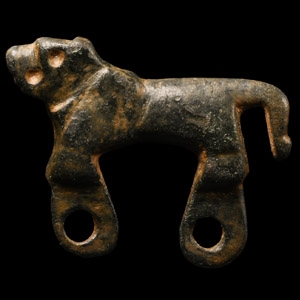
Romano-British 'Corbridge' Bronze Lion Mount
Circa 3rd century A.D.Sold for (Inc. bp): £26
With pierced lobe below the legs, arched body forming the bow. 14.9 grams, 36 mm
Found near Corbridge, Northumberland, UK. Property of a Gloucestershire, UK, collector. Property of an East Sussex, UK, gentleman.
