
Loading, please wait...
_900x900.jpg "Roman Archaising Silver Statuette")
_200x200.jpg "Roman Archaising Silver Statuette")
_900x900.jpg "Roman Archaising Silver Statuette")
_200x200.jpg "Roman Archaising Silver Statuette")
.jpg "Roman Archaising Silver Statuette")
.jpg "Roman Archaising Silver Statuette")
LOT 0790
Roman Archaising Silver Statuette
1ST CENTURY B.C.-1ST CENTURY A.D.
2 3/8 in. (2 5/8 in.) (37.4 grams, 61 mm (40.4 grams total, 66 mm including stand)).
Modelled in the round as a kouros standing wearing a calf-length robe held at the waist by a thick cord; shoulder-length hair held by a tiered diadem, collar with three pendant roundels, left arm with bracelet, holding a lyre in the left hand, right hand with handle; sandals to the feet; modern mounting pins and square wooden base.
ProvenanceEx Paris auction, 1990s.
From a French collection, 2000s.
This lot is accompanied by an illustrated lot declaration signed by the Head of the Antiquities Department, Dr Raffaele D’Amato.
This lot is accompanied by an illustrated lot declaration signed by the Head of the Antiquities Department, Dr Raffaele D'Amato.
Cf. larger figure of the god in the Getty Museum under reference 76.AD.11.1.
CONDITIONTimeLine Auctions follows a vetting process to ensure the authenticity and legality of all items, reinforcing our commitment to integrity and responsible trading. Each antiquity, antique, and coin lot undergoes thorough examination by a vetting committee of at least ten external specialists, professional trade association members, scientists, and archaeologists: Our Vetting Process
AUCTIONS:
TimeLine is a leading auction house specialising in antiquities, ancient art, collectables, natural history, coins, medals, and books. Our auctions offer museums, collectors, historians, and enthusiasts the opportunity to acquire unique and historically significant pieces.
-
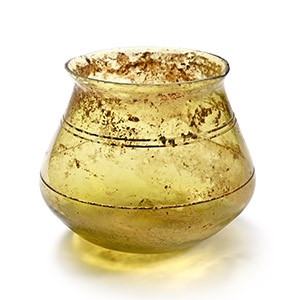
Roman Glass Cup with Wheel-Cut Lines
1st century A.D.Estimate: £800 - 1,000 (+bp*)
Opening Bid: £400
With biconvex body, dimple base, convex rim, wheel-cut circumferential bands. 131 grams, 95 mm
From an important London collection of glass, 1990s. This lot is accompanied by an illustrated lot declaration signed by the Head of the Antiquities Department, Dr Raffaele D'Amato. -
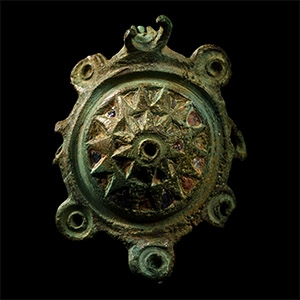
Roman Enamelled Bronze Umbonate Brooch
Circa 100-250 A.D.Sold for (Inc. bp): £65
Domed body decorated with two concentric circles of narrow, inward pointing triangles with traces of blue enamel, small bosses to the outer rim; pin-lugs and remains of pin to the reverse. 10.37 grams, 38 mm
Found Braintree, Essex, UK. Accompanied by a copy of the British Museum's Portable Antiquities Scheme (PAS) report no.ESS-CB128D. This lot is accompanied by an illustrated lot declaration signed by the Head of the Antiquities Department, Dr Raffaele D'Amato. -
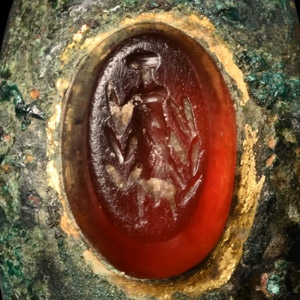
Roman Bronze Ring with Insect Intaglio
2nd-3rd century A.D.Sold for (Inc. bp): £416
Comprising a D-section hoop with expanding shoulders, gilt bezel set with an oval glass gem with engraved insect. 7.45 grams, 23.82 mm overall, 15.81 mm internal diameter (approximate size British E 1/2, USA 2 1/2, Europe 3, Japan 3)
Ex German art market, 2000s. Acquired from an EU collector living in London. From the collection of a Surrey, UK, gentleman. This lot is accompanied by an illustrated lot declaration signed by the Head of the Antiquities Department, Dr Raffaele D'Amato.
