Loading, please wait...

Roman and Other Mixed Glass Bead Group Roman and Other Mixed Glass Bead Group Roman and Other Mixed Glass Bead Group
Use mousewheel to zoom in and out, click to enlarge
Details

LOT 0717

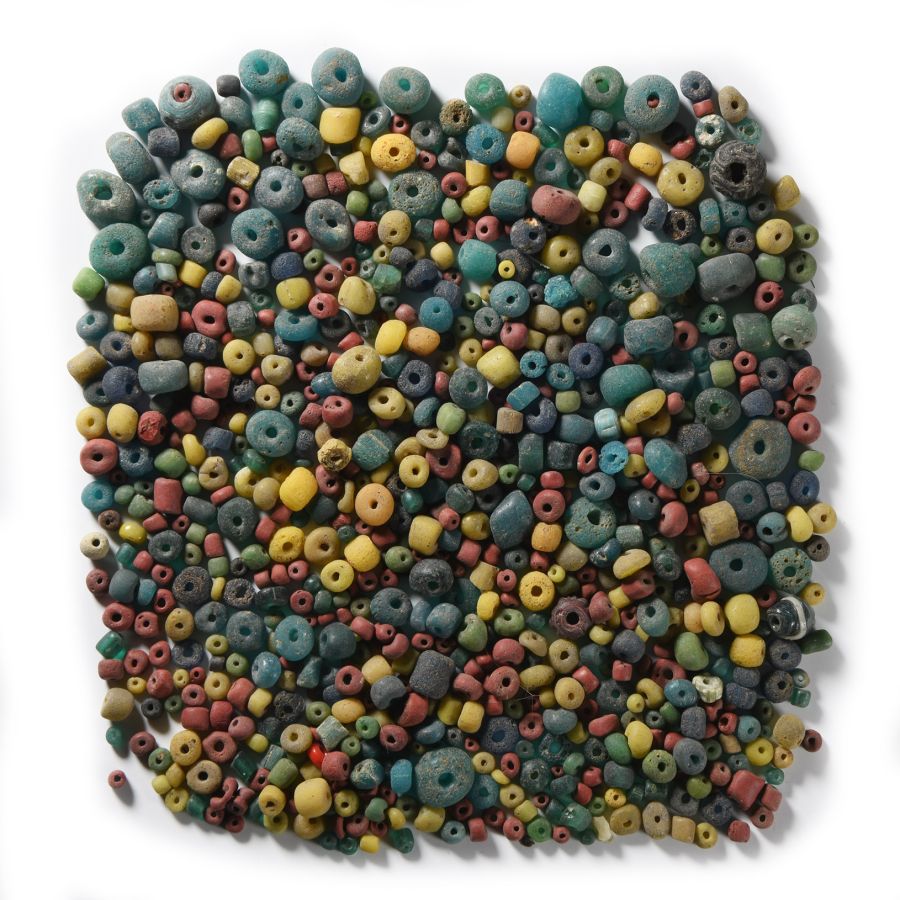
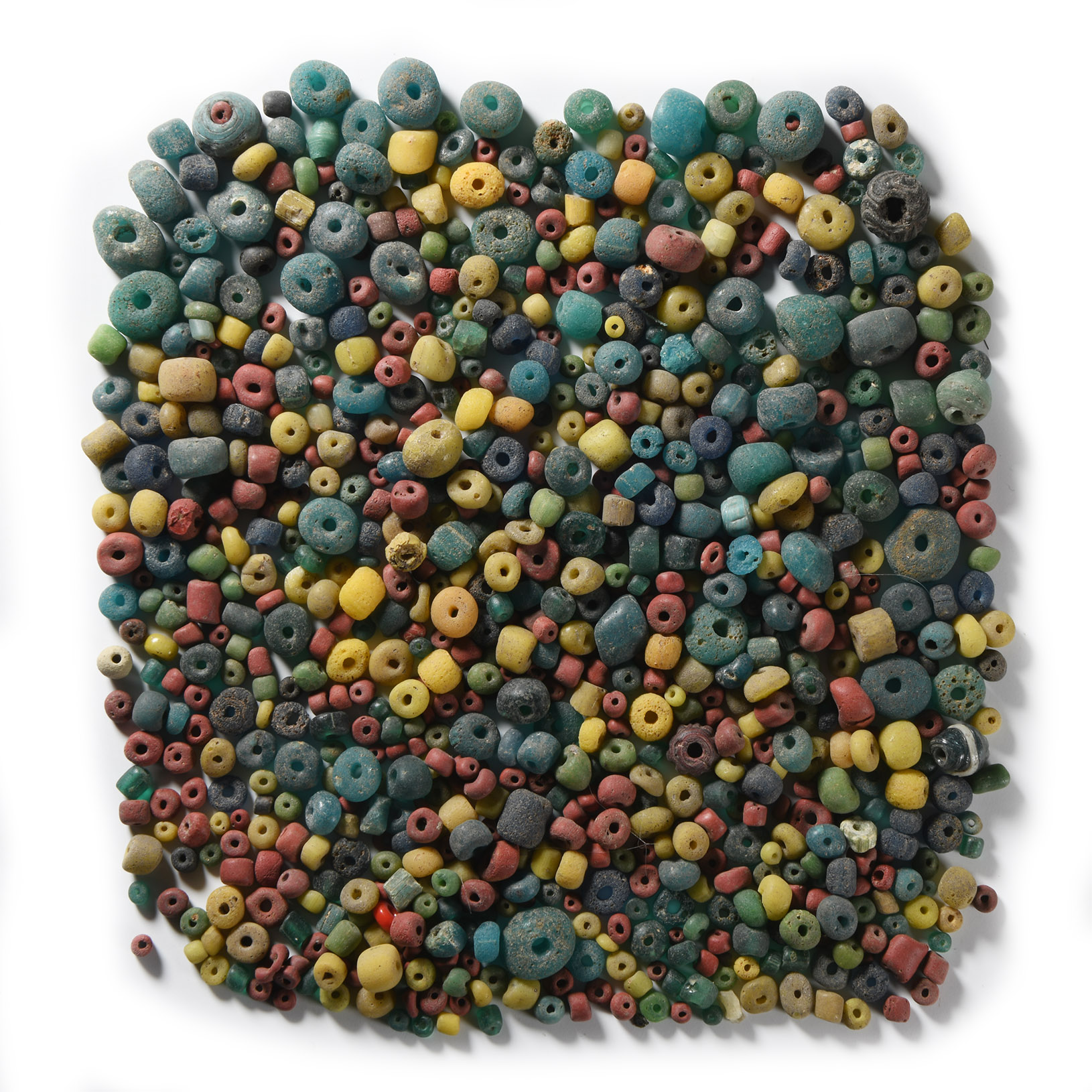
Roman and Other Mixed Glass Bead Group

1ST-4TH CENTURY A.D. AND LATER

1/8 - 1/2 in. (160 grams total, 2-12 mm).

Mainly spherical, drum-shaped, annular and other types, including some 'trade wind beads'. [600+, No Reserve]

Provenance

From the private collection of the late Mrs Belinda Ellison, a long time member of the Egyptian Exploration Society, c.1940-2020.

CONDITION
VETTING:

TimeLine Auctions follows a vetting process to ensure the authenticity and legality of all items, reinforcing our commitment to integrity and responsible trading. Each antiquity, antique, and coin lot undergoes thorough examination by a vetting committee of at least ten external specialists, professional trade association members, scientists, and archaeologists: Our Vetting Process


AUCTIONS:

TimeLine is a leading auction house specialising in antiquities, ancient art, collectables, natural history, coins, medals, and books. Our auctions offer museums, collectors, historians, and enthusiasts the opportunity to acquire unique and historically significant pieces.

LOT 0717

Roman and Other Mixed Glass Bead Group

Sold for (Inc. bp): £130

Print page

RELATED LOTS
  • Roman Lead Statuette of Mercury
    Roman Lead Statuette of Mercury
    1st-2nd century A.D.

    Sold for (Inc. bp): £221

    Standing in contrapposto pose, wearing a cloak draped from the right shoulder and tucked around the left arm supporting a caduceus with snake-head finials; broad-brimmed petasos with wings on the crown; the right arm held vertically at the side supporting the marsupium coin-purse; mounted on a custom-made display stand. 111 grams total, 88 mm including stand


    From a collection acquired on the UK art market from various auction houses and collections mostly before 2000. From an important Cambridgeshire estate; thence by descent.

    Mercury was the god of trade and industry, whose principle shrine in the city of Rome was at the Circus Maximus. The draped mantle is typical for statuary of Mercury from the 1st-2nd century A.D. (Boucher, pl.40, 43) as is the caduceus (Boucher, pl.46 (211)).

    Lot Details

  • Romano-British Decorated Colchester Pottery Sherds
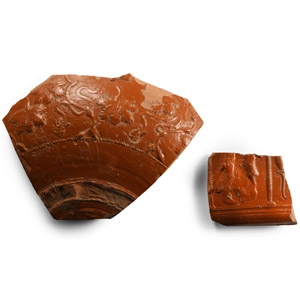
    Romano-British Decorated 'Colchester' Pottery Sherds
    1st-4th century A.D.

    Sold for (Inc. bp): £52

    Including rim- and base-fragments with moulded or applied decorative detailing, some with inked inscriptions including: 'Col' for Colchester. 1.42 kg total, 3-11.4 cm


    Found Colchester, UK. From the collection of a late East Anglian teacher and antiquarian who retired to the Isle of Wight in Hampshire, UK. He amassed a large collection of objects between the 1960s-1980s. Accompanied by a hand written information display card entitled 'Pottery from Colchester ...', and two other display cards, one typed one handwritten.

    Lot Details

  • Very Large Roman Bronze Oil Lamp with Jupiter and Eagle
    Very Large Roman Bronze Oil Lamp with Jupiter and Eagle
    3rd-4th century A.D.

    Sold for (Inc. bp): £8,450

    With a rounded body and double nozzle with volutes; the body flat with engraved volutes, raised rim and basal ring; to the rear a large crescent with Jupiter (Greek Zeus) to the centre and his eagle with spread wings before him; the god depicted with thick locks and voluminous beard, the eagle with detailed plumage and finely detailed face; accompanied by a custom-made display stand. 1.67 kg, 25.7 wide (3.08 kg total,18 cm high including stand)


    Old private British collection, pre-1965. Property of a gentleman; acquired in the UK before 2000. Accompanied by a copy of an old black and white photograph. Accompanied by an academic report by Dr Raffaele D’Amato. This lot has been checked against the Interpol Database of stolen works of art and is accompanied by search certificate number no.12034-215425.

    Here Jupiter is represented with his attributes connected with the crescent of goddess Luna. According to Bailey, all lamps in the category to which the map belongs, were intended for suspension. Lamps with multiple nozzles gave more light and thus were suitable for lighting large spaces.

    Lot Details

Stay up-to-date with the latest from TimeLine Auctions by joining our mailing list