
Loading, please wait...
LOT 0779
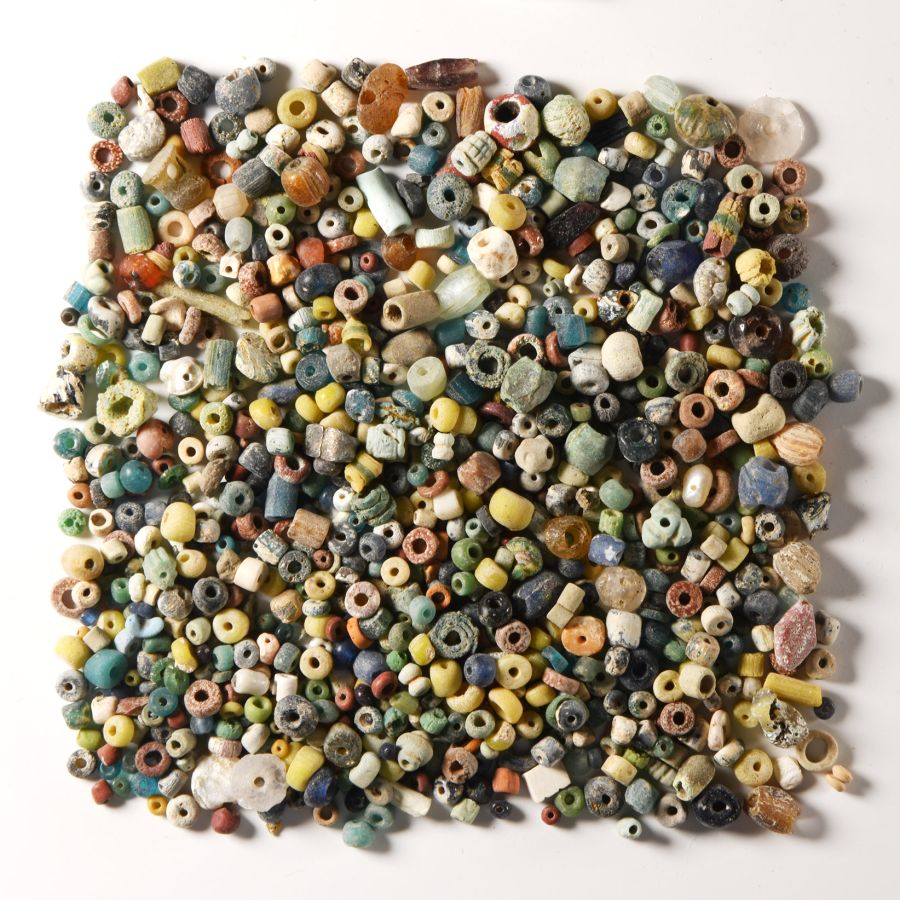
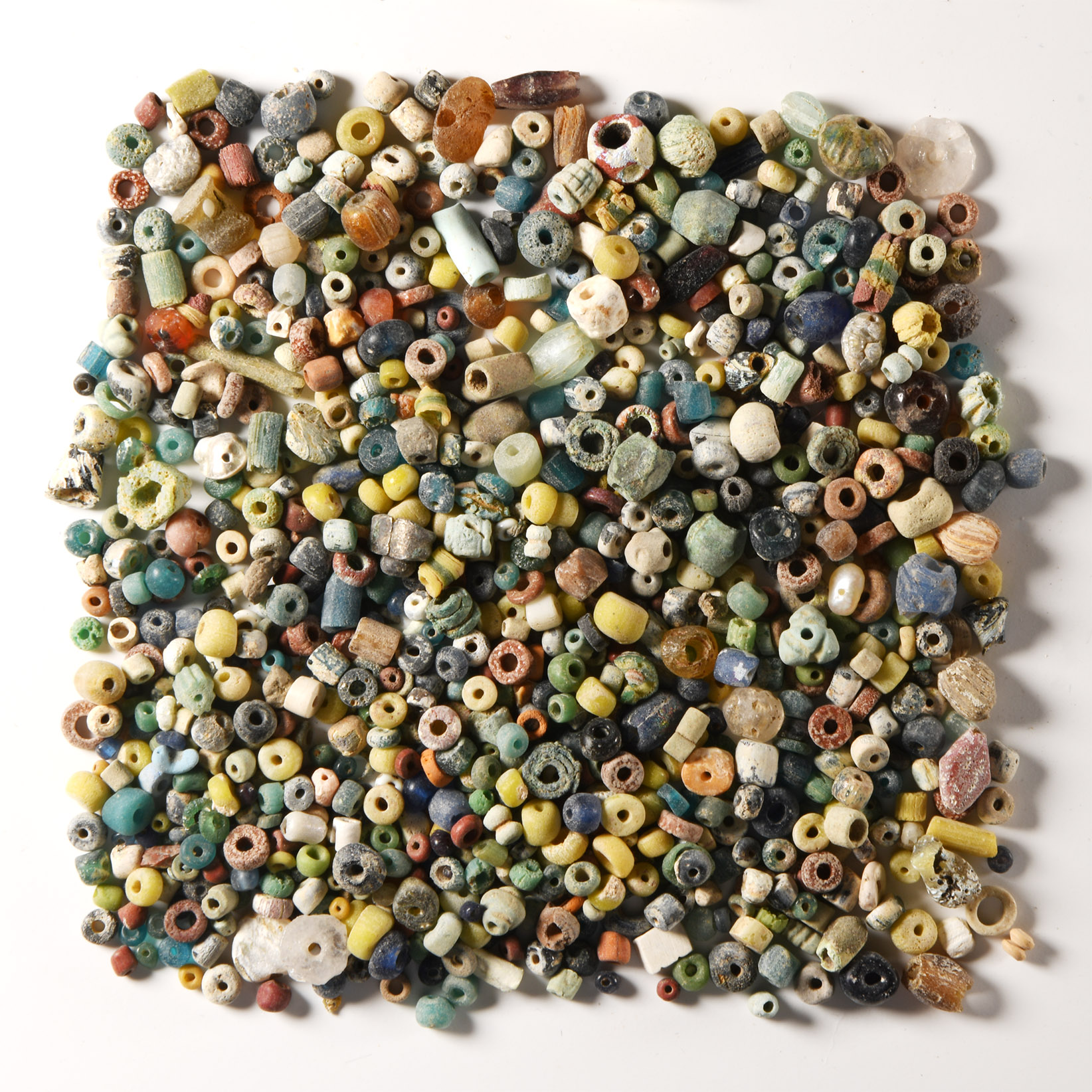
Roman and Other Glass and Stone Bead Group
1ST MILLENNIUM B.C. AND LATER
1/8 - 1/2 in. (58.5 grams total, 1-14 mm).
Comprising a quantity of mixed beads, mainly oblate and cylindrical in form, including glass, modelled, faience and stone etc. [No Reserve]
ProvenanceUK gallery, early 2000s.
LiteratureCf. Croom, A.T., Amber beads in Roman Britain, 2018, fig.1 nos.11,13,15.
FootnotesThe use of amber beads as amulets in the Roman world is well attested, even in Britain (series of bracelets have been found in late Roman graves at Cirencester and Colchester). The amber beads were associated with pierced coins, pierced dog’s teeth and a lunate pendant. Pliny said that amber was beneficial to infants ‘when attached to the body in the form of an amulet'.
CONDITIONTimeLine Auctions follows a vetting process to ensure the authenticity and legality of all items, reinforcing our commitment to integrity and responsible trading. Each antiquity, antique, and coin lot undergoes thorough examination by a vetting committee of at least ten external specialists, professional trade association members, scientists, and archaeologists: Our Vetting Process
AUCTIONS:
TimeLine is a leading auction house specialising in antiquities, ancient art, collectables, natural history, coins, medals, and books. Our auctions offer museums, collectors, historians, and enthusiasts the opportunity to acquire unique and historically significant pieces.
-
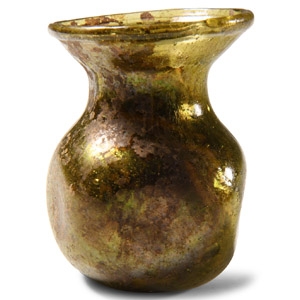
Roman Glass Spool-Shaped Vessel
1st-4th century A.D.Sold for (Inc. bp): £124
Broadly spool-shaped with a squat body, cylindrical neck and flared rolled rim. 25.6 grams, 53 mm
Acquired 1980-2015. Ex Abelita family collection. -
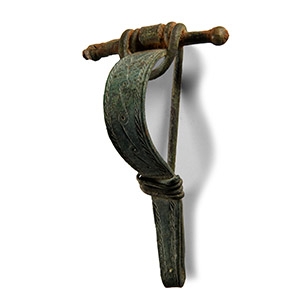
Large Roman Decorated Bronze Bow Brooch
2nd-3rd century A.D.Sold for (Inc. bp): £85
P-shaped with wide bow and foot, hatched to the edges with ring-and-dot ornament to the centre of the bow, bar above to hold the sprung pin, foot returning to form the catchplate, the upper edge of which is hammered into a flat wire coiled around the bottom of the bow. 56 grams, 95 mm
Ex property of an Austrian private collector since the 1970s. -
.jpg)
Large Roman Tinned Bronze Patera
1st century A.D.Estimate: £1,000 - 1,400 (‡+bp*)
Opening Bid: £500
With a deep bowl and flat-section handle with integral loop; shallow concentric grooves around the exterior of the neck, rolled rim, concentric rings to the underside; finished on a lathe; cracked and split. 903 grams, 33 cm wide
Acquired in Europe before 1993. Private collection, Europe. This lot has been checked against the Interpol Database of stolen works of art and is accompanied by search certificate number no.11788-206494.
In contrast to their elaborate counterparts, paterae such as this were likely carried as part of the standard kit of Roman soldiers, used as a general cooking and eating utensil. The regular heap up (sarcina) of the legionaries is well represented on the reliefs of Trajan's column. It was composed of a T stake (furca), to which a linen bag (sacculus) was hung, as well as the leather haversack for 15-20 days supplies (trinum nundinum) and personal effects, a pot (ollula), a cup (patera), and a basket for work on the fields.
