
Loading, please wait...
_900x900.jpg "Roman and Other Gemstone Collection")
_200x200.jpg "Roman and Other Gemstone Collection")
.jpg "Roman and Other Gemstone Collection")
LOT 1006
Roman and Other Gemstone Collection
2ND CENTURY A.D. AND LATER
3/8 - 5/8 in. (4.46 grams total, 10-17 mm).
Comprising mainly lentoid and plano-convex seals in carnelian, amethyst, and other materials with engraved intaglios including a stag, two human figures, huntsman with deer and other topics; each supplied with a museum-quality impression. [6, No Reserve]
ProvenanceFrom the collection of a London antiquarian, formed since the 1980s.
CONDITIONTimeLine Auctions follows a vetting process to ensure the authenticity and legality of all items, reinforcing our commitment to integrity and responsible trading. Each antiquity, antique, and coin lot undergoes thorough examination by a vetting committee of at least ten external specialists, professional trade association members, scientists, and archaeologists: Our Vetting Process
AUCTIONS:
TimeLine is a leading auction house specialising in antiquities, ancient art, collectables, natural history, coins, medals, and books. Our auctions offer museums, collectors, historians, and enthusiasts the opportunity to acquire unique and historically significant pieces.
-
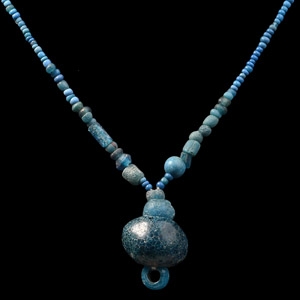
Roman Deep Blue Glass Bead Necklace String
1st-4th century A.D. and laterSold for (Inc. bp): £78
A restrung group of oblate and other types with an irregular pendant centrepiece, with some 'Indo-Pacific' beads. 12.62 grams, 37 cm
London, UK, collection, 2000s. -
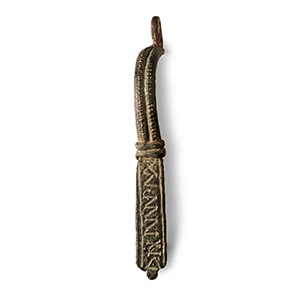
Roman Inscribed Bronze Bow Brooch
3rd-4th century A.D.Sold for (Inc. bp): £91
Colchester-type brooch shank with seriffed enigmatic legend 'DIXMNM'. 8.19 grams, 78 mm
Ex important German collection of brooches, 1980s. This lot is accompanied by an illustrated lot declaration signed by the Head of the Antiquities Department, Dr Raffaele D'Amato.
The inscription 'DIXMNM' is not easy to interpretate. MNM was possibly used as abbreviation for Dis Manibus Monumentum, i.e. ‘Monument to the spirit of the dead’. DIX was a shorter form for he/she/it said (dixit), but also refers sometimes to the numeral 12 (duodecimus). -
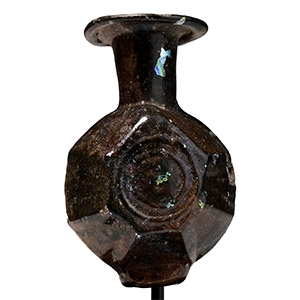
Roman Decorated Mould Blown Glass Amphoriskos
Circa 1st-2nd century A.D.Estimate: £2,000 - 3,000 (+bp*)
Opening Bid: £1,000
Comprising a biconvex body with ellipsoid base, short neck with everted rim and strap handle; the body facetted, with concentric rings to the central panel on each side; mounted on a custom-made stand. 82 grams total, 95 mm including stand
From an important collection of glass, London, UK, 1990s. This lot has been checked against the Interpol Database of stolen works of art and is accompanied by search certificate number no.12960-246379.
The word amphoriskos, Greek for 'small amphora', refers in the Graeco-Roman world to the shape of the object, a miniature version of the two-handled metal or ceramic vessels that contained oil or wine. Core-formed glass was made by dipping a removable core that gives the vessel its shape into a molten glass mixture.
